Refugee Reading Level: Lexile 800L, AR 5.3, Guided Reading Y
Refugee by Alan Gratz is Lexile 800L, AR level 5.3 with 10 AR points, Guided Reading Y and DRA 60. Short cliffhanger chapters keep kids reading, but it runs about 66,000 words and the war scenes are heavy, so many struggling readers do best with the audiobook or the graphic novel.

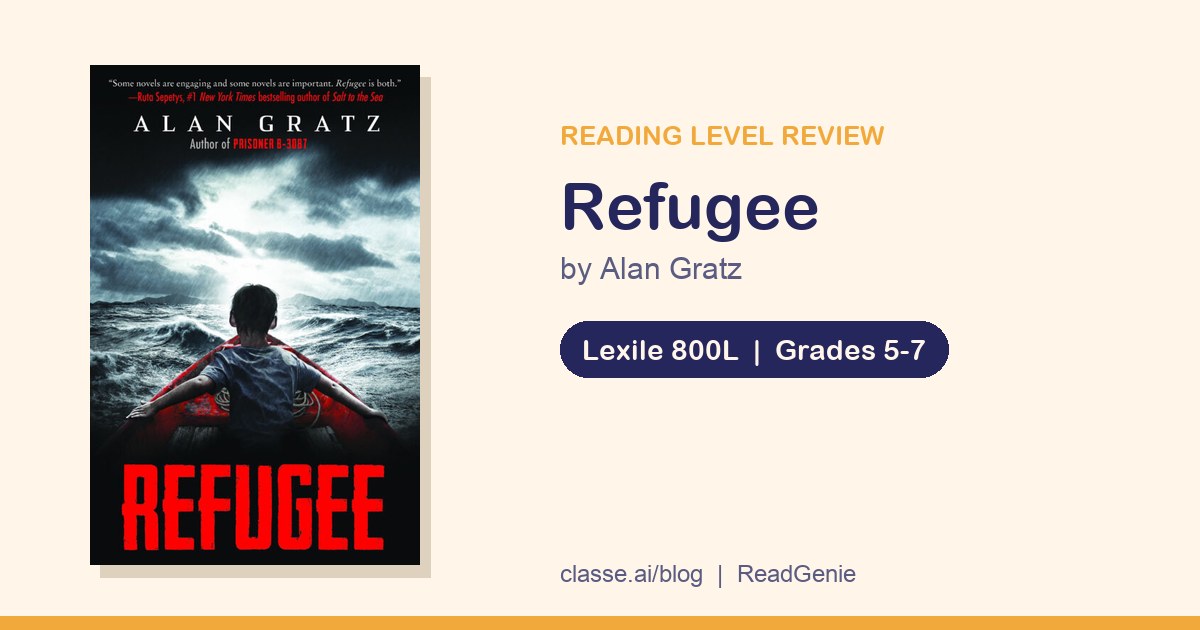
Refugee by Alan Gratz has a Lexile measure of 800L, an AR (ATOS) book level of 5.3 worth 10 AR points, Guided Reading level Y and DRA 60, so most kids can read it on their own somewhere in grades 5 to 7. The sentences are plain and the chapters are short, and every one ends on a cliffhanger, which keeps reluctant readers turning pages. It is also a long book, about 66,000 words, and the war, drowning and death scenes are heavy, so a struggling reader in 5th to 8th grade usually does best with the audiobook alongside or with the graphic novel edition first.
The book follows three kids in three different times who have to run for their lives. Josef is a Jewish boy in Berlin in 1938 whose family boards a ship for Cuba after the Nazis take his father. Isabel is a Cuban girl in 1994 who sets out for Florida on a homemade raft. Mahmoud is a Syrian boy in 2015 whose family leaves Aleppo after their apartment is destroyed and heads for Germany on foot and by boat. The chapters rotate between them, and the three stories connect in a surprising way at the end. Kids tend to finish it fast because the book never slows down.
Refugee reading level at a glance
| Lexile measure | 800L (Scholastic) |
|---|---|
| ATOS / AR book level | 5.3 (TeachingBooks) |
| AR points | 10 (TeachingBooks) |
| Guided Reading (Fountas & Pinnell) | Y (Scholastic) |
| DRA level | 60 (Scholastic) |
| Flesch Reading Ease (0-100) | 79.8 ReadGenie estimate |
| Flesch-Kincaid grade | 5.2 ReadGenie estimate |
| Interest level | Grades 6-9 (Scholastic) Also listed as Grades 5-12 |
| Approximate grade band | Grades 5-7 (ages 10-13) ReadGenie |
| Length | 352 pages, ~65,915 words |
| Format | Middle grade novel |
| Good for struggling readers? | ★★★★★ 3/5 |
| Dyslexia-friendly rating | ★★★★★ 3/5 |
We couldn't find a published grade level equivalent for this book.
Is Refugee a struggle for your child right now? ReadGenie gives struggling readers short daily Orton-Gillingham practice at home, out loud, with help on the exact sound they missed.
Try ReadGenie and get this book freeScores checked 2026-11-24. Different leveling systems don't always agree, so we show each published value with its source and mark our own estimates. Links to every source are under How we rate books.
What grade level is the book Refugee?
The words read at about a 5th grade level. The story is pitched at middle school, and most schools teach it in 6th, 7th or 8th grade.
An AR level of 5.3 means the text is about as hard as what a typical student reads early in 5th grade. A Lexile of 800L sits in the same spot, toward the upper end of the usual 4th and 5th grade range. Our own readability check on the first chapter of each narrator came out at a 5th grade level too. Sentences average about 12 words, and only about 6 percent of the words have three or more syllables.
Guided Reading Y and DRA 60 point a bit higher, closer to 6th and 7th grade on most leveling charts. That is normal for a book like this. Those two systems weigh themes and background knowledge as well as words, and Refugee asks a reader to follow three storylines, three countries and three moments in history.
Scholastic, which publishes the book, lists it for grades 6 to 9. TeachingBooks lists grades 5 to 12. Common Sense Media notes that the publisher recommends it from age 9 but suggests 11 and up because of the violence. So the reading level and the content level are not quite the same. A strong 4th or 5th grade reader can handle the words, but the story fits kids a little older.
Is Refugee good for struggling readers?
For some, with support. We rate it 3 out of 5 for struggling readers.
The pacing is the best thing about it for a reluctant reader. The first chapter opens with a night raid on Josef's home, and from there almost every chapter ends with someone in danger before the book cuts to another kid. Each chapter gives a child a small, finishable goal and a strong reason to start the next one. The opening chapters run about 1,100 to 1,350 words each, roughly 10 minutes for a slower reader.
The narrators are 11 to 13, close in age to the kids who are assigned the book, and the language is direct. Gratz writes in short paragraphs with a lot of action and dialogue and very little description for its own sake.
A few things make it hard going for a child who reads below grade.
- At about 66,000 words, it is three times the length of Because of Winn-Dixie
- Three storylines and three families to keep straight, with chapters switching every few pages
- Names and places that are hard to decode, from German, Spanish and Arabic
- Background on Nazi Germany, Cuba and Syria that some kids won't have yet
A 6th to 8th grader reading a year or two behind can do well with the audiobook alongside the print. A child reading below a 4th grade level on their own will find the novel a long haul. The graphic novel edition, which came out in 2025, tells the same three stories in comics at an AR level of 2.7, and it is a good way in.
Is Refugee good for kids with dyslexia?
Overall: ★★★★★ 3/5
| Factor | Score | Why |
|---|---|---|
| Sentence length | 3/5 | About 12 words per sentence in the opening chapters, with short action lines mixed with longer descriptive ones. |
| Vocabulary load | 3/5 | Mostly everyday words, about 6 percent with three or more syllables, plus historical and political terms (concentration camp, Brownshirts, protective custody). |
| Decodability | 3/5 | Most words follow common patterns, but German, Spanish and Arabic names and places (Sturmabteilung, Landau, Lázaro, Aleppo, Mahmoud) are hard to decode. |
| Text density and layout | 3/5 | Standard novel pages in a serif font, broken up by frequent dialogue and sound words. |
| Pictures that carry meaning | 1/5 | No illustrations, only maps of the three routes. |
| Chapter length | 3/5 | The opening chapters run about 1,100 to 1,350 words, roughly 10 minutes each for a slower reader. |
| Engagement for reluctant readers | 5/5 | Starts with a night raid on page one, and every chapter ends on a cliffhanger. |
| Audiobook / read-along support | 5/5 | Unabridged Scholastic Audio edition read by Michael Goldstrom, Kyla Garcia and Assaf Cohen, about 7.5 hours. |
Factor mean 3.25, rounded to 3. No adjustment.
We rate Refugee 3 out of 5 for dyslexic readers. Engagement and audio support are excellent. Length, hard names and plain novel pages with no pictures pull the score down.
Sentence length is moderate. Action scenes use short, punchy lines and sound words, which are easy to read. Descriptive passages and history explanations run longer. Most dyslexic readers will be fine with the sentences once they know who is talking.
Vocabulary is mostly everyday, with a layer of history terms on top. Words like concentration camp, custody and Brownshirts come up in the first chapter, and each storyline brings its own. A quick explanation before each narrator's first chapter saves a lot of stopping.
Decoding is where most kids get stuck. Regular words follow common patterns, but the names do not. Sturmabteilung, Landau, Lázaro, Aleppo, Mahmoud and Bishara all appear early, and a dyslexic reader can burn a lot of energy on them. Saying them aloud together first, and agreeing it's fine to read Sturmabteilung as "the storm troopers," removes the problem.
The pages are standard novel pages in a serif font, broken up by dialogue. There are no illustrations, only maps of the three routes. Chapters are short enough that a slower reader can usually finish one at a time.
Audio is the best support. The unabridged Scholastic Audio edition runs about 7.5 hours and uses a different reader for each kid, Michael Goldstrom, Kyla Garcia and Assaf Cohen. That makes the chapter switches easy to hear, and listening while following the print lets a dyslexic student keep pace with a class reading schedule.
Words and phonics patterns to practice first
The regular words in Refugee are built from patterns a child can learn to break apart, and the opening chapters give plenty of practice.
Past tense -ed shows up on almost every page because the action never stops: kicked, grabbed, dragged, screamed, laughed, turned. Sort them by the sound at the end. Kicked and laughed end in a t sound, screamed and turned end in a d sound, and words like started add a syllable.
Doubling before a suffix is worth pointing out with grabbed, dragged and wrapped. A short vowel in a closed syllable needs the extra consonant to stay short.
Consonant-le endings come up often: little, middle, trouble, huddled, scrambled, crackle. Teach that the consonant before -le joins it to make the last syllable (lit-tle, mid-dle, trou-ble).
R-controlled vowels (dark, burst, shirts, storm, hurt) and vowel teams (dream, street, boat, sea, shadow) round out the common patterns. The igh and ough spellings are the irregular ones to watch, as in night, light, right, thought, through and enough.
Pre-teach these as whole words before chapter 1: Josef, Landau, Isabel, Mahmoud, Bishara, Aleppo, Havana, Sturmabteilung, Brownshirts, concentration, custody, Khalid and Waleed. If multisyllable words and suffixes are still slow, short daily Orton-Gillingham practice on exactly these patterns, like the lessons ReadGenie gives at home, makes a long book like this one far more manageable.
How to read Refugee with your child
Read the first Josef chapter together. It opens with the Nazis breaking into the family's apartment at night, and it is one of the hardest scenes in the book emotionally. Being there for it lets you answer questions and sets the tone for talking as you go.
Make a small chart on an index card with the three kids, their country and year, and who is in each family. Kids lose track less when they can glance at it between chapters.
Say the hard names out loud before you start, and again the first time each narrator appears. Josef Landau, Isabel, Mahmoud Bishara, Aleppo and Havana cover most of what comes up early.
On long or tired days, let your child listen to the audiobook and follow along. Each kid has a different reader, which helps with the switches. If the novel is too much right now, the graphic novel edition tells the same story with pictures, and some kids read it first and then go back to the novel.
Plan to talk about the ending. The three stories meet in a way most kids don't see coming, and it is a good moment to look at the maps together.
Using Refugee in the classroom or tutoring
For teachers, Refugee works well for literature circles. Give each group one storyline to follow closely, then bring the groups together for the last chapters, where the stories connect. Pair each storyline with a map and a short history lesson before reading: Nazi Germany in 1938 and the ship the St. Louis for Josef, Cuba in 1994 for Isabel, and Syria in 2015 for Mahmoud. The author's note at the end explains what is true history and what Gratz made up, which makes a good closing discussion.
For tutors, preview Josef, Landau, Isabel, Mahmoud, Aleppo, Havana and Brownshirts before the first session. Chapter 1 is full of -ed words for practice (kicked, grabbed, dragged, screamed, laughed). For a student who loses the thread, try reading one narrator's chapters in a row for a session or two, then go back to the book's order once the characters feel familiar.
Content notes for parents
Refugee is a war and survival story, and it does not look away. Nazis raid Josef's home in the first chapter, beat the family and take his father to a concentration camp. Later his father, deeply traumatized, tries to take his own life by jumping off the ship. A character is bitten by a shark and bleeds to death, Mahmoud's home is destroyed by a missile, characters nearly drown, and a baby is handed to another family and not seen again. Readers see dead bodies, including a soldier who was shot, and learn that one character died in a concentration camp. Bullies beat Mahmoud and his friend at school, and a storm trooper uses crude language in chapter 1. Common Sense Media rates it for ages 11 and up.
Should your child read it?
If your child is in 6th, 7th or 8th grade, likes suspense, and reads at or a little below grade, Refugee is a great choice, especially with the audiobook for the long stretches. A strong 5th grade reader can manage the words, but read the content notes first and plan to talk along the way. If your child reads below a 4th grade level or is very sensitive, start with the graphic novel edition, I Survived the Sinking of the Titanic, 1912 or Number the Stars, and come back to the novel later.
Make the next book easier
Short daily sessions of reading, spelling and handwriting practice, built with Orton-Gillingham teachers. It works alongside tutoring and school support. The first 7 days are free. Join today and we'll mail your child Refugee for free.
Try ReadGenie and get your free bookStarts with a free 7-day trial. Book mailed after your first paid month. US only, one per family.
FAQ
How many AR points is Refugee?
Refugee by Alan Gratz is worth 10 AR points, with an AR (ATOS) book level of 5.3. It earns that many because it is long, about 66,000 words. The graphic novel edition has its own quiz worth 1 AR point.
What is the Lexile level of Refugee by Alan Gratz?
Refugee has a Lexile measure of 800L, according to Scholastic and TeachingBooks. That is about a 5th grade reading level. The story itself is meant for middle school.
What age range is Refugee for?
Most kids read it between ages 10 and 13. Scholastic lists it for grades 6 to 9, and Common Sense Media suggests 11 and up because of the violence. A younger child who reads well can manage the words, but the content suits kids a little older.
What is the reading level of the Refugee graphic novel?
The graphic novel edition from 2025 has an AR (ATOS) level of 2.7 and is worth 1 AR point, according to TeachingBooks. It tells the same three stories in about 10,000 words with pictures, so it works well for kids not ready for the novel.
Is Refugee appropriate for 5th grade?
For many 5th graders, yes, with an adult to talk with. The reading level fits a typical 5th grade reader. The violence, near drownings and deaths are intense, so read the content notes and decide based on your child.
Is Refugee hard to read?
The words are not hard, and the chapters are short. The length, the hard names and keeping three storylines straight are the tricky parts. A character chart and the audiobook get most kids through it.
Get Refugee free
ReadGenie helps struggling readers improve their reading, spelling and handwriting in short daily sessions at home. Join and we'll mail your child this book for free.
Claim your free bookStarts with a free 7-day trial. Book mailed after your first paid month. US only, one per family.
What to read next
- I Survived the Sinking of the Titanic, 1912 by Lauren Tarshis (easier). A short survival story from history, a good step before Refugee for younger or struggling readers.
- Number the Stars by Lois Lowry (easier). A shorter Holocaust novel about a girl helping her Jewish friend escape Nazi-occupied Denmark.
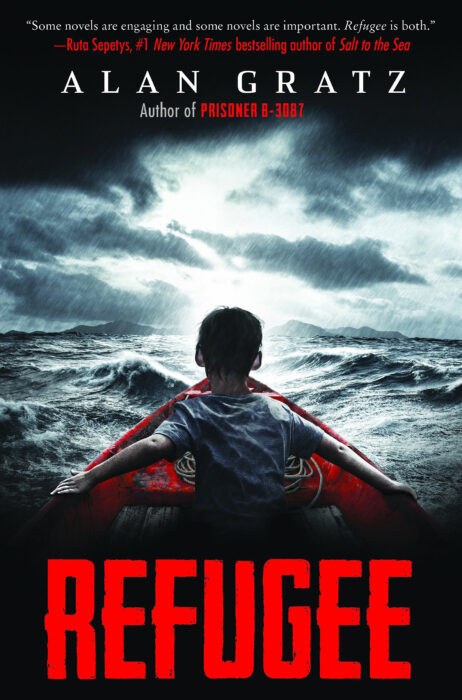
- Refugee: The Graphic Novel by Alan Gratz (easier). The same three stories told in comics, at AR level 2.7, for kids who need the pictures.
- Prisoner B-3087 by Alan Gratz (similar). Gratz's novel about a Jewish boy who survives ten concentration camps, written in the same fast style.
- The Hunger Games by Suzanne Collins (harder). Another high-stakes survival story with cliffhanger chapters, for older readers.
Browse all of our reading-level book reviews.
How we rate books
Lexile, ATOS (Accelerated Reader), Guided Reading and DRA levels come from the companies that own them and from publishers. We link to where we found each one, and when a level isn't published we say so. Anything marked "ReadGenie estimate" is our own call, not an official level. Flesch scores come from a short public excerpt when the publisher offers one. The struggling-reader and dyslexia-friendly ratings are our judgment, based on eight things (sentence length, vocabulary, decodability, page layout, pictures, chapter length, how gripping the story is, and audiobook support). Treat them as a starting point. The right book is one your child can read with about 95% accuracy and wants to keep reading.
Sources
- Scholastic Teacher Store: Refugee (paperback) (Lexile, Guided Reading, DRA, ACR, pages, grades, edition)
- Scholastic Teacher Store: Refugee (hardcover) (Lexile check, Guided Reading check, DRA check, excerpt (See Inside), summary)
- TeachingBooks: Refugee (ATOS, AR points, word count, Lexile check, grades)
- TeachingBooks: Refugee: The Graphic Novel (graphic novel ATOS, AR points and word count)
- Common Sense Media: Refugee (content notes, age guidance, chapter structure)
- Publishers Weekly: Refugee audiobook review (Scholastic Audio) (audiobook narrators, edition and length)
- Wikipedia: Refugee (Gratz novel) (plot check, content notes)