A to Z Mysteries Reading Level: Lexile 510L, AR 3.4, Guided Reading N
The Absent Author, the first A to Z Mystery by Ron Roy, is Lexile 510L, AR level 3.4 with 1 AR point and Guided Reading N. Most kids read it alone in 3rd grade, and its short sentences and 10 quick chapters make it a strong first chapter-book mystery for struggling readers.

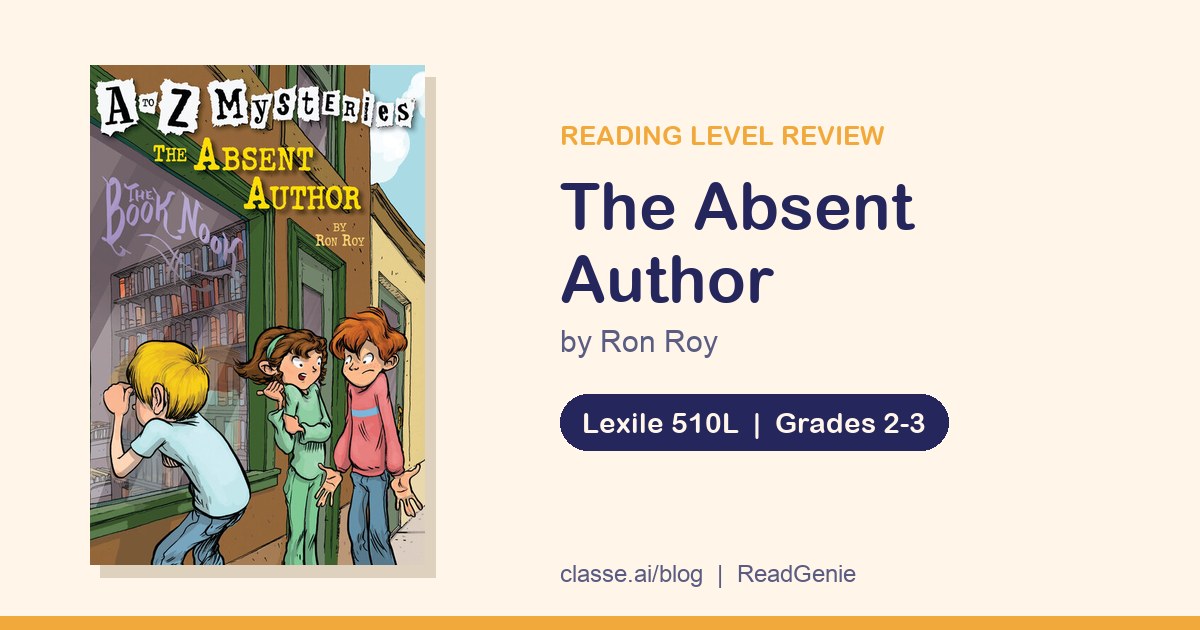
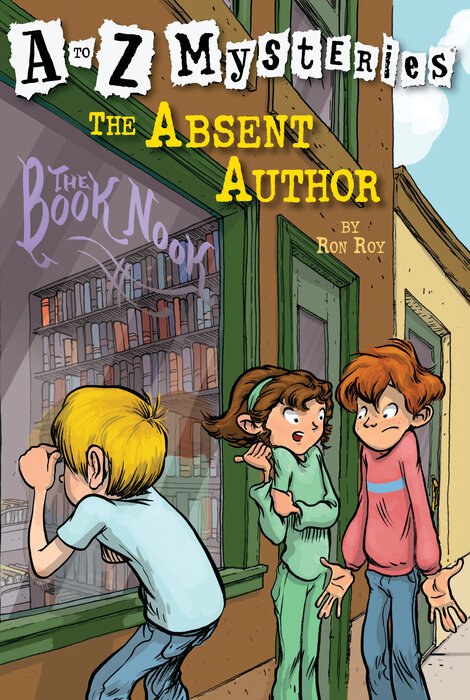
The Absent Author, the first of Ron Roy's A to Z Mysteries, has a Lexile measure of 510L, an AR (ATOS) book level of 3.4 worth 1 AR point and a Guided Reading level of N. Most kids can read it on their own in 3rd grade, and strong readers can by the end of 2nd. For a child in grades 3 to 5 who is behind, it is one of the best first chapter-book mysteries around, with about 8,500 words split into 10 short chapters and a case they can solve before the characters do.
Dink Duncan wrote to his favorite mystery writer, Wallis Wallace, and invited the author to sign books in his small town of Green Lawn. On the big day the author never shows up. Dink and his two best friends, Josh and Ruth Rose, start following clues around town to find out where Wallace went. The three friends tease each other and chase leads, and the clues are laid out so readers can solve the case before the kids do. There are 26 books in the main series, one for each letter of the alphabet, which is a big reason so many parents search for the series level and not just this one book.
The Absent Author reading level at a glance
| Lexile measure | 510L (Penguin Random House) |
|---|---|
| ATOS / AR book level | 3.4 (Penguin Random House) |
| AR points | 1.0 (TeachingBooks) |
| Guided Reading (Fountas & Pinnell) | N (Penguin Random House) |
| Flesch Reading Ease (0-100) | 94.9 ReadGenie estimate |
| Flesch-Kincaid grade | 1.7 ReadGenie estimate |
| Interest level | Grades 1-4 (Penguin Random House) Also listed as Grades 2-4 and Grades 3-5 (ages 8-10) and Grades 1-6 |
| Approximate grade band | Grades 2-3 (ages 7-9) ReadGenie |
| Length | 96 pages, ~8,535 words |
| Format | Chapter book |
| Good for struggling readers? | ★★★★★ 4/5 |
| Dyslexia-friendly rating | ★★★★★ 4/5 |
We couldn't find a published DRA level or grade level equivalent for this book.
Is The Absent Author a struggle for your child right now? ReadGenie gives struggling readers short daily Orton-Gillingham practice at home, out loud, with help on the exact sound they missed.
Try ReadGenie and get this book freeScores checked 2026-11-25. Different leveling systems don't always agree, so we show each published value with its source and mark our own estimates. Links to every source are under How we rate books.
What grade level is A to Z Mysteries?
The Absent Author reads at about a 2nd to 3rd grade level. A typical child can read it independently partway through 3rd grade, and a confident 2nd grader can manage it by spring. Younger kids enjoy it as a read-aloud.
The three official measures tell a slightly different story, and it helps to know why. An ATOS level of 3.4 means the text is about as hard as what an average student reads in the fourth month of 3rd grade. Guided Reading level N is usually taught in the first half of 3rd grade. A Lexile of 510L falls at the low end of the typical 3rd grade range on most charts, closer to late 2nd grade. Put together, 3rd grade is the sweet spot.
The publisher's pages list later books in the series a little higher on Lexile, but every A to Z Mystery we checked there is still Guided Reading level N. So if your child can read book 1 comfortably, the rest of the alphabet should feel about the same.
Our readability check on chapter 1 came out easier than any of the official levels. Sentences average 6.8 words, and fewer than 2 percent of the words have three or more syllables. The formula placed the excerpt near a 2nd grade level. The official levels run higher because the whole book is 96 pages long, kids have to track three friends and a handful of grown-ups, and the clues build from chapter to chapter.
Is A to Z Mysteries good for struggling readers?
Yes. We rate The Absent Author 4 out of 5 for struggling readers. It is a real chapter book that doesn't look young, the sentences are short, and the mystery pulls kids from one chapter to the next. The main hurdle is that pictures are few, which can be a jump for a child coming from early readers.
Much of the text is quick back-and-forth talk between Dink and Josh. Dialogue like this is easier to read than long description, and the short lines move fast down the page. A struggling reader gets through a chapter in about 7 to 9 minutes, which is short enough to finish in one sitting without losing steam.
The mystery itself does a lot of work. Kids want to know what happened to Wallis Wallace, and they get a fair shot at figuring it out. That sense of being smart, of solving something, is a powerful reason for a reluctant reader to keep going.
A few things to watch for.
- John Steven Gurney's drawings appear only now and then, so kids have to picture most scenes from the words
- Names like Wallis Wallace, Ruth Rose and Loretta come up early and are worth a preview
- Kids have to hold clues in mind across chapters to solve the case
- At 96 pages it can look long to a child used to early readers, so reading chapter 1 together helps
This book is a great match for a 3rd, 4th or 5th grader reading a year or two behind. The kid-detective plot doesn't feel too young for older kids, and a 5th grader can read it without it looking like a little-kid book. For a child who still needs pictures on every page to follow along, Nate the Great or Cam Jansen is the gentler first step.
Is A to Z Mysteries good for kids with dyslexia?
Overall: ★★★★★ 4/5
| Factor | Score | Why |
|---|---|---|
| Sentence length | 5/5 | Sentences in chapter 1 average 6.8 words, with many short lines of dialogue. |
| Vocabulary load | 4/5 | Mostly everyday words. Only 1.9% of words in the excerpt have three or more syllables, such as mystery and important. |
| Decodability | 3/5 | Most words follow common patterns, but the chapter 1 sample has irregular words like mischievous, guinea and business, and several names that don't decode easily. |
| Text density and layout | 3/5 | A standard chapter-book page of plain type with lots of short dialogue lines. We could not see the print layout, so this is scored as a typical early chapter book. |
| Pictures that carry meaning | 2/5 | John Steven Gurney's drawings appear now and then, but the words carry the story and the chapter 1 sample has no pictures. |
| Chapter length | 4/5 | About 850 words a chapter, roughly 7 to 9 minutes for a reader at level N. |
| Engagement for reluctant readers | 4/5 | A missing author, clues to follow and three friends who joke with each other keep the pace up. |
| Audiobook / read-along support | 4/5 | Listening Library publishes an unabridged audiobook read by David Pittu, about 55 minutes long. |
We rate it 4 out of 5 for dyslexic readers. Short sentences, everyday vocabulary, quick chapters and an official audiobook all help. Thin picture support and a handful of irregular words keep it from a higher score.
Sentence length is where this book shines. In chapter 1, sentences average under seven words, and many lines of dialogue are just a few words long. A dyslexic reader rarely has to carry a long sentence in their head before reaching a period, which leaves more energy for decoding.
Vocabulary is mostly familiar. The longer words in the opening chapter are ones kids hear every day, like mystery, important and basement. A few irregular words are harder, though. Mischievous, guinea and business don't sound the way they look, and the names Wallis and Wallace are easy to mix up. A quick preview before reading takes care of most of this.
Picture support is the weak spot. Unlike Magic Tree House or Nate the Great, The Absent Author leans almost entirely on its words. Kids who rely on pictures to keep their place in a story may need an adult nearby for the first few chapters.
Listening Library publishes an unabridged audiobook read by David Pittu that runs about 55 minutes. That is short enough to hear the whole book in one or two car rides. Many dyslexic kids do best hearing a chapter first and then reading it themselves, and this book is easy to use that way.
Words and phonics patterns to practice first
The Absent Author is a good fit for a child who knows short vowels, silent e and the common vowel teams and is ready to practice suffixes.
Closed syllables with short vowels are everywhere, in Dink, Josh, brush, thick, back and bathtub. These give quick wins at the start of each page.
Silent e shows up in name, time, make, wrote, like and these. Contrast each with a closed syllable word so your child hears the vowel change.
Vowel teams appear in green, see, fifteen, book, nook and please. The bookstore in the story is called the Book Nook, which makes a handy reminder of the oo sound.
R-controlled vowels come up in shirt, turned, for, charged, under and author. Shirt and turned are a good place to point out that ir and ur make the same sound.
Chapter 1 is full of words with -ing, and many of them double the last letter first, like sitting, getting and kidding. Others, like standing and pulling, don't need to. Sorting these is a great way to teach the doubling rule.
Consonant-le appears in little, castle and riddle.
Pre-teach these words before reading: Wallis, Wallace, Loretta, Ruth, mischievous, guinea, business, usually, author and mystery. If your child gets stuck on suffixes or vowel teams, a few minutes a day of Orton-Gillingham practice on those exact patterns with ReadGenie can make a book like this one they read on their own.
How to read The Absent Author with your child
Before you open the book, introduce the cast. Dink, Josh and Ruth Rose are the three friends, and Wallis Wallace is the author who goes missing. Knowing these names ahead of time saves a lot of stops mid-sentence.
There is a map of Green Lawn at the front of the book. Use it. Each time the kids go somewhere new, find it on the map together. It turns the town into a game board and helps a child who struggles to picture places from words alone.
Plan on two chapters a night and you'll finish in a week. At the end of each chapter, ask your child what they think happened to the author. Keep their guesses on a sticky note, along with any clues, and check them against the ending.
If your child is tired or the reading is slow, play the audiobook for a chapter and then have them read the next one aloud. On a long drive, the whole 55-minute recording fits easily, and a favorite chapter makes a good reread the next day.
Using A to Z Mysteries in the classroom or tutoring
For teachers, the publisher's own educators' guide suggests reading The Absent Author together as a class first, so students learn how the series works before they pick other titles. It is a natural level N guided reading text, and the 10 chapters split neatly into five sessions of two chapters each. Start a class list of mystery words like clue, suspect, case and missing, and add to it as you go. After book 1, let each student pick a letter from the series for independent reading.
For tutors, chapter 1 is a ready-made lesson on the doubling rule. Pull sitting, getting and kidding and sort them against standing and pulling. Then practice silent e with name, time, make and wrote, paired with closed syllable words. Treat mischievous, guinea and business as heart words, since they don't follow regular patterns. End with the student reading a stretch of Dink and Josh's dialogue aloud in two voices, and reread it at the next session.
Content notes for parents
This is a gentle mystery. A grown-up goes missing, and the kids search for clues around town. Common Sense Media calls the A to Z Mysteries series very mildly tense, and says the adults in it are supportive and the kids try to do the right thing. There is no violence, no swearing and no romance. It works well as a read-aloud for kids as young as 5 or 6.
Should your child read it?
If your child is in 2nd or 3rd grade and reading near grade level, The Absent Author is a great next chapter book. A struggling 4th or 5th grader can read it as a real chapter book that still feels like a challenge they can win. If it is too much right now, try Nate the Great or Cam Jansen first. When A to Z feels easy, The Boxcar Children and Encyclopedia Brown are good next steps in mysteries.
Make the next book easier
Short daily sessions of reading, spelling and handwriting practice, built with Orton-Gillingham teachers. It works alongside tutoring and school support. The first 7 days are free. Join today and we'll mail your child The Absent Author for free.
Try ReadGenie and get your free bookStarts with a free 7-day trial. Book mailed after your first paid month. US only, one per family.
FAQ
What reading level is The Absent Author?
The Absent Author has a Lexile measure of 510L, an AR book level of 3.4 and a Guided Reading level of N. Together those point to about a 2nd to 3rd grade reading level, and most kids read it alone in 3rd grade.
What is the A to Z Mysteries AR level?
The first book, The Absent Author, has an AR book level of 3.4 and is worth 1 AR point. At about 8,500 words, most 3rd graders finish it in a week.
What is the A to Z Mysteries Guided Reading level?
The publisher lists The Absent Author at Fountas and Pinnell level N, and every other A to Z Mystery we checked on its site is level N too. Level N is usually taught in the first half of 3rd grade.
What age is A to Z Mysteries for?
The publisher recommends the series for ages 6 to 9, grades 1 to 4. Most kids read the books on their own around age 8, and younger children enjoy them as read-alouds.
Do you have to read A to Z Mysteries in order?
No. Each book is its own case, and the publisher's guide says they don't need to be read in order. It does suggest starting with The Absent Author so kids get to know Dink, Josh and Ruth Rose first.
Get The Absent Author free
ReadGenie helps struggling readers improve their reading, spelling and handwriting in short daily sessions at home. Join and we'll mail your child this book for free.
Claim your free bookStarts with a free 7-day trial. Book mailed after your first paid month. US only, one per family.
What to read next
- Nate the Great by Marjorie Weinman Sharmat (easier). A shorter kid-detective mystery with pictures on most spreads, for kids not ready for A to Z yet.
- Cam Jansen and the Mystery of the Stolen Diamonds by David A. Adler (easier). Another short mystery series with a kid detective and clues to spot.
- Dinosaurs Before Dark by Mary Pope Osborne (similar). Magic Tree House #1 has the same Lexile, short chapters and two kids on an adventure instead of a case.
- The Boxcar Children by Gertrude Chandler Warner (harder). Four siblings who later solve mysteries, with longer chapters and older-fashioned language.
- Encyclopedia Brown, Boy Detective by Donald J. Sobol (harder). Short cases kids solve themselves before checking the answer, a good next step after A to Z.
Browse all of our reading-level book reviews.
How we rate books
Lexile, ATOS (Accelerated Reader), Guided Reading and DRA levels come from the companies that own them and from publishers. We link to where we found each one, and when a level isn't published we say so. Anything marked "ReadGenie estimate" is our own call, not an official level. Flesch scores come from a short public excerpt when the publisher offers one. The struggling-reader and dyslexia-friendly ratings are our judgment, based on eight things (sentence length, vocabulary, decodability, page layout, pictures, chapter length, how gripping the story is, and audiobook support). Treat them as a starting point. The right book is one your child can read with about 95% accuracy and wants to keep reading.
Sources
- Penguin Random House: A to Z Mysteries: The Absent Author (Lexile, ATOS, Fountas & Pinnell level, pages, ages and grades, ISBN, audiobook narrator and length)
- Penguin Random House: A to Z Mysteries series page and 14 title pages (series Lexile, ATOS and Fountas & Pinnell range)
- Random House A to Z Mysteries Educators' Guide (PDF) (grades, classroom use of book 1)
- TeachingBooks: The Absent Author (AR points, word count, Lexile check, ATOS check)
- Booksource: The Absent Author (Guided Reading check, Lexile check, AR level and points check, interest level)
- Scholastic Parent Store: The Absent Author (ages and grades)
- OverDrive ebook sample: The Absent Author (excerpt, chapter count)
- Common Sense Media: A to Z Mysteries series (content notes)