How to Help a 4th or 5th Grader With Dyslexia Read Digraph Words Without Mixing Them Up
If your child still mixes up sh, ch, and th, they are not alone. Here is how to help a 4th or 5th grader with dyslexia read digraph words with clear, simple practice at home.

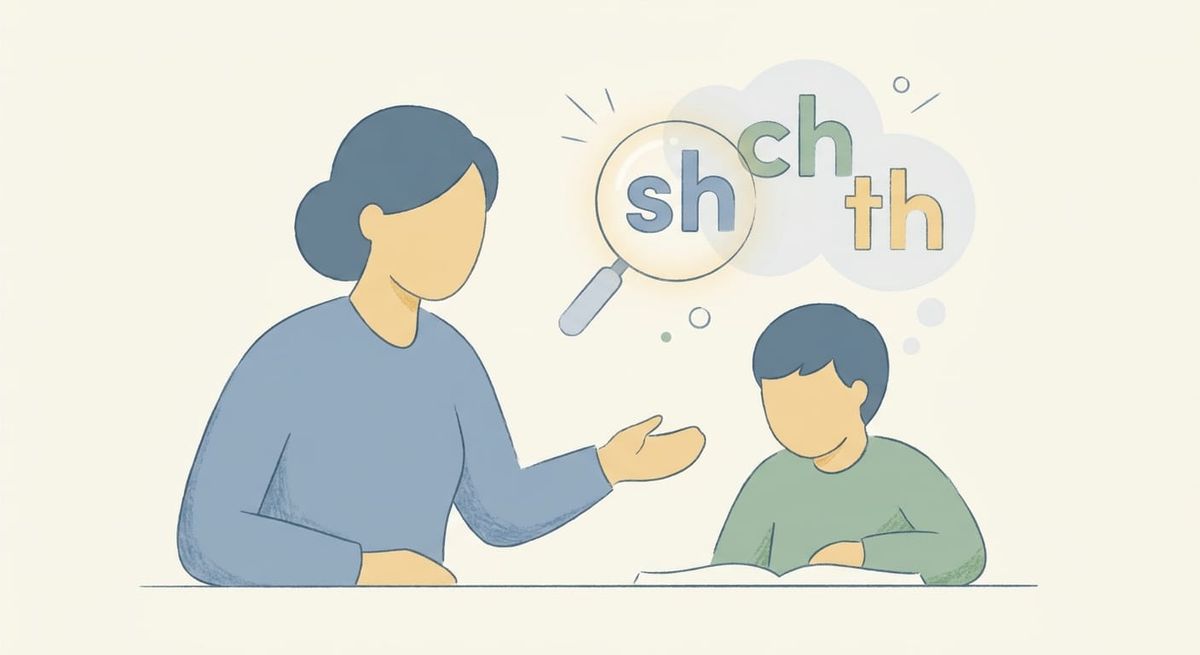
If your child is in 4th or 5th grade and still stumbles over sh, ch, and th, you may be wondering why these patterns are still so hard. A lot of parents feel confused by this. These are small sound patterns, and the words often look familiar, so it can seem like your child should have outgrown the problem by now.
But this is a very common decoding gap for older elementary students with dyslexia. If those patterns were not taught clearly, practiced enough, or fully mastered early on, they can keep causing trouble later.
This post will show you how to help a 4th grader with dyslexia read digraph words more accurately, with simple ways to practice at home that do not feel overwhelming.
Why digraphs still trip up older kids
A digraph is when two letters work together to make one sound, like sh in ship, ch in chin, and th in thin. For a child with dyslexia, these sound patterns do not always become automatic just because they have seen them many times.
Some kids guess from the first letter. Others rush and swap one digraph for another. A child might read shop as chop, then as shen, or pause on a word like thick even though they have seen it before.
This usually does not mean they are not trying. It means the sound-symbol connection is still shaky.
Takeaway: Treat digraph confusion as a skill gap, not a motivation problem. Your child may need direct review of a pattern that was never fully locked in.
What does digraph confusion actually look like?
It does not always show up the same way. Your child might:
- mix up sh and ch in short words
- read th correctly in one word and miss it in the next
- skip over the digraph and focus on the rest of the word
- know the sound in isolation but lose it while reading a full sentence
For example, a 5th grader might read these words like this:
- shop → chop
- that → tat
- chest → shest
- thick → long pause, then a guess
This is one reason older kids can seem inconsistent. They may know the pattern some of the time, but not well enough to use it smoothly in connected reading.
Takeaway: Listen for patterns in the mistakes. If the same digraphs keep getting confused, that gives you a clear place to focus.
Should you go back to basic phonics in 4th or 5th grade?
Yes, if that is where the breakdown is.
Going back to basic phonics does not mean your child is being babied or starting over. It means you are strengthening a weak spot that is interfering with bigger reading tasks.
In upper elementary, many struggling readers are asked to work on comprehension, vocabulary, and longer texts while they still have unfinished decoding issues. That makes reading feel harder than it needs to be.
If digraphs are not solid, it helps to return to short, focused word work. Keep it age-respectful, but make the practice simple and direct.
A good rule is this: if your child cannot read a pattern accurately in a one-syllable word, that pattern will likely keep causing trouble in longer words too.
Takeaway: It is completely appropriate to revisit digraphs in 4th or 5th grade. Solid decoding supports everything that comes after.
How to practice digraph words without causing more guessing
The goal is not to drill random words as fast as possible. The goal is to help your child notice the sound pattern, connect it to print, and read it accurately enough times that it starts to feel familiar.
Here is a simple way to do that.
1. Practice one digraph at a time
Do not mix sh, ch, and th together at first. Pick one pattern and stick with it for a few days.
For example, if you are working on sh, use a short list like:
- ship
- shop
- shut
- shell
- rush
- dish
- fresh
This helps your child focus on what stays the same.
2. Read the words aloud more than once
Repetition matters. Have your child read the same small list two or three times rather than reading a long list once.
The first read is often slow. The second read is where accuracy improves. The third read helps build recognition.
3. Use decodable words and sentences
If you are targeting th, use words where that pattern is clear and consistent, such as:
- thick
- than
- bath
- thing
- math
Then move into short decodable sentences like:
- The thick path is in the sun.
- Beth has a math quiz.
This helps your child carry the skill from word reading into actual text.
4. Correct gently and right away
If your child reads shop as chop, stop and point to the letters sh. Say, “These two letters say /sh/.” Then have them read the word again.
Keep corrections short. Long explanations in the middle of reading can make kids lose track.
Takeaway: Short, repeated practice with one pattern at a time works better than bouncing between many sound patterns at once.
A real example of what improvement can look like
A parent might notice that their 4th grader reads chin, chat, and chop correctly during practice, but then reads ship as chip in a story. That can feel frustrating, but it is actually useful information.
It shows the child can learn the pattern, but it is not automatic yet.
After a week of short practice sessions focused only on sh words, the same child may start reading ship, shop, and fish more smoothly. Then, when those words show up in a decodable passage, there is less stopping and guessing.
That is the kind of progress to look for first. Not perfect reading overnight, but fewer mix-ups, quicker recognition, and more confidence.
Simple things to try at home
You do not need a long lesson. Ten minutes is enough if the practice is focused.
Keep a small word list
Write 5 to 8 words with the same digraph on an index card. Read the same card across several days until the pattern feels easier.
Highlight the digraph
Use a colored pencil or highlighter on sh, ch, or th so your child sees the letter team before reading the whole word.
Sort words by sound
Put a few sh words in one column and ch words in another. Have your child read and sort them. This helps them notice the difference instead of guessing.
Reread a short decodable passage
Choose a short passage with several examples of the target digraph. Reread it on another day. Familiar text can help the sound pattern stick.
Conclusion
If your child still mixes up sh, ch, and th, it does not mean they have missed their chance to become a stronger reader. It usually means they need more direct practice with a pattern that never became automatic.
When you slow down, focus on one digraph at a time, and use repeated practice with decodable words and sentences, those confusing patterns can start to click.
If you want extra support at home, ReadGenie gives children structured practice based on Orton-Gillingham principles, Science of Reading, phonics, repetition, and decodable reading.
ReadGenie is available on iOS through the Apple App Store, and on Android and Chromebooks through Google Play.



