How to Help a 4th or 5th Grader With Dyslexia Decode Unfamiliar Words Instead of Guessing From Pictures or Context
If your older elementary child guesses words from pictures or context, this guide shows how to shift them toward real decoding with phonics, repetition, and decodable text.

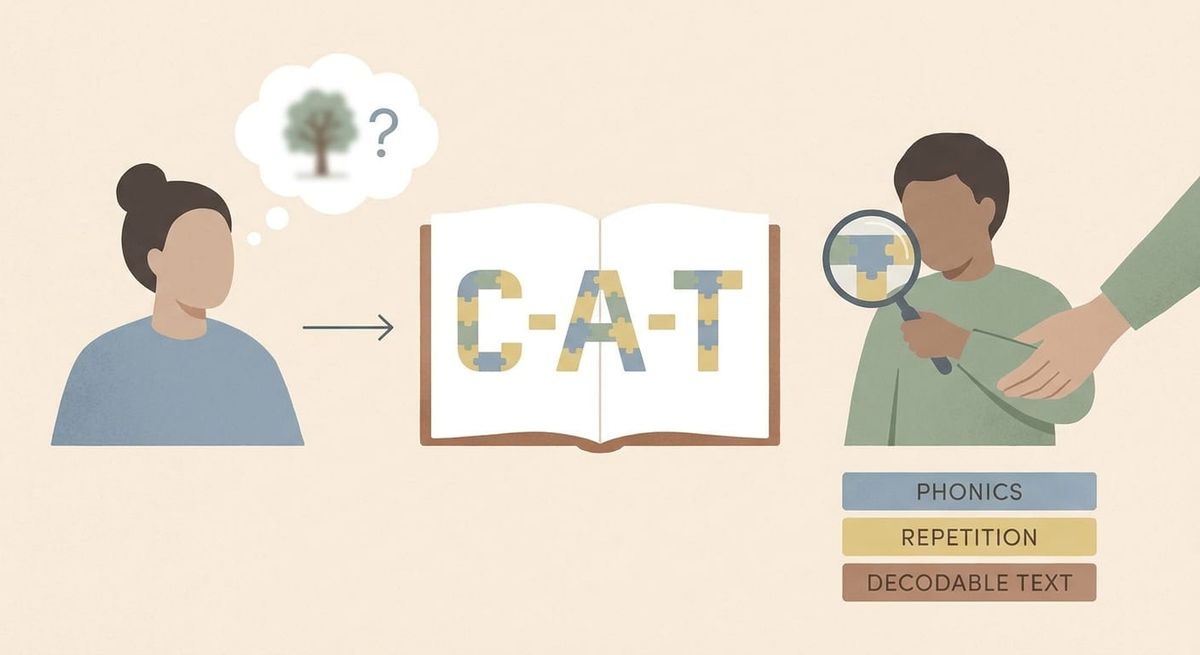
If your child seems to “read” by looking at the picture, the first letter, or the rest of the sentence, you are not imagining it. A lot of 4th and 5th graders with dyslexia learn to survive this way. They get very good at guessing, especially when books have strong picture support or predictable language.
The problem is that guessing falls apart fast. Once the text gets harder, pictures disappear, vocabulary becomes less familiar, and your child is left stuck.
If you are searching for how to help a child with dyslexia decode unfamiliar words, the goal is not to give more context clues. The goal is to help your child look through the word, notice the spelling patterns, and read it piece by piece. This post will show you what is going on and what you can do at home to help.
Why older kids with dyslexia guess instead of decode
Guessing is often a coping strategy, not laziness.
A child with dyslexia may have weak sound-symbol connections, trouble hearing all the sounds in a word, or difficulty remembering common spelling patterns. So when they see a hard word, they may do what has worked before:
- look at the picture
- use the first letter and guess
- swap in a word that makes sense in the sentence
- skip the word and keep going
This can sound fluent at times, but it is not accurate reading.
For example, a child might see the sentence, “The rabbit hopped into the burrow,” and read “The bunny ran into the hole.” That tells you they understood the general idea, but they did not actually read the words on the page.
Practical takeaway: If your child often replaces words with ones that “make sense,” treat that as a sign they need more decoding practice, not more exposure to picture books or context-based guessing.
What should your child do when they get stuck on a word?
When a word is unfamiliar, your child needs a simple routine they can use every time.
Teach them to:
- Look at all the letters in the word
- Find a part they know, like a prefix, suffix, vowel team, or syllable
- Say the sounds
- Blend the parts together
- Reread the sentence after decoding the word
The order matters. The child should try to read the word first, then check whether it makes sense in the sentence. Meaning matters, but it should not come before looking closely at the word.
Take the word sunset. A guessing reader might say “evening” because it fits the meaning. A decoding reader learns to break it into sun and set, then blend it.
With longer words, you can model chunking. For fantastic, you might guide your child through fan / tas / tic. For replaying, try re / play / ing.
Practical takeaway: Use the same language each time: “Look through the whole word. What parts do you know?” That is more helpful than saying, “Try again,” or “What would make sense?”
Why pictures and context clues are not enough
Pictures and context can support understanding, but they should not be the main reading strategy for a child with dyslexia.
By 4th and 5th grade, text becomes more demanding. There are fewer visual supports, more multisyllable words, and more academic vocabulary. A child who depends on guessing may seem okay in easier books but hit a wall in science, social studies, and chapter books.
This is one reason parents feel confused. Their child may tell a story well, understand read-alouds, and even appear to read smoothly. But when you point to a single word and ask them to read it, they cannot.
That gap matters.
Decoding is what allows a child to read new words independently. Without it, reading stays fragile.
Practical takeaway: If a book encourages guessing more than decoding, it may not be the best practice text for your child right now. Choose text that matches the phonics patterns your child is learning.
What kind of reading practice actually helps?
If you want to know how to help a child with dyslexia decode unfamiliar words, the most helpful practice is explicit, phonics-based reading with repetition.
That usually means:
- reviewing sound-spelling patterns directly
- practicing reading words that use those patterns
- reading decodable passages, not just leveled books
- rereading to build accuracy and confidence
Decodable text is especially important because it gives your child a fair chance to apply what they have learned. If they are working on vowel teams, suffixes, or syllable types, the reading material should include those patterns often enough to practice them.
Here is what this can look like at home:
A parent sits with their 5th grader for 10 minutes. First, they review a few word parts like -ing, -ed, and oa. Then the child reads a short decodable passage that includes those patterns. When they get stuck on coasted, the parent helps them break it into coast / ed instead of supplying the word. The next day, the child rereads the same passage and gets through coasted on their own.
That kind of repetition is not boring busywork. It is often exactly what helps a struggling reader finally hold onto a pattern.
Practical takeaway: Short, focused practice done consistently works better than long reading sessions where your child spends most of the time guessing.
Simple things to try at home this week
You do not need to turn your kitchen table into a classroom. A few small shifts can make a big difference.
1. Stop prompting with “Look at the picture”
If your child is stuck, point them back to the letters and sounds instead. Try: “Start at the beginning. What do you see?”
2. Cover part of the word and reveal chunks
This helps with longer words. Show one chunk at a time so your child can focus on decoding instead of feeling overwhelmed.
3. Reread short decodable passages
Rereading helps patterns stick. If your child struggled through a passage yesterday, reading it again today can build real accuracy.
4. Praise the strategy, not just the result
Say things like, “You broke that word into parts,” or “You looked at all the letters.” This reinforces decoding habits.
What progress can look like
Progress is not always dramatic at first.
A child who used to guess floating from the picture might start saying float…ing slowly. That may not sound smooth yet, but it is real reading. Another child might still need help with a word like disappear, but now they can identify dis and appear instead of blurting out a random guess.
Those small changes matter because they show your child is learning to rely on print.
Conclusion
If your child is guessing from pictures or context, the answer is not more guessing practice. The answer is helping them decode words directly with phonics, chunking, repetition, and the right kind of text.
When you focus on the word itself, your child gets a strategy they can carry into harder books and school reading.
If you want extra support at home, ReadGenie gives children structured decoding practice using Orton-Gillingham principles, Science of Reading methods, and decodable passages designed for repeated reading. ReadGenie is available on iOS through the Apple App Store, and on Android and Chromebooks through Google Play.



