When to Move Past CVC Words in Orton-Gillingham
If your child can read simple short vowel words some days but still gets stuck on others, it can be hard to know whether to keep reviewing or move on. This guide helps parents tell when a child is truly ready to move past CVC words in Orton-Gillingham-style reading practice.

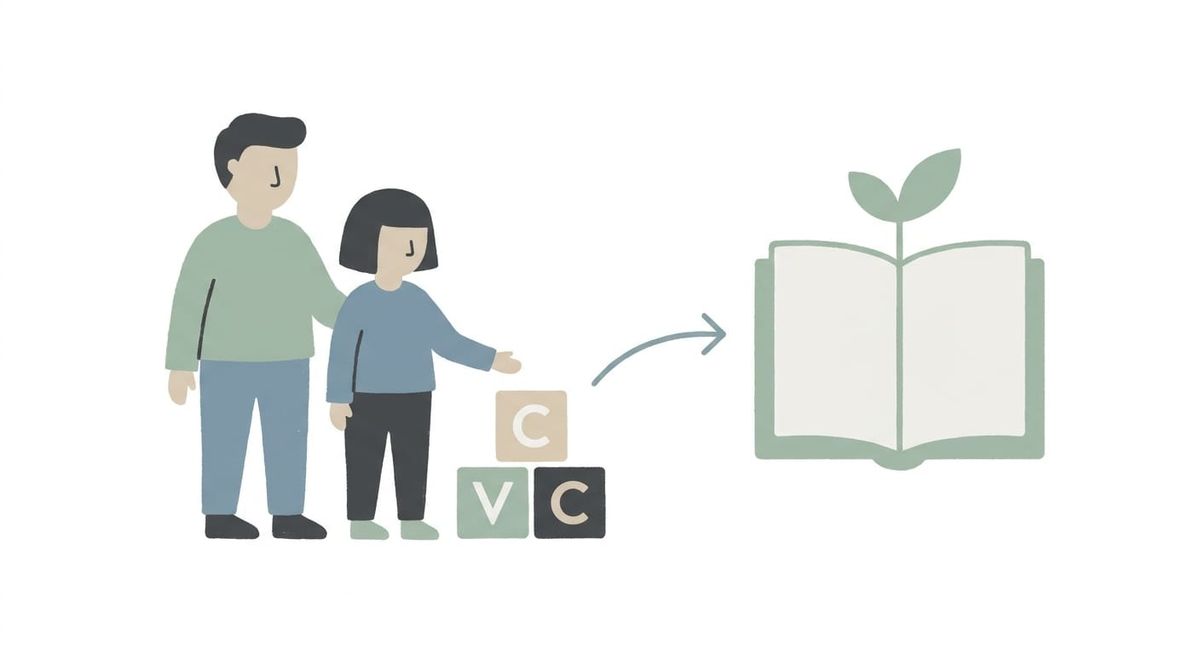
If your child can read words like cat, mop, and bed during practice, you may be wondering what comes next. You do not want to rush ahead and leave gaps. But you also do not want to stay on the same kind of word for so long that your child gets bored or starts reading on autopilot.
Knowing when to move past CVC words can make home reading practice feel much clearer. This guide will help you spot the signs that your child is ready, the signs that they still need review, and what to teach next in an Orton-Gillingham-style routine.
What does it really mean to master CVC words?
A child is not ready to move on just because they got a few short vowel words right once.
In Orton-Gillingham-style practice, mastery usually means your child can:
- read CVC words accurately without guessing
- say each sound in order and blend smoothly
- handle different short vowels, not just one favorite pattern
- read both real and unfamiliar words with the same strategy
- stay fairly steady even when the words are mixed
That last point matters. Some children can read cat, bat, and hat because the pattern repeats. Then they fall apart when they see mop, pen, and rug in the same list. That usually means the skill is still fragile.
How can you tell if your child is truly ready?
Instead of asking whether your child can read CVC words at all, ask whether they can do it consistently.
Your child may be ready for the next step if they can:
- read a mixed list of short vowel CVC words with only minor hesitation
- sound out unfamiliar CVC words instead of relying on memory
- correct themselves when something sounds wrong
- read a short decodable passage with mostly CVC words and keep the meaning together
You may also notice that your child is no longer using all their energy just to get through each word. Reading still may not be fast, but it looks more controlled and less exhausting.
That is often the point where staying too long on basic CVC lists stops being helpful.
Signs you should not move on yet
Sometimes a child looks close to ready but still needs a little more time.
Hold off on moving ahead if your child:
- guesses from the first letter
- mixes up short vowel sounds often
- can read practiced words but not new ones
- loses accuracy when words appear in a sentence or passage
- gets overwhelmed when reviewing several patterns together
If you see those signs, the answer is usually not more pressure. It is better review.
Go back to short, structured practice with blending, word reading, and decodable text that matches what your child already knows. A few more solid days or weeks at this level can save a lot of frustration later.
What should you teach after CVC words?
Once your child is solid with CVC words, the next step is usually not a giant jump. It is a small increase in complexity.
Good next-step options often include:
- beginning consonant blends like stop or flag
- ending blends like milk or hand
- digraphs like ship, chat, or thin
- simple suffix endings when appropriate
The best next target depends on what your child has already learned. The key is to add one new challenge at a time while keeping the rest of the word familiar.
For example, if your child can read map, it may make sense to try snap or mash before asking them to read something much longer or less predictable.
What if my child is accurate but very slow?
This is where many parents get stuck.
If your child is accurate but slow, that does not always mean you should stay on CVC words forever. Slow but correct reading often means the skill is still becoming automatic. In that case, you can sometimes move forward carefully while still reviewing CVC words in every lesson.
Think of it like this: review keeps the foundation strong, while the new pattern helps your child keep growing.
You do not have to choose one or the other.
A real-life example
Let’s say Maya can read words like dog, sit, and cup in isolation. Her mom notices that Maya does well when the words all use the same vowel, but starts guessing when the list mixes a, i, o, and u. In a decodable passage, she reads the first few lines accurately, then begins skipping sounds when she gets tired.
That usually means Maya is not fully ready to leave CVC work behind.
Instead of jumping to harder words right away, her mom spends another week on mixed short vowel review, short decodable passages, and a few nonsense words to make sure Maya is actually decoding. After that, Maya handles the same kinds of words more steadily and can start simple blends without as much stress.
That is what a good next step looks like. Not rushed, not stuck. Just better timed.
Practical things to try this week
If you are unsure when to move past CVC words, try these simple checks:
- Use a mixed word list
Put together 8 to 10 CVC words with different short vowels. If your child can read them with good accuracy and little guessing, that is useful information. - Test one unfamiliar word
Add a word your child has not practiced before. If they can decode it, they are relying on skill, not memory. - Listen during passage reading
See whether your child can carry the same accuracy into a short decodable passage. - Add one new pattern, not five
If CVC reading seems steady, try a very small next step like a digraph or blend while keeping review in place.
Keep progress steady, not rushed
Moving on in Orton-Gillingham is not about checking a box. It is about making sure your child has enough control over a pattern to build on it without falling apart.
If you are still unsure, it often helps to ask not, “Can my child read these words?” but “Can my child read these words accurately, consistently, and without guessing?” That question usually gives you the answer.
You might also find this helpful: How to Know When to Review in Orton-Gillingham
And if you want extra support between lessons, ReadGenie gives children short, structured reading practice built on Orton-Gillingham principles, decodable text, and repetition. You can explore it here: App Store and Google Play.