How to Fix Guessing Words in Orton-Gillingham
If your child keeps blurting out a word that looks kind of right but is not actually what is on the page, you are not alone. This guide shows how to stop guessing words in Orton-Gillingham with simple, structured practice that helps kids slow down and read through the whole word.

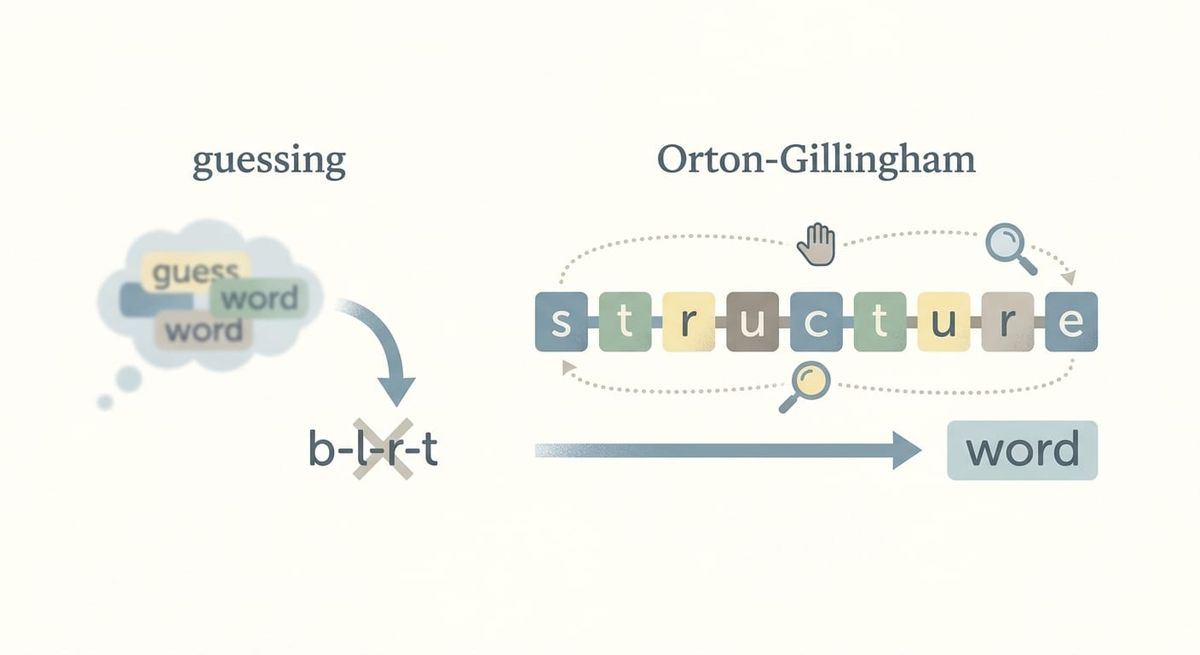
If your child looks at a word for one second and says something that is close but wrong, it can feel confusing fast. Maybe from becomes for. Maybe chimp becomes chip. Maybe your child knows the sounds in practice, but when it is time to read an actual word, they still guess.
This is a very common problem for struggling readers. It does not always mean your child is lazy or not paying attention. More often, it means they are trying to read before the whole word feels manageable.
If you are trying to stop guessing words in Orton-Gillingham, the goal is not to keep saying “slow down.” The goal is to make the word easier to process in a clear, structured way.
Why do kids guess at words?
Guessing usually happens when a child is using partial information. They might notice the first sound and then fill in the rest. They might focus on one chunk they know and skip the rest. They might also guess because sounding out still feels hard, slow, or tiring.
A child who guesses often may be struggling with:
- blending all the sounds in sequence
- tracking left to right through the whole word
- holding sounds in memory long enough to combine them
- recognizing which phonics pattern they are supposed to use
- reading with enough confidence to stay with the process
This matters because guessing can become a habit. Once that habit sets in, a child may keep choosing speed over accuracy, even when they know more than they show.
What should you do in the moment?
When your child guesses, try not to correct the whole word right away. If you immediately give the answer, your child gets less practice doing the reading work.
Instead, guide them back into the word.
You can say things like:
- “Start at the beginning.”
- “Touch each sound.”
- “Read every part.”
- “Try that again and do not skip the middle.”
Then help your child move through the word in order. Point under each sound or chunk as they read. If the word is longer, cover part of it and reveal one section at a time.
The goal is to interrupt the guessing pattern without turning the moment into a struggle.
How to stop guessing words in Orton-Gillingham practice
Orton-Gillingham works best when reading is explicit and sequential. If your child is guessing, go back to more visible, more supported steps.
1. Use finger tracking or tapping
Have your child touch under each sound, blend, or syllable as they read. This helps slow the process just enough to keep them from jumping ahead.
For example, with the word sand, your child touches s / a / n / d and then blends the word. With sunset, they can read it in parts: sun + set.
2. Practice with controlled words first
If guessing shows up a lot in books, step back and practice with words that match the pattern your child is learning. A child who is working on blends should read blend words. A child who is working on vowel teams should read words with that pattern, not a random mix of harder words.
This lowers the load and makes accurate reading more likely.
3. Ask for the part they skipped
Sometimes a child reads stamp as step or sled as said. In those cases, point to the skipped or changed part.
You might say:
- “What sound do you see in the middle?”
- “You read the first part. Now check the end.”
- “Does that match every letter?”
That helps your child learn to confirm the full word, not just approximate it.
4. Build accuracy before speed
Many parents worry that sounding out every word will make reading too slow. At first, it often does. But accuracy comes before fluency. If a child keeps guessing, faster reading will not solve the problem. Accurate practice is what eventually makes reading smoother.
What does this look like with a real child?
Let’s say a fourth grader sees the word floating and says flower. A parent might feel shocked because the guess is not even close. But if you slow it down, the child may have noticed only the first few letters and then filled in the rest from memory.
A more helpful response would be:
- cover the ending
- read float
- uncover ing
- blend the whole word
Now the child is not guessing. They are reading in steps.
Over time, this kind of support helps a child trust the process instead of rushing past it.
Is guessing a sign the text is too hard?
Sometimes, yes.
If your child guesses on most words in a passage, the text may ask for patterns they cannot use confidently yet. That does not mean they should never see challenging text. It does mean practice text should usually match what they have already been taught.
A good rule is this: if your child can read some words accurately with support but falls apart on many others, go simpler for practice and save harder books for reading together.
Simple things parents can try this week
Here are a few realistic ways to reduce guessing at home:
- Use shorter practice sessions. Ten calm minutes often works better than pushing through when your child is tired.
- Keep a pointer or index finger under the word. This helps your child stay visually anchored.
- Choose just one pattern to review at a time. Too many new patterns can lead to guessing.
- Praise accurate effort. Say, “I like how you checked the middle,” not just, “Good job.”
Small changes like these can make practice feel more successful very quickly.
A helpful next step for blending
You might also find this helpful: How to Blend Sounds in Orton-Gillingham
If your child is guessing, blending is often one of the first skills worth strengthening.
Conclusion
If your child keeps guessing at words, it does not mean reading practice is failing. It usually means your child needs more support reading through the whole word in order. When you slow things down, point to each part, and practice patterns your child can actually use, guessing often starts to fade.
The goal is not perfect reading overnight. It is helping your child build a more reliable way to approach words.
If you want extra support, ReadGenie gives kids structured phonics practice with repetition, decodable reading, and dyslexia-friendly routines based on Orton-Gillingham principles. You can explore it here: App Store or Google Play.



