How to Teach CVCe Words in Orton-Gillingham
If your child can read short vowel words like cap and kit but gets mixed up by cape and kite, CVCe words may be the next pattern to teach. This guide shows how to introduce them in a simple, structured way at home.

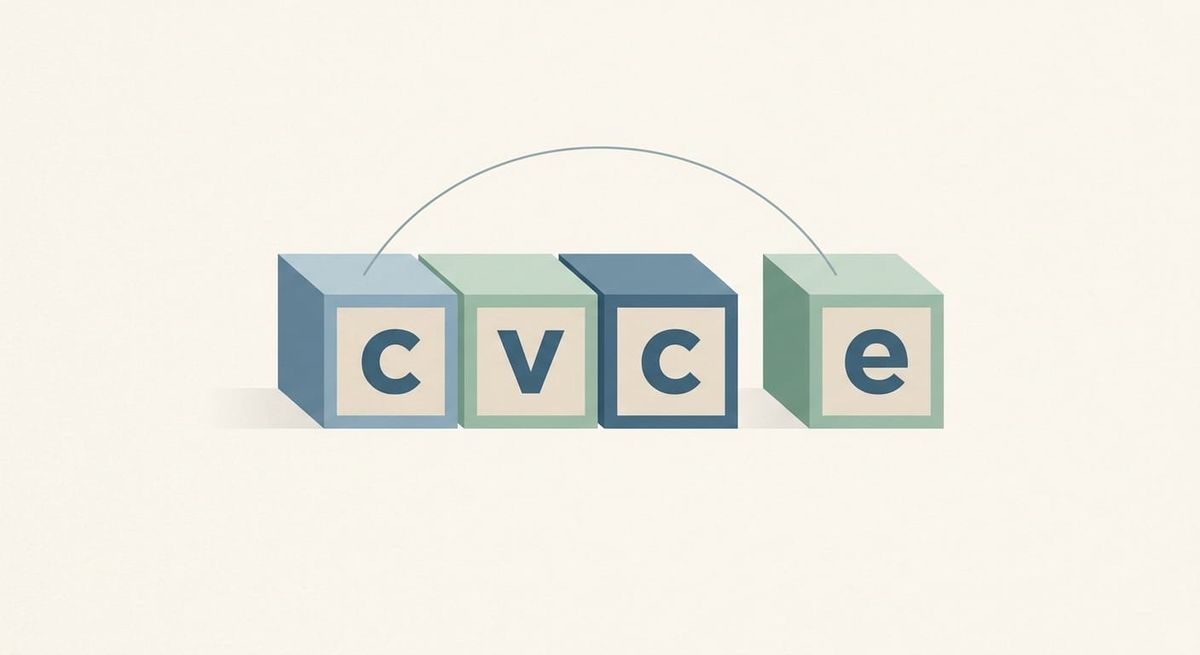
If your child can read words like cap, kit, and hop but stumbles on cape, kite, or hope, you are probably seeing a very common next-step problem.
They may understand short vowels in closed syllables, but they have not yet learned how a final e changes the vowel sound in a CVCe word.
This is often the point where parents start wondering, Why did my child know this yesterday and miss it today? The answer is usually not that your child is not trying. It is that this pattern needs to be taught clearly, slowly, and with enough review.
In this post, you will learn how to teach CVCe words in Orton-Gillingham in a way that feels structured, simple, and manageable at home.
What are CVCe words?
CVCe words follow a common pattern: consonant, vowel, consonant, silent e.
Words like cake, Pete, bike, home, and cube fit this pattern.
In these words, the final e is not pronounced, but it helps the vowel say its name. That is why cap becomes cape and hop becomes hope.
For many struggling readers, this pattern is not obvious. They often try to read cube like cub or bike like bik. That is why it helps to teach the pattern directly instead of hoping your child will just pick it up from exposure.
When is a child ready for CVCe words?
CVCe words usually come after a child can read simple closed-syllable words with short vowels.
Your child may be ready if they can:
- read CVC words like mad, pet, and sit
- hear the difference between short and long vowel sounds
- blend 3-sound words without a lot of guessing
- handle short practice with one new pattern at a time
If your child is still guessing on short vowel words, it is usually better to strengthen that foundation first before adding CVCe.
How do you teach CVCe words step by step?
The easiest way is to compare known short vowel words with new CVCe words.
Start with word pairs that change only one part:
- cap → cape
- kit → kite
- hop → hope
- cub → cube
- mad → made
Write one pair at a time. Read the short vowel word first. Then add the final e and show how the vowel changes.
You can say something simple like:
This e is silent, but it makes the vowel say its name.
Keep the language consistent. You do not need a long explanation. Most children learn this better through repeated examples than through a big rule talk.
A simple lesson might look like this:
- Review 3 to 5 short vowel words your child already knows
- Add the matching CVCe word
- Read both words aloud
- Ask your child what changed
- Practice blending a few new CVCe words
This side-by-side contrast helps your child notice the pattern instead of memorizing random words.
What if your child keeps forgetting the silent e rule?
That is normal.
Many children with dyslexia need much more repetition before a new pattern sticks. Forgetting does not always mean the lesson failed. It usually means your child needs more review with fewer words at a time.
If your child keeps missing CVCe words, try this:
- teach only one vowel pattern at first, like a_e in cake, same, and late
- avoid mixing all five vowels too early
- use word chaining, like cap, cape, tape, tame
- go back and forth between reading and spelling
Spelling often helps the pattern click. When your child builds cap and then changes it to cape, they can see exactly what the final e is doing.
A real-world example
Let’s say Maya can read mat, rid, and hop easily, but when she sees made, she says mad.
Her parent starts correcting every mistake right away, but Maya gets tense and begins guessing.
Instead, they slow down and practice just three pairs: mad/made, rid/ride, and hop/hope.
First, Maya reads the short word. Then she adds the e tile and reads the new word. After a few days of short practice, she starts noticing that the vowel changes when the final e is added.
That small shift matters. She is not just reading one word correctly. She is starting to see the pattern.
Simple ways to practice CVCe words at home
You do not need a long lesson to make progress. A few focused minutes can be enough.
Here are some realistic ways to practice:
1. Use word pairs
Keep a small list of matched words like fin/fine or tub/tube. This helps your child compare patterns directly.
2. Build words with tiles or paper slips
Let your child build cap and then add e to make cape. Changing one part helps the rule feel concrete.
3. Read decodable words, not random lists
Choose words that really follow the pattern your child is learning. Too many exception words can create confusion.
4. Keep practice short
Try 5 to 10 minutes. Stop before your child is worn out. Short, calm repetition usually works better than longer practice.
A helpful next step after closed syllables
CVCe words are often one of the first big shifts in phonics because the vowel no longer makes its short sound. That can feel confusing at first, especially for a child who has worked hard to learn closed syllables.
You might also find this helpful: How to Teach Closed Syllables in Orton-Gillingham
Conclusion
If your child is getting stuck on words like cake, bike, or home, they may need direct practice with the CVCe pattern, not more pressure.
When you teach CVCe words in a clear, step-by-step way, your child gets a better chance to notice what the final e is doing and apply it in new words.
Small lessons, repeated practice, and simple comparisons can go a long way.
If you want extra support, ReadGenie gives children structured reading practice with systematic phonics, repetition, and decodable text designed to build confidence over time. You can explore it here: App Store and Google Play.



