How to Teach Syllable Division in Orton-Gillingham
If your child can read short words but falls apart when words get longer, syllable division may be the next step. This guide shows parents how to teach it in a simple, structured way at home.

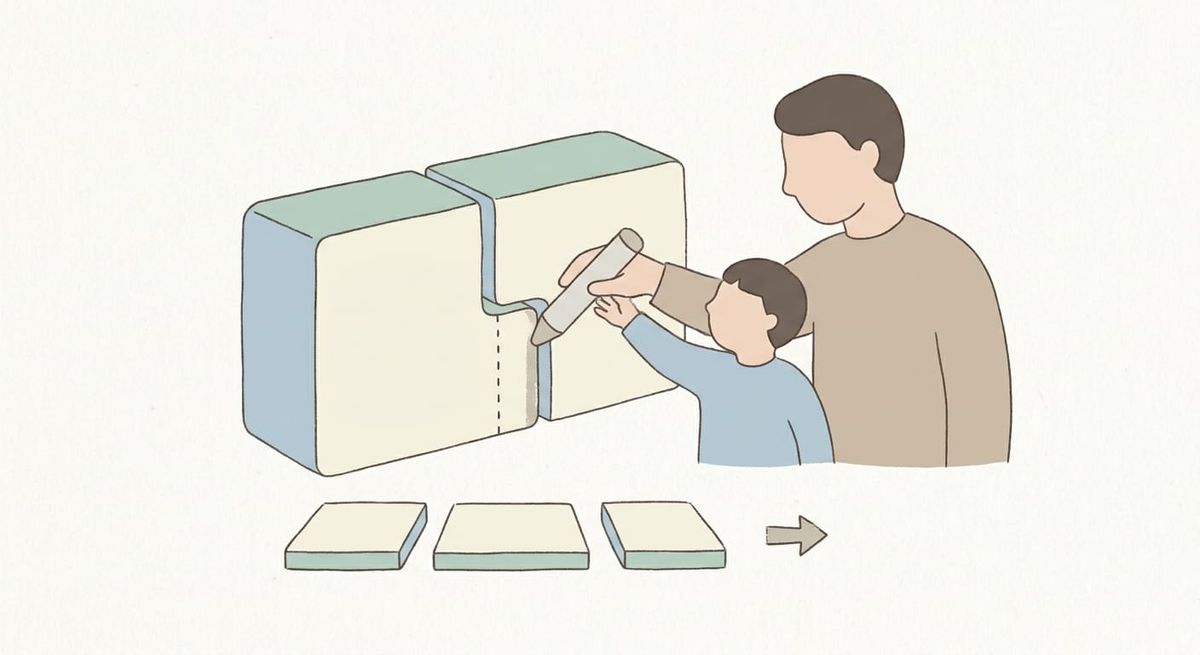
If your child can read cat, shop, or sunset but freezes on words like napkin, robot, or picnic, you are not imagining the pattern. Many struggling readers do fine with short words and then start guessing as soon as the word gets longer.
That is often the point where parents start wondering what to do next.
If you are using an Orton-Gillingham approach at home, syllable division can help your child break longer words into smaller, readable parts. This post will show you how to teach syllable division in Orton-Gillingham without making reading feel complicated or heavy.
What is syllable division, and when does a child need it?
Syllable division means teaching a child to split a longer written word into parts they can decode one at a time. Instead of staring at the whole word and guessing, they learn to look for chunks.
This usually becomes helpful when your child:
- can read simple one-syllable words with some consistency
- knows short vowel sounds well enough to use them in reading
- can blend sounds in short words
- starts to get stuck mostly on two-syllable words
- looks overwhelmed by longer words on the page
You do not need to start with every syllable type or every rule. For most parents, it is better to begin with a few easy patterns and practice them over and over.
Start with simple two-syllable words
The best place to begin is with words that are easy to hear and easy to split, like:
- napkin
- basket
- sunset
- robin
- magnet
- dentist
At first, choose words with familiar sounds and common spelling patterns. Avoid words with unusual spellings, suffixes your child has not learned, or too many new ideas at once.
A simple routine looks like this:
- Write the word.
- Read it together slowly.
- Find the vowels.
- Mark or scoop the syllables.
- Read the first syllable.
- Read the second syllable.
- Blend the whole word.
You can say something like, “This word is too big to read all at once, so we are going to break it into parts.” That one sentence often lowers stress right away.
How do you teach syllable division without too many rules?
Parents often get stuck because syllable division can sound rule-heavy. At home, you do not need to turn it into a full lesson on every division pattern right away.
Start with the most useful idea first: look between the vowels.
For a word like napkin, your child can:
- spot the two vowels
- look at the consonants in the middle
- divide the word into nap / kin
- read each part
- blend the whole word
For a word like robot, your child can try ro / bot.
At this stage, what matters most is not perfect labeling. What matters is helping your child stop guessing and start working through longer words in a structured way.
You can keep your language simple:
- “Find the vowels.”
- “Let’s break the word into two parts.”
- “Read this part.”
- “Now read the next part.”
- “Put them together.”
That is often enough for early practice.
What if my child still guesses at the whole word?
That is very common, especially if your child has spent a long time trying to survive reading by using pictures, context, or the first letter.
When that happens, slow the process down.
Cover part of the word and reveal one syllable at a time. Point to each chunk. Ask your child to read one part only, not the whole word yet. Then uncover the second part and blend them together.
If your child says a random word quickly, avoid saying, “No, that’s wrong,” and moving on. Instead, bring them back to the print:
- “Let’s look at the first part.”
- “What vowel do you see?”
- “Read just this chunk.”
- “Now try the next one.”
The goal is to build the habit of decoding through the word instead of jumping past it.
A real example of how this can look at home
Let’s say your fourth grader reads short words fairly well but keeps stumbling on words in decodable passages like picnic, basket, and fabric.
Before syllable work, he might look at picnic and guess picture because it starts with pic. He is not being careless. He is trying to cope with a word that feels too big.
Once you show him how to find the vowels and split the word into pic / nic, the word becomes manageable. He may still need support at first, but he is now working from the letters instead of guessing from the first chunk.
After a week or two of short practice with similar words, many children start approaching longer words more calmly because they know what to do first.
Simple ways to practice syllable division at home
You do not need long lessons. A few focused minutes is usually enough.
Try these:
- Use word cards with two-syllable words. Have your child mark the split with a finger or pencil.
- Highlight the vowels first. This gives your child a visual starting point.
- Read word lists by pattern. Group words like napkin, picnic, and magnet so the task feels predictable.
- Practice in decodable text. Once your child can read the words in isolation, help them find similar words in a passage.
Keep practice short enough that your child can stay successful. If accuracy falls apart, the words may be too hard or the lesson may be too long.
When should you move beyond basic syllable division?
Once your child can handle simple two-syllable words, you can gradually introduce more patterns, including words with open syllables, closed syllables, and common endings. But you do not need to rush.
The most helpful next step is usually more repetition, not more complexity.
If your child still struggles with blending sounds inside shorter words, go back and strengthen that foundation first.
You might also find this helpful: How to Blend Sounds in Orton-Gillingham
Final thoughts
If longer words are where reading starts to fall apart, syllable division may be the missing piece. Teaching your child to break words into smaller parts can reduce guessing, lower frustration, and make reading feel more doable.
Keep it simple, stay consistent, and focus on just a few clear patterns at a time.
If you want extra support between practice sessions, ReadGenie gives children structured phonics practice with decodable reading designed to build confidence step by step. You can explore it here: App Store and Google Play.



