Ivy and Bean Reading Level: Lexile 580L, AR 3.2, Guided Reading M
Ivy + Bean book 1 is Lexile 580L, AR level 3.2 and Guided Reading level M, so most kids read it alone late in 2nd grade or in 3rd grade. Here is how it works for struggling readers and kids with dyslexia, and which words to practice first.

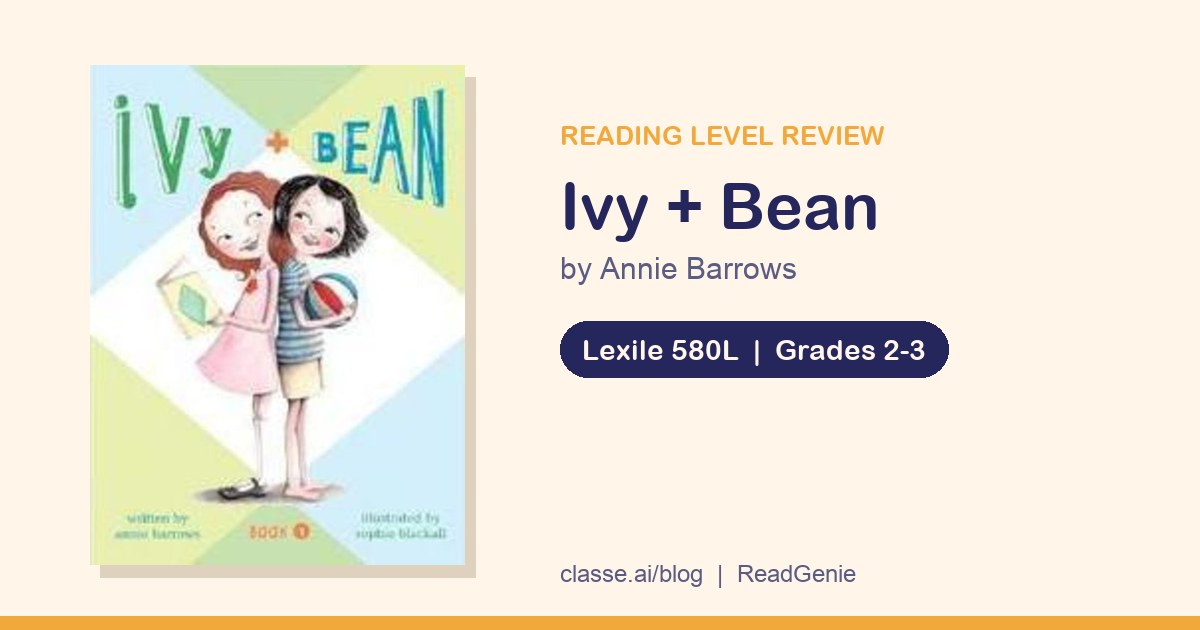
Ivy + Bean, the first book in Annie Barrows' series, has a 580L Lexile measure, an AR (ATOS) book level of 3.2 and a Guided Reading level of M. Most kids can read it on their own late in 2nd grade or in 3rd grade. It works well for struggling readers in grades 2 to 4 because it is short, about 7,800 words in 10 chapters, and the sentences in the opening chapters average only 7 to 8 words. A child who is still sounding out most words will need it as a read-together book first.
Bean is seven, loud and happiest when she is stomping in puddles. Ivy is the new girl across the street who wears dresses and a sparkly headband and always seems to be reading. Bean's mom keeps telling her to go play with Ivy, and Bean is sure Ivy is boring. Then a trick on her big sister Nancy goes wrong, Bean needs somewhere to hide, and Ivy turns out to have plans that are anything but boring. Kids like these two because they get into the kind of trouble real kids dream up on a slow afternoon.
Ivy + Bean reading level at a glance
| Lexile measure | 580L (TeachingBooks) |
|---|---|
| ATOS / AR book level | 3.2 (TeachingBooks) |
| AR points | 1.0 (TeachingBooks) |
| Guided Reading (Fountas & Pinnell) | M (Booksource) |
| Flesch Reading Ease (0-100) | 97.5 ReadGenie estimate |
| Flesch-Kincaid grade | 1.5 ReadGenie estimate |
| Interest level | Grades 1-4 (Chronicle Books) Also listed as Grades 1-6 |
| Approximate grade band | Grades 2-3 (ages 7-9) ReadGenie |
| Length | 120 pages, ~7,828 words |
| Format | Chapter book |
| Good for struggling readers? | ★★★★★ 4/5 |
| Dyslexia-friendly rating | ★★★★★ 4/5 |
We couldn't find a published DRA level or grade level equivalent for this book.
Is Ivy + Bean a struggle for your child right now? ReadGenie gives struggling readers short daily Orton-Gillingham practice at home, out loud, with help on the exact sound they missed.
Try ReadGenie and get this book freeScores checked 2026-11-21. Different leveling systems don't always agree, so we show each published value with its source and mark our own estimates. Links to every source are under How we rate books.
What grade level is Ivy and Bean?
Book 1 reads at about a 2nd to 3rd grade level. A child who is reading comfortably by the spring of 2nd grade can usually manage it alone, and for most 3rd graders it is an easy, quick book.
The AR level of 3.2 says the text is about as hard as what a typical student reads a couple of months into 3rd grade. It is worth 1 AR point, which is what you would expect from a book this short. Guided Reading level M is a letter many schools look for near the end of 2nd grade. If the teacher says your child is at level K or L, this book is a small stretch alone and a comfortable one with you beside them.
The 580L Lexile can look high next to the other numbers. Lexile leans on sentence length and how common the words are, and Annie Barrows mixes very short lines of talk with the occasional long, breathless sentence, the way a seven-year-old actually tells a story. In the two chapters we measured, about 6 sentences in 10 were under 8 words, and about 1 in 10 ran past 15. Those few long ones lift the Lexile. The words themselves are plain. Only about 1 word in 100 had three or more syllables.
Chronicle Books describes the series as chapter books for grades 1 to 4. That is an interest range more than a reading range. First graders usually hear it read aloud, 2nd and 3rd graders read it themselves, and plenty of 4th graders still enjoy it.
Is Ivy and Bean good for struggling readers?
For most of them, yes. We rate it 4 out of 5 for struggling readers.
Length is the first reason. Ten chapters share about 7,800 words, so a chapter is usually a few minutes of reading, and the very first one is under 350 words. A child who has never finished a chapter book can finish chapter 1 before they have time to get tired, and that first win counts.
The second reason is Bean. She is funny, she is a little bit naughty, and she says what kids think about big sisters. Reluctant readers will often push through a hard word to find out what she does next. Sophie Blackall's black-and-white drawings turn up four or five times a chapter, which breaks the pages into smaller pieces and gives a reader somewhere to rest.
There are also 12 books in the series, all written for the same audience. Once a child gets through one, the next one is waiting, with the same characters and the same kind of sentences. That kind of easy mileage is what builds fluency.
A few cautions. Both girls are 7, and some 4th and 5th graders reading below grade won't want a book about kids that young. The long sentences that show up now and then can trip a slow reader, so show your child how to pause at the commas. And the pictures add to the story without telling it, so there is no getting by on the drawings alone.
Is Ivy and Bean good for kids with dyslexia?
Overall: ★★★★★ 4/5
| Factor | Score | Why |
|---|---|---|
| Sentence length | 4/5 | Sentences in the excerpt average 7.5 words and about 6 in 10 are under 8 words. Roughly 1 in 10 runs past 15. |
| Vocabulary load | 4/5 | Everyday words about home, sisters and play. Only 1.2% of words in the excerpt have three or more syllables, such as afternoon and actually. |
| Decodability | 4/5 | Most words follow common patterns. Irregular words like thought, through, tongue and could, plus a few names, need pre-teaching. |
| Text density and layout | 4/5 | Roomy pages with short paragraphs and wide spacing in the paperback, set in a traditional serif font rather than a sans-serif. |
| Pictures that carry meaning | 3/5 | Four or five black-and-white drawings per chapter show the characters and the mood, but the text carries the story. |
| Chapter length | 4/5 | Ten chapters averaging under 800 words. The first chapter is under 350 words, a few minutes of reading. |
| Engagement for reluctant readers | 4/5 | Sneaky plans, a bossy big sister and a pretend witch pull kids along. The humor is everyday mischief rather than action. |
| Audiobook / read-along support | 5/5 | Two unabridged audiobooks exist, one from Recorded Books read by Cassandra Morris and a 2022 Chronicle recording read by Hallie Ricardo. |
Our dyslexia-friendly rating is 4 out of 5.
The text is the strong point. Most sentences are short, the words are the everyday words of home and play, and the long words that do appear are ones kids already say out loud, like afternoon and actually. Most of the vocabulary follows the phonics patterns taught in 1st and 2nd grade.
The pages are roomy too. Paragraphs are short and there is a lot of dialogue, so a page rarely looks like a solid block. The type is a traditional serif, though, and not the plain sans-serif some dyslexic readers find easier.
Pictures score lowest here. They show who the girls are and how they feel, and kids love them, but a child still has to read every line to follow the plot.
Audio is where this book shines. There are two unabridged recordings, an older one from Recorded Books read by Cassandra Morris and a 2022 Chronicle Books recording read by Hallie Ricardo, and many library apps carry at least one. Listening to a chapter and then reading the next one aloud keeps a child in the story on days when decoding is slow. We did not find a special dyslexia-friendly print edition.
Words and phonics patterns to practice first
The first two chapters lean on patterns that kids meet early in a structured literacy program, so a short warm-up before reading goes a long way.
Closed syllables with short vowels are the base of the book. Try chin, shin, pest, trick, stuck and brush as a quick read-and-spell list.
Silent e words come up often. Made, nice, cute, stage, whole and life are all in the opening chapters. If your child still reads these with a short vowel, put a few next to their short-vowel partners and sort them.
Vowel teams matter because one of them is in the title. Bean, seat, teach and teeth all use ea or ee for the same long e sound, and train and street add two more teams.
R-controlled vowels show up in bored, skirt, shirts, yard, purple and curly. Bored is a word Bean uses a lot, so make sure it is automatic.
Past tense endings are everywhere in a story told this way. Zipped and stomped end with a t sound, yelled and climbed with a d sound, and tangled and frowned are good ones for covering the ending and reading the base word first.
Compound words are worth a minute. Headband, tightwad, someone, without, afternoon and nobody each split neatly into two smaller words a child already knows.
A handful of words are better taught whole before you begin. Thought, through, tongue, could, would, should and once don't play by the rules, and minute, mirror, triangle and pretzels are long enough to slow a reader down. Add the names Ivy, Bean and Nancy to the list.
If patterns like these are still shaky, a few minutes of practice each day will do more than struggling through the chapters. ReadGenie has kids read these kinds of words out loud and helps with the exact sound they missed, which makes a book like this one feel lighter.
How to read Ivy and Bean with your child
Start by reading chapter 1 aloud yourself. It is very short, and it sets up everything a child needs to know about Bean, her mom and the girl across the street. Explain that Bean is a nickname so the title makes sense.
Then take turns by character. You read Nancy and the grown-ups, and your child reads Bean. Most pages are back-and-forth talk, so this splits the work fairly and keeps the pace up. Later, your child can pick up Ivy's lines as well.
One or two chapters a night is plenty. At that pace the whole book takes about a week, and a child who is used to never finishing books gets to finish one.
After chapter 4, when the two girls finally meet, stop and ask whether Bean was right about Ivy. It checks understanding without feeling like a quiz, and it opens up a good talk about deciding who someone is before you know them.
On tired nights, play a chapter of the audiobook and have your child read the next chapter to you the following day.
Using Ivy and Bean in the classroom or tutoring
For teachers, book 1 fits a Guided Reading level M group and divides cleanly into five sessions of two chapters each. Chapters 1 to 4 are a good place to chart what Bean thinks of Ivy before and after they meet, and then to look at how the author shows that change. Because so much of the book is conversation between two characters, it also works well for partner reading in 2nd and 3rd grade.
For tutors, the opening chapters are a ready-made source of past tense words to sort by ending sound. Split the compound words into their two parts before the student meets them on the page, and teach thought, through and tongue as heart words, then have the student hunt for them in chapter 1. A page of dialogue between Bean and Nancy makes a good repeated reading for fluency, with a different voice for each sister.
Content notes for parents
Bean is not a model child, and that is much of the fun. She plays tricks on her older sister, sneaks around, hides from her mom and helps plan a pretend magic spell, and she does get in a little trouble for it. The sisters call each other names, and words like dumb and booger appear. The witch business is make-believe play between two seven-year-olds. There is nothing violent or scary, and no swearing or romance.
Should your child read it?
If your child reads at about Guided Reading level L or M, or is a 2nd or 3rd grader ready to leave early readers behind, this is a very good first real chapter book. A 4th grader reading a year behind may like it too, as long as younger characters don't bother them. For a child who is not there yet, read it aloud together or start with Mercy Watson to the Rescue, which is shorter and has color pictures on every spread. Kids who finish the series and want more can move up to Clementine or Ramona Quimby, Age 8.
Make the next book easier
Short daily sessions of reading, spelling and handwriting practice, built with Orton-Gillingham teachers. It works alongside tutoring and school support. The first 7 days are free. Join today and we'll mail your child Ivy + Bean for free.
Try ReadGenie and get your free bookStarts with a free 7-day trial. Book mailed after your first paid month. US only, one per family.
FAQ
What reading level is Ivy and Bean?
Book 1 is Lexile 580L, AR level 3.2 and Guided Reading level M. In plain terms that is a late 2nd grade to 3rd grade book for a child reading on their own.
How many AR points is Ivy and Bean worth?
The first book is worth 1 AR point at a book level of 3.2. It is a short book, so the quiz is a quick one for kids who use Accelerated Reader at school.
What age is Ivy and Bean for?
Most kids read it themselves between 7 and 9. The publisher aims the series at grades 1 to 4, and younger children in that range usually enjoy it as a read-aloud first.
What grade are Ivy and Bean in?
Both girls are 7 years old in book 1, which takes place around their homes on Pancake Court. In later books they are in the same 2nd grade class.
Do you have to read the Ivy and Bean books in order?
It helps to read book 1 first, because it tells how the girls meet and become friends. After that each book is its own story, so a child can pick whichever of the 12 looks most fun.
Is Ivy and Bean good for a child with dyslexia?
It is one of the easier chapter books to start with. The sentences are mostly short, the chapters are brief and there are two unabridged audiobooks. Go over the irregular words and the names first, and share the reading at the start.
Get Ivy + Bean free
ReadGenie helps struggling readers improve their reading, spelling and handwriting in short daily sessions at home. Join and we'll mail your child this book for free.
Claim your free bookStarts with a free 7-day trial. Book mailed after your first paid month. US only, one per family.
What to read next
- Mercy Watson to the Rescue by Kate DiCamillo (easier). A shorter, funnier-looking first chapter book with color pictures on every spread.
- Junie B. Jones and the Stupid Smelly Bus by Barbara Park (easier). Another loud, funny girl narrator in short chapters, with simpler sentences.
- Judy Moody Was in a Mood by Megan McDonald (similar). A third grader with big moods at the same Guided Reading level, in a slightly longer book.
- Clementine by Sara Pennypacker (harder). A warm, funny third grade story with longer chapters and more to think about.
- Ramona Quimby, Age 8 by Beverly Cleary (harder). The classic the publisher compares Ivy and Bean to, with denser pages and longer chapters.
Browse all of our reading-level book reviews.
How we rate books
Lexile, ATOS (Accelerated Reader), Guided Reading and DRA levels come from the companies that own them and from publishers. We link to where we found each one, and when a level isn't published we say so. Anything marked "ReadGenie estimate" is our own call, not an official level. Flesch scores come from a short public excerpt when the publisher offers one. The struggling-reader and dyslexia-friendly ratings are our judgment, based on eight things (sentence length, vocabulary, decodability, page layout, pictures, chapter length, how gripping the story is, and audiobook support). Treat them as a starting point. The right book is one your child can read with about 95% accuracy and wants to keep reading.
Sources
- TeachingBooks: Ivy and Bean (Lexile, ATOS, AR points, word count, grades)
- Booksource: Ivy and Bean (Chronicle paperback) (Guided Reading level, Lexile check, AR level check, pages, ISBN, interest level)
- Chronicle Books: Ivy and Bean (Book 1) (publisher grades, series facts, cover)
- OverDrive ebook sample: Ivy and Bean (excerpt, chapter list, layout)
- OverDrive: Ivy and Bean audiobook (Recorded Books) (audiobook narrator)
- OverDrive: Ivy & Bean audiobook (Chronicle Books) (audiobook narrator)