Mr. Morris Lessmore Reading Level: Lexile AD650L, AR 3.7
The Fantastic Flying Books of Mr. Morris Lessmore by William Joyce is Lexile AD650L and AR level 3.7 with 0.5 AR points. Most kids can read it alone around 3rd grade. It is short and the pictures carry the story, but words like happenstance make it a better shared read for struggling readers.

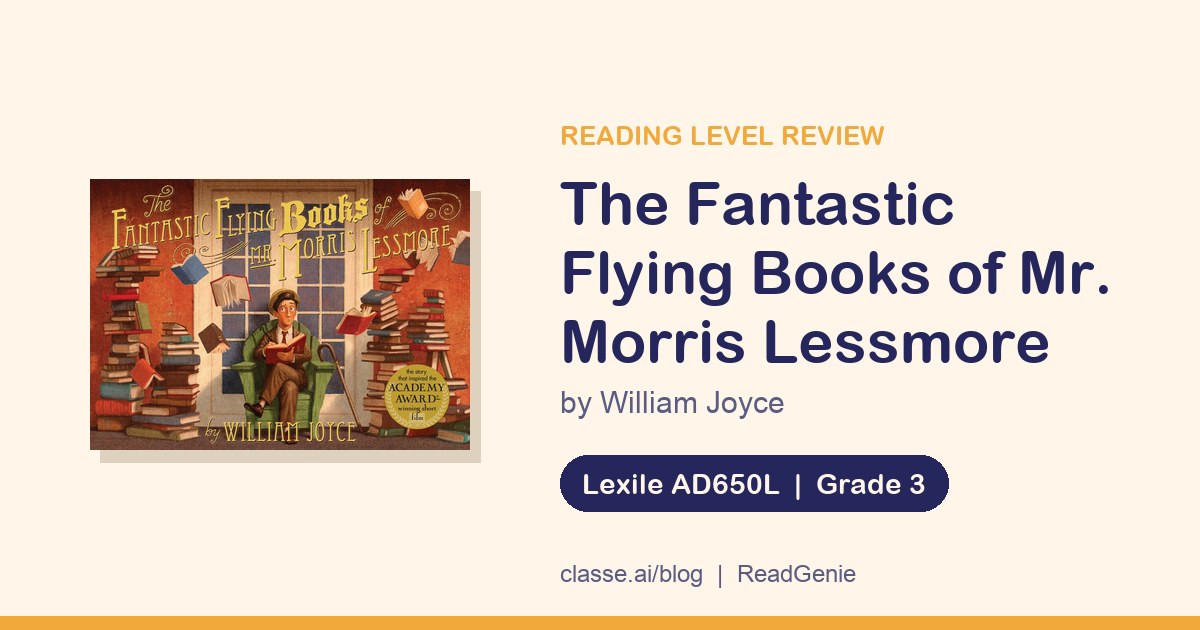
The Fantastic Flying Books of Mr. Morris Lessmore by William Joyce has a Lexile measure of AD650L and an AR (ATOS) book level of 3.7, worth 0.5 AR points. Most children can read it on their own around 3rd grade, and kids as young as 4 enjoy it as a read-aloud. For a struggling reader it works best as a shared read. The book is short and the paintings tell the story, but words like happenstance and squadron are hard to sound out.
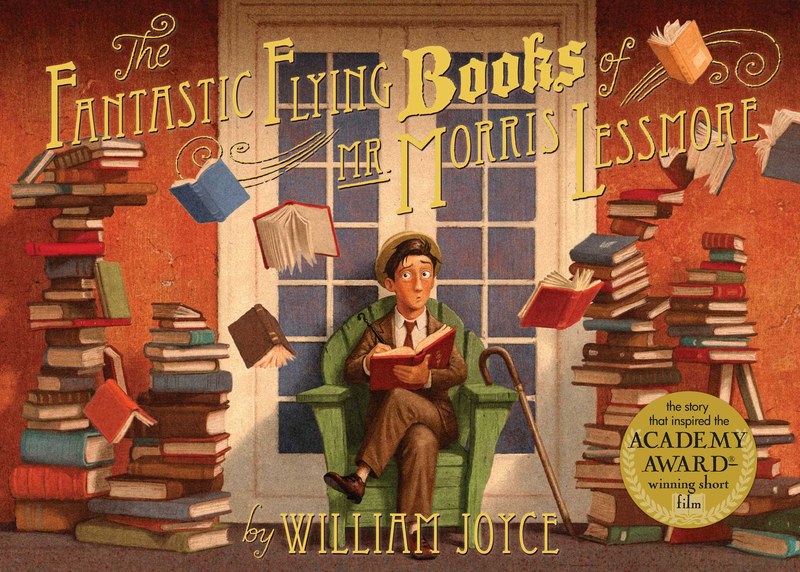
Morris Lessmore loves words and writes his own life story, one page at a time. Then a great storm scatters his words, his house and his whole town. As he wanders, he meets a lady carried along by flying books, and one of them leads him to a library where the books are alive. Morris spends his life caring for them. The story began as an animated short film by William Joyce and Brandon Oldenburg that won the Academy Award for Best Animated Short, and the book came out the year after. Kids who love books tend to love this one.
The Fantastic Flying Books of Mr. Morris Lessmore reading level at a glance
| Lexile measure | AD650L (Simon & Schuster) Also listed as 650L |
|---|---|
| ATOS / AR book level | 3.7 (TeachingBooks) |
| AR points | 0.5 (TeachingBooks) |
| Flesch Reading Ease (0-100) | 84.3 ReadGenie estimate |
| Flesch-Kincaid grade | 3.6 ReadGenie estimate |
| Interest level | Grades Pre-K to 3 (ages 4 to 8) (Simon & Schuster) Also listed as Grades PK-6 |
| Approximate grade band | Grade 3 (ages 8-9) ReadGenie |
| Length | 56 pages, ~728 words |
| Format | Picture book |
| Good for struggling readers? | ★★★★★ 3/5 |
| Dyslexia-friendly rating | ★★★★★ 4/5 |
We couldn't find a published Guided Reading level, DRA level or grade level equivalent for this book.
Is The Fantastic Flying Books of Mr. Morris Lessmore a struggle for your child right now? ReadGenie gives struggling readers short daily Orton-Gillingham practice at home, out loud, with help on the exact sound they missed.
Try ReadGenie and get this book freeScores checked 2026-11-20. Different leveling systems don't always agree, so we show each published value with its source and mark our own estimates. Links to every source are under How we rate books.
What grade level is Morris Lessmore?
The Fantastic Flying Books of Mr. Morris Lessmore reads at about a 3rd grade level. A typical child can read it independently somewhere in 3rd grade, and a younger child can follow every word when a grown-up reads it aloud.
The AD in front of the Lexile stands for adult-directed. MetaMetrics adds that code to picture books that are usually read to children before children read them alone. So the 650L is the difficulty of the words and sentences, and the AD is a reminder that the book was built for reading together first. A 650L text sits in the range many charts give for 3rd grade.
The AR level of 3.7 points to the same place. It means the text is about as hard as what a typical student reads in the seventh month of 3rd grade. Our own readability check on the opening pages landed in the same spot, a little past the start of 3rd grade, with sentences that average between 8 and 9 words.
Here is where the numbers can mislead. The publisher lists the book for ages 4 to 8 and grades Pre-K to 3, because that is who it is read to. That is the listening level. The reading level is higher. A 1st grader will love hearing it, but very few 1st graders can read it on their own. We didn't find a published Guided Reading or DRA level for this book.
At 0.5 AR points and roughly 730 words across 56 pages, it is short. A confident 3rd grader can read the whole thing in about ten minutes.
Is Morris Lessmore good for struggling readers?
It can be, with support. We rate it 3 out of 5 for struggling readers. The length and the pictures help a lot. The vocabulary is the hard part.
Start with what works. Most spreads hold only a few sentences, set apart from the art on plain cream pages. The type is clear and there is plenty of space around it. Every event in the story shows up in a large painting, so a child who stumbles on a word can look over and see what is going on. When the storm hits, the color drains out of the pictures, and it slowly returns as Morris finds the books again. Even a child who misses some words can follow the story through the art.
The look of the book is a real plus for older kids. The paintings feel like stills from a film, and Morris is a grown-up, not a cartoon animal. Nothing about it says baby book, so a 4th or 5th grader who reads at a 2nd or 3rd grade level can carry it without feeling embarrassed.
The catch is the language. William Joyce writes in a literary, slightly old-fashioned voice. In the first few spreads alone a reader meets orderly, sorrows, happenstance, festive and squadron. Some sentences tuck a phrase in the middle, set off by commas, which makes a struggling reader lose the thread. A child reading below grade level will hit several of these per page.
There are a few things to watch for.
- Long literary words show up on almost every page and can't be guessed from phonics alone
- Some sentences are long, with a phrase tucked into the middle
- The story is quiet and reflective, so kids who need action may drift
- The ending is bittersweet, which some children find sad
For a 3rd grader reading on grade level, it is a lovely independent read. For a child who is behind, read it together, with you taking the long sentences and your child taking the short ones. Watching the short film first helps even more.
Is Morris Lessmore good for kids with dyslexia?
Overall: ★★★★★ 4/5
| Factor | Score | Why |
|---|---|---|
| Sentence length | 3/5 | Sentences average about 8 or 9 words, and a few run longer with commas in the middle. |
| Vocabulary load | 2/5 | Literary words such as happenstance, squadron, festive and sorrows show up on almost every spread. |
| Decodability | 3/5 | Many short regular words, but names like Morris Lessmore and words like through, knew and which need to be known by sight. |
| Text density and layout | 4/5 | A few centered lines of clear serif type on plain parchment pages, set apart from the art. |
| Pictures that carry meaning | 5/5 | Full-page paintings show every event, and the color coming back into the pictures tracks the story. |
| Chapter length | 5/5 | The whole book reads in about ten minutes, and each spread makes a natural stopping point. |
| Engagement for reluctant readers | 4/5 | Flying books and a living library pull kids in, though the pace is calm and reflective. |
| Audiobook / read-along support | 2/5 | Learning Ally lists it for members, and the animated short film tells the same story. We didn't find a standard retail audiobook. |
We rate it 4 out of 5 for dyslexic readers, mostly because of the layout and the pictures. The vocabulary pulls the score down, and there isn't a standard audiobook to lean on.
Layout is the strongest point. The text sits in a few centered lines on plain pages, away from the busy parts of the paintings. There are no speech bubbles, no handwritten fonts and no words wrapped around art. A dyslexic child can keep their place on the line without much trouble.
Pictures come next. Almost every sentence has a picture beside it that shows what the sentence says. That gives a dyslexic reader a way to check their reading. If they read flying and the picture shows books with wings, they know they got it right.
The words are the hardest factor. Many of the short words are regular, like bit, wind, page and life. But the story leans on long, rare words and on the names Morris and Lessmore, which come up again and again. Words like through, knew and which also appear often and don't follow the rules a beginner knows. Teaching a handful of these before reading makes a big difference.
On audio, we didn't find a retail audiobook. Learning Ally, a library for students with reading disabilities including dyslexia, lists the book for its members. The animated short film tells the same story with music and pictures, and watching it first gives a dyslexic child the whole plot before they face the print.
Words and phonics patterns to practice first
Morris Lessmore is a good book for a child who knows short vowels, silent e and the common vowel teams and is ready to tackle longer words in a real story.
Closed syllables with short vowels show up in bit, habit, upset, wind, drift and festive. Habit and upset are good words for practicing how to split a word between two consonants or after a short vowel.
Silent e words like life, page, write, hope and came are everywhere. They are a quick review before reading.
R-controlled vowels are worth a short lesson, with morning, orderly, darkened, after, wander and story. Orderly and darkened give a reader practice with two r-controlled syllables in one word.
Vowel teams and diphthongs appear in joys, day, way, blew, down and book. Remind your child that oy and ay usually come at the end of a word, and oi and ai in the middle.
The -ed ending makes three different sounds in this book. Looked and hoped end in a t sound, loved and pulled end in a d sound. Darkened is a nice one to split slowly.
Pre-teach these words before reading: Morris, Lessmore, happenstance, squadron, sorrows, orderly, festive, through, knew and which. Happenstance is a fun one to break into hap, pen and stance. If your child keeps tripping on longer words like these, short daily Orton-Gillingham practice with ReadGenie on syllable division and r-controlled vowels builds exactly the skills this book asks for.
How to read Morris Lessmore with your child
Watch the short film together first. It runs about 15 minutes, and knowing the story means your child can spend their energy on the words instead of on figuring out what happens.
Before you read, say the harder words out loud and point to the picture that explains each one. The festive squadron is a lot less scary once a child has seen the line of flying books.
Read the book aloud once. On the second read, take turns. Your child reads the short pages, some of which are just a few words, and you read the long ones. By the third read, most kids want to take more of the pages.
The storm spread is a natural place to stop if your child is tired. Ask what Morris lost and how he might feel. It keeps them thinking about the story between sessions.
After you finish, have your child start a little book about their own life, the way Morris does. One sentence a day is plenty. It turns the book into writing practice and gives a reluctant reader a reason to care about words.
Using Morris Lessmore in the classroom or tutoring
For teachers, it works as a 3rd grade read-aloud or as a shared-reading text for a small group reading around an AR level of 3.5. It is a natural fit for a vocabulary lesson on figuring out words from context and pictures, since the art explains most of the rare words. Pair the book with the film and have students compare how each one tells the story. It also supports a lesson on theme, because the message about stories living on is clear without ever being stated outright.
For tutors, the excerpt words give you a ready-made r-controlled vowel lesson with morning, orderly and darkened, and an -ed sort with looked, loved and darkened. Teach Morris and Lessmore as names before reading, then have the student divide happenstance into syllables. Let them read the short one-line pages aloud and read the longer pages together, so they stay fluent. Two or three spreads per session is plenty.
Content notes for parents
A storm wrecks Morris's town, and the film's makers have said Hurricane Katrina was part of the inspiration. Morris grows old over the course of the story and flies away at the end, and a young girl finds the book he wrote. Many readers take that as a gentle picture of dying, and some children ask about it. There are no villains, no violence and no rude humor.
Should your child read it?
If your child is in 3rd grade and reading on grade level, hand it over. They can read it alone in one sitting. If your child is younger or behind, read it together, and expect to explain a few big words along the way. For an easier book about loving books, try The Incredible Book Eating Boy. When Morris Lessmore feels easy, The Invention of Hugo Cabret is a great next step, a long novel told half in pictures.
Make the next book easier
Short daily sessions of reading, spelling and handwriting practice, built with Orton-Gillingham teachers. It works alongside tutoring and school support. The first 7 days are free. Join today and we'll mail your child The Fantastic Flying Books of Mr. Morris Lessmore for free.
Try ReadGenie and get your free bookStarts with a free 7-day trial. Book mailed after your first paid month. US only, one per family.
FAQ
What is the AR level of The Fantastic Flying Books of Mr. Morris Lessmore?
It has an AR (ATOS) book level of 3.7 and is worth 0.5 AR points. That puts it around the seventh month of 3rd grade, and at about 730 words most kids can read it and take the quiz in one day.
What is the Morris Lessmore Lexile level?
The publisher lists it at AD650L. The AD means adult-directed, so the book is meant to be read aloud to young children first. The 650L part puts the text around a 3rd grade level.
What age is Morris Lessmore for?
Simon & Schuster lists it for ages 4 to 8 as a read-aloud. Most children can read it on their own around ages 8 and 9, once they are in 3rd grade.
Is The Fantastic Flying Books of Mr. Morris Lessmore a sad book?
It is bittersweet rather than sad. Morris grows old and flies away at the end, and many readers see that as a gentle picture of dying, but the book closes on a new reader finding his story.
Is the book the same as the Oscar-winning short film?
They tell the same story. The short film by William Joyce and Brandon Oldenburg won the Academy Award for Best Animated Short, and the picture book followed. Watching the film first is a good way to help a struggling reader with the book.
Get The Fantastic Flying Books of Mr. Morris Lessmore free
ReadGenie helps struggling readers improve their reading, spelling and handwriting in short daily sessions at home. Join and we'll mail your child this book for free.
Claim your free bookStarts with a free 7-day trial. Book mailed after your first paid month. US only, one per family.
What to read next
- The Incredible Book Eating Boy by Oliver Jeffers (easier). A funny, shorter picture book about loving books, with fewer hard words.
- Library Lion by Michelle Knudsen (similar). Another gentle library story with full-page art and a warm ending.
- The Numberlys by William Joyce (similar). Same author and same film-studio art style, a playful story about how the alphabet began.
- The Invention of Hugo Cabret by Brian Selznick (harder). A long novel told half in pictures, a next step for a child who loved the look of Morris Lessmore.
Browse all of our reading-level book reviews.
How we rate books
Lexile, ATOS (Accelerated Reader), Guided Reading and DRA levels come from the companies that own them and from publishers. We link to where we found each one, and when a level isn't published we say so. Anything marked "ReadGenie estimate" is our own call, not an official level. Flesch scores come from a short public excerpt when the publisher offers one. The struggling-reader and dyslexia-friendly ratings are our judgment, based on eight things (sentence length, vocabulary, decodability, page layout, pictures, chapter length, how gripping the story is, and audiobook support). Treat them as a starting point. The right book is one your child can read with about 95% accuracy and wants to keep reading.
Sources
- Simon & Schuster: The Fantastic Flying Books of Mr. Morris Lessmore (Lexile, grades, ages, page count, ISBN, publisher, publication date, interior spreads)
- TeachingBooks: The Fantastic Flying Books of Mr. Morris Lessmore (ATOS, AR points, AR quiz number, Lexile, word count, grades, Spanish edition, OverDrive sample link)
- OverDrive ebook sample (Flesch excerpt)
- Simon & Schuster LOOK interior spread (Flesch excerpt, layout)
- Reading Is Fundamental: The Fantastic Flying Books of Mr. Morris Lessmore (Lexile check (AD650L), ages)
- Wikipedia: The Fantastic Flying Books of Mr. Morris Lessmore (film) (Academy Award, Hurricane Katrina inspiration, film directors)
- Learning Ally: The Fantastic Flying Books of Mr. Morris Lessmore (audio format for members)