Big Nate Reading Level: Lexile GN500L, AR 3.1, Guided Reading S
Big Nate: In a Class by Himself is Lexile GN500L, AR level 3.1 and Guided Reading level S. The words are 3rd grade, the hero is in 6th grade, and that gap is why it works so well for kids who are behind in reading.

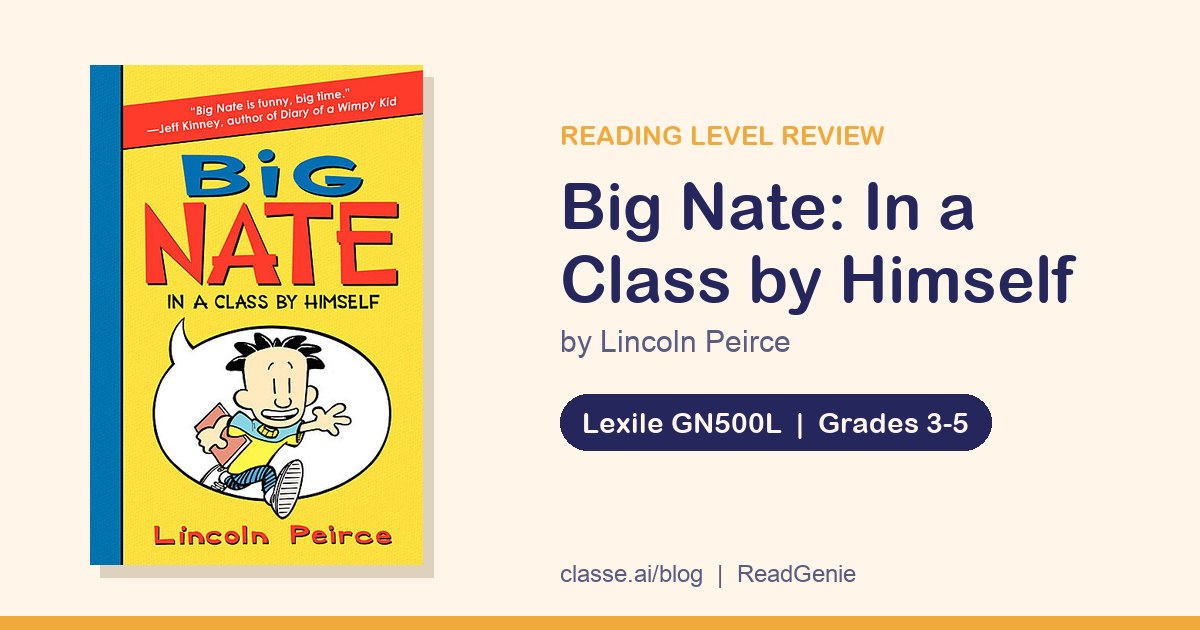
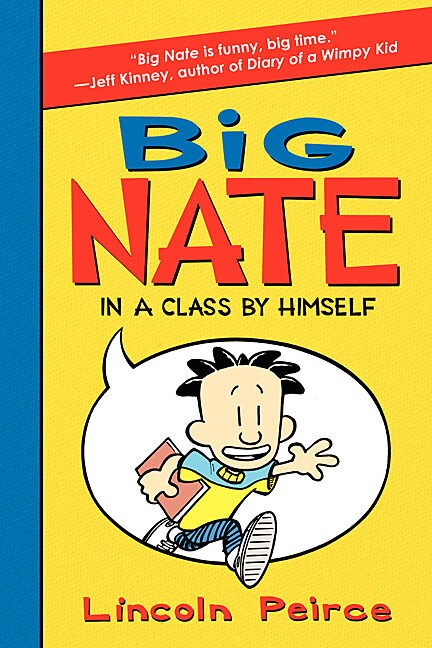
Big Nate: In a Class by Himself by Lincoln Peirce has a Lexile measure of GN500L, an AR (ATOS) book level of 3.1 and a Guided Reading level of S. The words and sentences sit at about a 3rd grade level, but the hero is a sixth grader and the humor is aimed at kids up to 7th grade. That gap makes it one of the best books we know for struggling readers in grades 3 to 6, especially kids who want to read Diary of a Wimpy Kid but find it too hard on their own.
Nate Wright is a sixth grader who is sure he is meant for great things. One morning a fortune cookie tells him he will be better than everyone else that day, and he sets out to prove it. Instead, every plan backfires, and by the final bell he has a detention from every one of his teachers. The book switches between Nate telling the story and comic strips, some of them drawn by Nate himself. Kids like it because Nate is loud, overconfident and very funny, and because the whole thing happens in one school day they already know by heart.
Big Nate: In a Class by Himself reading level at a glance
| Lexile measure | GN500L (Booksource) Also listed as 500L and 500L |
|---|---|
| ATOS / AR book level | 3.1 (TeachingBooks) |
| AR points | 2 (TeachingBooks) |
| Guided Reading (Fountas & Pinnell) | S (ABDO) |
| Interest level | Grades 3-7 (Booksource) |
| Approximate grade band | Grades 3-5 (ages 8-11) ReadGenie |
| Length | 224 pages, ~13,810 words |
| Format | Middle grade novel |
| Good for struggling readers? | ★★★★★ 5/5 |
| Dyslexia-friendly rating | ★★★★★ 4/5 |
We couldn't find a published DRA level, grade level equivalent or Flesch score for this book.
Scores checked 2026-11-13. Different leveling systems don't always agree, so we show each published value with its source and mark our own estimates. Links to every source are under How we rate books.
Is your child working hard and still getting stuck on words?
ReadGenie helps struggling readers improve their reading, spelling and handwriting with Orton-Gillingham practice at home. Your child reads out loud, the app listens, and it helps with the exact sound they missed. Join today and we'll mail your child Big Nate: In a Class by Himself for free.
Try ReadGenie and get your free bookStarts with a free 7-day trial. Book mailed after your first paid month. US only, one per family.
What grade level is Big Nate?
By the text, Big Nate is a 3rd grade book. An AR level of 3.1 means the words and sentences are about as hard as what a typical student reads at the start of 3rd grade. The Lexile of 500L lands in the same place. The GN in front of the number means MetaMetrics, the company behind Lexile, treats the book as a graphic novel, because the comics carry part of the story. So the number tells you about the words, and the pictures make the book easier still.
Guided Reading level S is higher. Most schools expect level S around the end of 4th grade. That is not a mistake. Fountas and Pinnell levels look at more than word difficulty. They also weigh how much a reader has to figure out between the lines, and Big Nate is full of jokes that only work if you notice that Nate is wrong about himself. A child can decode every word on the page and still miss why it's funny.
Put together, most kids can read Big Nate on their own somewhere in grades 3 to 5. A 3rd grader will manage the words but may need an adult to point out some of the jokes. A 5th or 6th grader reading a year or two behind gets a book that is easy to decode and still feels like it was written for their age.
Booksource lists an interest level of grades 3 to 7. The book is about 14,000 words, which is short for a 224-page novel because so much of the space goes to comics, and it is worth 2 AR points.
Is Big Nate good for struggling readers?
Yes. We give it 5 out of 5 for struggling readers, our top rating, and it earns it the same way the best hi-lo books do.
The level is low and the look is not. Nate is in middle school, the cover looks like something a 6th grader would carry, and nothing about it says baby book. A 10-year-old reading at a 2nd or 3rd grade level can read it in class without anyone thinking twice.
The format helps a lot too. Chapters are a few pages each, and comic strips break up the text every few pages, so a child is never faced with a long run of print. The comics aren't decoration. They tell parts of the story that the text skips, so a slower reader gets a break and still moves the plot forward. And because the whole book covers one day, there are no time jumps or flashbacks to keep track of.
There are a few things to watch.
- The Guided Reading level is higher than the Lexile and AR level, because the jokes and Nate's bragging take some reading between the lines.
- There are a lot of names. Francis, Teddy, Gina, Jenny and several teachers all show up in the first few chapters.
- Nate mouths off to teachers and calls one of them by a monster nickname, which some parents will want to talk about.
It is a great fit for kids in grades 3 to 6 who are a year or two behind, kids who love comics, and Wimpy Kid fans who keep stalling in that book. It is less of a fit for a child still reading around Guided Reading levels J to M. For them, Dog Man or Fly Guy is a gentler start, and Big Nate can come a few months later.
Is Big Nate good for kids with dyslexia?
Overall: ★★★★★ 4/5
| Factor | Score | Why |
|---|---|---|
| Sentence length | 4/5 | Nate talks in short, punchy sentences, and the comic panels use only a few words each. |
| Vocabulary load | 4/5 | Mostly everyday school words, with a few longer ones like detention, fortune and social studies. |
| Decodability | 3/5 | Regular words for the most part, but names, slang and sound effects in the comics need some help. |
| Text density and layout | 4/5 | Short blocks of text in a large font with lots of white space. The comic lettering is all capitals, which some dyslexic readers find harder. |
| Pictures that carry meaning | 4/5 | Comic strips and drawings show up every few pages and carry many of the jokes. |
| Chapter length | 5/5 | Chapters are a few pages each, a natural stopping point every five minutes or so. |
| Engagement for reluctant readers | 5/5 | Fast, silly and set in a school kids recognize, with a running question of how many detentions Nate will get. |
| Audiobook / read-along support | 4/5 | HarperAudio's unabridged recording read by Fred Berman runs about 1 hour 50 minutes and is in many public libraries. |
We give it 4 out of 5 on our dyslexia-friendly scale. Its strongest scores are for chapter length and engagement. Chapters are short enough to finish in one sitting, about five minutes each for most kids, and the question of how many detentions Nate will collect keeps kids turning pages.
The layout is friendly. Nate's narration is set in a large font in short blocks with plenty of white space around it. The comic panels are the one thing to watch. Like most comics, their lettering is all capital letters. Some dyslexic readers find all-caps harder, because every word turns into the same rectangle shape and the tall and short letters that help with recognition disappear. If your child slows down a lot in the panels, read those parts aloud together and let them carry the regular text.
Audio support is good. HarperAudio publishes an unabridged audiobook read by Fred Berman that runs just under two hours, and many public libraries carry it. Because the book is so short, a child can listen to the whole thing over a weekend while following along in print, then go back and read favorite chapters on their own. There is also a Spanish edition for bilingual families.
Decoding is mostly straightforward. Most words are everyday school words. The harder ones are names, a handful of longer words like detention and assignment, and the sound effects and slang in the comics, which don't follow any rules at all.
Words and phonics patterns to practice first
If your child is in an Orton-Gillingham or structured literacy program, Big Nate works well once closed syllables, silent e and the most common vowel teams are solid. These patterns come up often.
- Closed syllables with short vowels, like class, lunch, test, gym and desk. Gym is worth pointing out, since the y says the short i sound.
- Silent e, as in Nate, grade, joke, smile, late and note. The hero's own name is a silent e word, which kids remember.
- R-controlled vowels in teacher, fortune, first, sister, partner and turn.
- Vowel teams, as in cookie, team, need, school and read. Great is the odd one out, since ea says the long a sound there.
- The -tion suffix in detention, attention, question and vacation. Detention shows up all through the book, so it is the best word to teach first.
- Longer words to chunk, such as surpass, cartoonist, homework, basketball and assignment.
The words to pre-teach are Wright, Francis, Teddy, Gina, Godfrey, fortune, detention, surpass, science and genius. Wright has a silent w and a silent gh, so it's worth showing next to write and right. Science and genius both have a soft c or g that trips kids up. Five minutes on these before chapter 1 makes the opening pages much smoother.
ReadGenie practices patterns like these every day. Your child reads aloud, the app listens, and it helps with the exact sound they missed, so words like detention and fortune feel familiar by the time they meet them in the book.
How to read Big Nate with your child
Start with the names. Say Nate Wright, Francis, Teddy, Gina, Jenny and Mrs. Godfrey out loud together and talk about who each person is as they appear. A quick list on a sticky note inside the cover helps.
Let the comics count as reading. When you reach a strip, ask your child what happened in it and what it adds that the text didn't say. Some of the best jokes in the book are in the pictures, and talking about them builds the same understanding a teacher looks for at level S.
Keep score as you go. Since the whole story happens in one day, it's fun to keep a tally of Nate's detentions and which teacher gave each one. It gives a reluctant reader a reason to keep going and is a simple way to check that they're following the plot.
Two or three short chapters a night will get you through the book in about two weeks. If your child is flying, let them read more. If a night is hard, play a chapter of the audiobook while they follow along and then have them read the next chapter to you.
Using Big Nate in the classroom or tutoring
For teachers, Big Nate fits a Guided Reading level S group that needs work on inference and humor while keeping decoding light. Nate's fortune cookie is a natural prediction anchor. After each class period in the story, ask whether Nate is beating everyone yet and how he will react. Pre-teach detention, fortune and surpass before chapter 1. Because Nate is a cartoonist, the book pairs well with a short writing task where students draw a comic strip about their own worst school day.
For tutors, the -tion words give a ready-made suffix lesson tied to the story. Have the student read Nate's narration aloud and let the comic panels be a short break between chapters. The all-caps lettering in the comics is also a good check on whether a student is truly decoding or leaning on word shape.
Content notes for parents
Big Nate is silly, not mean-spirited, but Nate is no model student. He talks back to teachers, gives one of them a monster nickname and earns detention after detention, all played for laughs. There's teasing between classmates and from Nate's older sister Ellen. There's no swearing, no violence and no romance beyond Nate's crush on a classmate named Jenny. Many families use Nate's day as an easy way to talk about what happens when you think you're always right.
Should your child read it?
If your child is in 3rd to 6th grade, likes comics and gets discouraged by long chapter books, Big Nate is a great place to start. It's especially good for an older child who is behind in reading, because the words are easy and the book still feels grown up. If your child reads around Guided Reading levels J to M, start with Dog Man or Fly Guy and come back to Nate later. When Big Nate gets easy, Diary of a Wimpy Kid is the natural next step.
Make the next book easier
Short daily sessions of reading, spelling and handwriting practice, built with Orton-Gillingham teachers. It works alongside tutoring and school support. The first 7 days are free. Join today and we'll mail your child Big Nate: In a Class by Himself for free.
Try ReadGenie and get your free bookStarts with a free 7-day trial. Book mailed after your first paid month. US only, one per family.
FAQ
What age is Big Nate for?
Big Nate is usually read by kids from about 8 to 12. The text is easy enough for most 3rd graders, and the middle-school hero keeps it appealing up to about 7th grade, so it suits older kids who are behind in reading too.
What is the AR level of Big Nate: In a Class by Himself?
The first Big Nate novel has an ATOS book level of 3.1 and is worth 2 AR points. That means the text is about as hard as what a typical student reads at the start of 3rd grade.
What is the Lexile level of Big Nate?
Book 1 has a Lexile measure of GN500L. The GN means it is measured as a graphic novel, since the comic strips tell part of the story.
What Fountas and Pinnell level is Big Nate?
The first book is listed at Guided Reading level S, which most schools expect near the end of 4th grade. It's higher than the Lexile because F&P also weighs the humor and inference the book asks for.
Is Big Nate easier than Diary of a Wimpy Kid?
Yes. Big Nate's text is listed well below Diary of a Wimpy Kid's on both Lexile and AR, and the chapters are shorter. Many kids read Big Nate first and move to Greg Heffley's journal when it gets easy.
Is Big Nate good for a struggling reader in 5th grade?
It's one of the best choices. The words sit at a 3rd grade level, but Nate is in 6th grade and the book doesn't look young, so a 5th grader can read it on their own without feeling embarrassed.
Get Big Nate: In a Class by Himself free
ReadGenie helps struggling readers improve their reading, spelling and handwriting in short daily sessions at home. Join and we'll mail your child this book for free.
Claim your free bookStarts with a free 7-day trial. Book mailed after your first paid month. US only, one per family.
What to read next
- Dog Man by Dav Pilkey (easier). A full graphic novel at a lower level, for kids not ready for Nate's mix of text and comics.
- Diary of an Awesome Friendly Kid: Rowley Jefferson's Journal by Jeff Kinney (easier). A short, cheerful doodled journal that makes a good warm-up.
- The Adventures of Captain Underpants by Dav Pilkey (similar). Same school pranks and kid-made comics, with even more pictures.
- The Last Kids on Earth by Max Brallier (harder). Heavily illustrated and just as funny, with a monster adventure plot.
- Diary of a Wimpy Kid by Jeff Kinney (harder). The next step up, with the same school humor and cartoons but harder text.
Browse all of our reading-level book reviews.
How we rate books
Lexile, ATOS (Accelerated Reader), Guided Reading and DRA levels come from the companies that own them and from publishers. We link to where we found each one, and when a level isn't published we say so. Anything marked "ReadGenie estimate" is our own call, not an official level. Flesch scores come from a short public excerpt when the publisher offers one. The struggling-reader and dyslexia-friendly ratings are our judgment, based on eight things (sentence length, vocabulary, decodability, page layout, pictures, chapter length, how gripping the story is, and audiobook support). Treat them as a starting point. The right book is one your child can read with about 95% accuracy and wants to keep reading.
Sources
- TeachingBooks: Big Nate in a Class by Himself (Lexile (conflict), ATOS, AR points, word count, grades, Spanish edition)
- Booksource: Big Nate: In A Class By Himself (Lexile, AR level, AR points, interest level, ISBN)
- ABDO: Big Nate: In a Class by Himself (Spotlight library edition) (Guided Reading, AR interest level, page count, Lexile (conflict))
- Open Library: Big Nate in a Class by Himself (editions, ISBNs, first publication year)
- AudioFile: Big Nate, read by Fred Berman (audiobook)
- OverDrive: In a Class by Himself (audiobook) (audiobook length and publisher)