Diary of a Wimpy Kid Reading Level: Lexile, AR and F&P Guide
Diary of a Wimpy Kid is Lexile 950L, AR level 5.2 and Guided Reading level T, so on paper it's a 5th grade book. The cartoons make it feel easier than that. Here's how it works for reluctant, struggling and dyslexic readers.

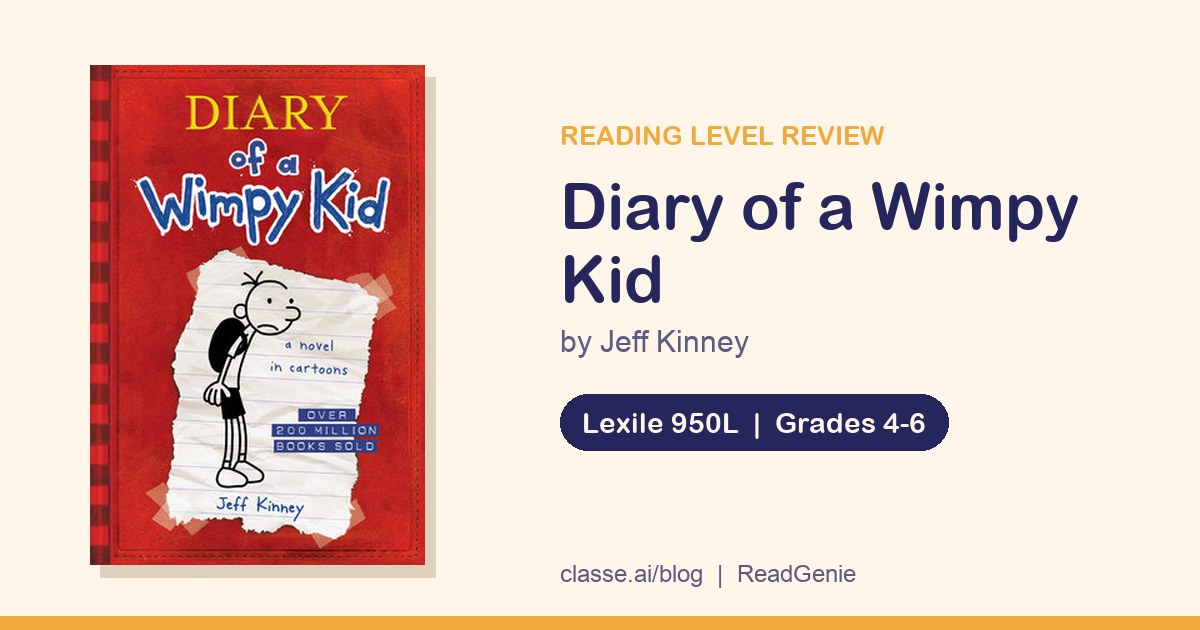
Diary of a Wimpy Kid by Jeff Kinney has a 950L Lexile measure, an AR (ATOS) book level of 5.2 and a Guided Reading level of T. On paper that makes it a 5th grade book, but the cartoons on nearly every page carry so many of the jokes that plenty of 3rd and 4th graders read it too. For reluctant readers in grades 4 to 6 it is one of the best books there is. A child reading well below grade level, though, may get stuck on the longer sentences and the sarcasm, and will do better sharing it with an adult or the audiobook.
Greg Heffley is starting middle school, and his mom has given him a journal. He insists it is not a diary. Over the school year, from September to June, he writes about his plans to become popular, and almost every plan goes wrong. His best friend Rowley usually ends up paying for it. The pages look like a real notebook, with lined paper, handwritten-style text and Greg's stick-figure cartoons, and that look is a big part of why kids who avoid books will pick this one up.
Diary of a Wimpy Kid reading level at a glance
| Lexile measure | 950L (TeachingBooks) |
|---|---|
| ATOS / AR book level | 5.2 (TeachingBooks) |
| AR points | 3 (TeachingBooks) |
| Guided Reading (Fountas & Pinnell) | T (Novel Units (ECS Learning Systems), Diary of a Wimpy Kid Teacher's Guide) |
| Interest level | Ages 8-12 (Wimpy Kid official site) |
| Approximate grade band | Grades 4-6 (ages 9-12) ReadGenie |
| Length | 224 pages, ~19,784 words |
| Format | Middle grade novel |
| Good for struggling readers? | ★★★★★ 4/5 |
| Dyslexia-friendly rating | ★★★★★ 4/5 |
We couldn't find a published DRA level, grade level equivalent or Flesch score for this book.
Scores checked 2026-11-02. Different leveling systems don't always agree, so we show each published value with its source and mark our own estimates. Links to every source are under How we rate books.
Is your child working hard and still getting stuck on words?
ReadGenie helps struggling readers improve their reading, spelling and handwriting with Orton-Gillingham practice at home. Your child reads out loud, the app listens, and it helps with the exact sound they missed. Join today and we'll mail your child Diary of a Wimpy Kid for free.
Try ReadGenie and get your free bookStarts with a free 7-day trial. Book mailed after your first paid month. US only, one per family.
What grade level is Diary of a Wimpy Kid?
By the numbers, Diary of a Wimpy Kid is a 5th grade book. An AR level of 5.2 means the text is about as hard as what a typical student reads in the second month of 5th grade. A Lexile of 950L sits near the top of the range most schools expect in 4th and 5th grade, so the words and sentences are harder than many parents expect from a book full of doodles.
Guided Reading level T usually lines up with the middle of 5th grade. If your child's teacher says they read at level Q, R or S, this book will be a stretch alone but very doable with help. At T and above, most kids can read it on their own.
So why do so many younger kids read it? The pictures. Kinney draws a cartoon on almost every page, and a lot of the time the drawing is the punch line. A 3rd grader can follow the story and laugh at the jokes even when some of the words are over their head. That is real reading progress, but it's worth knowing that a child who loves the series may still need help with a harder chapter book that has no pictures.
The publisher's site gives ages 8 to 12. The book is only about 20,000 words, which is short for its level, and it's worth 3 AR points. The series gets a little harder as it goes. Later books like The Ugly Truth and Diper Överlöde are listed at higher Lexile and AR levels than book 1, so book 1 is the easiest place to start.
Is Diary of a Wimpy Kid good for struggling readers?
Yes, for most kids. We give it 4 out of 5 for struggling readers.
The format does a lot of the work. There are no long chapters. The book is a run of dated journal entries, most a few pages long, so a child can stop at almost any point without losing their place in the story. Every page has white space and a drawing, so nothing looks like a wall of text. And it doesn't look like a school book or a little kid's book. A 6th grader reading two years behind can carry it around without anyone noticing.
The humor is the other big draw. Greg is funny, a little rotten and very honest about how embarrassing middle school is. Kids who say they hate reading often laugh out loud at it, and a child who finishes one has 20 more books in the series waiting.
There are a few things that make it harder than it looks.
- The text level is high for a book that looks this friendly. Some sentences run long to set up a joke.
- Much of the humor is sarcasm. Greg often says the opposite of what he means, and literal readers can miss it.
- The font imitates handwriting on lined paper, which some dyslexic readers find harder than plain print.
- Greg is not a nice friend to Rowley, which some parents will want to talk about.
It fits best for 4th to 6th graders reading a little below grade level, kids who love comics, and kids who need one book to finally click. It is less of a fit for children still reading at Guided Reading levels J to M. For them, Dog Man or Rowley's own spin-off journal is a gentler start.
Is Diary of a Wimpy Kid good for kids with dyslexia?
Overall: ★★★★★ 4/5
| Factor | Score | Why |
|---|---|---|
| Sentence length | 3/5 | Greg's voice is chatty, with a mix of short punch lines and longer sentences that wind up a joke. |
| Vocabulary load | 3/5 | Mostly everyday middle-school words, with some longer ones like popularity, wrestling and obviously. |
| Decodability | 3/5 | Plenty of regular words, but also names, slang and irregular spellings a struggling reader will need help with. |
| Text density and layout | 4/5 | Short blocks of text on ruled notebook pages with lots of white space. The font imitates handwriting, which some dyslexic readers find harder. |
| Pictures that carry meaning | 4/5 | Cartoons on almost every page show the action and often deliver the punch line. |
| Chapter length | 4/5 | No long chapters. The book is a run of dated entries, most a few pages long. |
| Engagement for reluctant readers | 5/5 | Fast, funny and about school life kids recognize, which pulls reluctant readers from page to page. |
| Audiobook / read-along support | 4/5 | Recorded Books publishes an unabridged audiobook read by Ramón de Ocampo, held by many public libraries. |
We give it 4 out of 5 on our dyslexia-friendly scale. Its best scores are for engagement, visual support and layout. The cartoons show what's happening on almost every page, so a child who decodes slowly can use the picture to check their understanding. The text sits in short blocks with lots of space around it, and no page is crowded.
The font is the one thing to watch. Kinney's books are set in a typeface that looks like a kid's handwriting on lined notebook paper. Most kids like it because it feels like a real diary. A few dyslexic readers find handwriting-style letters harder to tell apart than a clean print font. If your child seems to struggle more with this book than its level suggests, try the ebook, where you can sometimes change the font, or try the audiobook.
Audio support is good. Recorded Books publishes an unabridged audiobook read by Ramón de Ocampo, and many public libraries carry it. Listening while following along in the print book lets a dyslexic child keep up with the jokes and still see every word. There's also a Spanish edition for bilingual families.
Decoding sits in the middle. Most words are everyday school words, but names like Heffley and Fregley, and longer words like cafeteria and definitely, need to be broken into parts. A few minutes of pre-teaching before each sitting removes most of that friction.
Words and phonics patterns to practice first
If your child is in an Orton-Gillingham or structured literacy program, this book works best once silent e and vowel teams are solid and they have started breaking longer words into syllables. These patterns show up again and again.
- Closed syllables with short vowels, like Greg, kid, gym, mom, test and snack. Gym is a good one to point out, since the y says the short i sound.
- Silent e, as in game, joke, grade, smile, note and bike.
- R-controlled vowels in sister, party, birthday, mirror, torture and first.
- Vowel teams, as in cheese, team, seat, boat, week and road. The Cheese Touch alone gives plenty of practice.
- Suffixes like -tion and -ity in popularity, vacation, position and attention. Popularity is the word Greg cares about most, so it's worth learning early.
- Longer words to chunk, such as Halloween, wrestling, basically, journal, homework and cafeteria.
The words to pre-teach are Heffley, Rowley, Rodrick, Fregley, journal, diary, wrestling, Halloween, cafeteria and definitely. Rowley and Rodrick look alike at a glance, so practice them side by side. The w in wrestling is silent, and the ou in journal doesn't sound the way most kids expect. Once those are familiar, the rest of the book reads much more smoothly.
This is the kind of practice ReadGenie does each day. Your child reads aloud, the app listens, and it helps with the exact sound they missed, so a book like this one gets easier one pattern at a time.
How to read Diary of a Wimpy Kid with your child
Start by practicing the names. Greg Heffley, Rowley, Rodrick and Fregley come up on almost every page, and knowing them ahead of time saves a lot of stopping.
Let the cartoons count as reading. After an entry, ask your child what the drawing adds to the joke, or what Greg would say if he could see himself. Kids who skip the pictures miss half the humor, and kids who only read the pictures miss the other half.
When Greg says something he doesn't mean, stop and ask what he really thinks. For example, if he says something went great when it clearly didn't, ask how he actually feels. This is one of the best ways to build the skill of reading tone, which literal readers often need help with.
The book is split by month, which makes pacing easy. One month a week gets you through the whole school year in about ten weeks, at a relaxed pace. If your child is flying, let them go faster.
If the reading is a stretch, use the audiobook. Let your child listen to one entry while following along, then read the next one aloud to you. That keeps the story moving and still gives them real practice.
Using Diary of a Wimpy Kid in the classroom or tutoring
For teachers, this book fits a Guided Reading level T group, and the monthly sections make natural places to stop and check in. Greg is a great example of an unreliable narrator. Have students compare what he writes about himself with what the cartoons show, and talk about why the two don't always match. It also pairs well with a short journal-writing unit where students write and draw their own entries.
For tutors, it's good connected text once silent e and vowel teams are secure, since everyday words like game, cheese and team lean on both. Words like Halloween, cafeteria and popularity are perfect for syllable division practice. The short dated entries suit repeated reading. Have the student reread one entry for smoothness, then read the next one cold and compare.
Content notes for parents
Diary of a Wimpy Kid is funny, not dark, but Greg is not a role model. He tricks his best friend Rowley, takes advantage of him and lets him take the fall for some of his schemes. Teenagers chase Greg and Rowley on Halloween. There's name-calling, gross-out humor and a running joke about a piece of moldy cheese called the Cheese Touch, plus plenty of teasing from Greg's older brother Rodrick. There's no swearing and no romance. Many families use Greg's behavior as an easy way to talk about what a good friend does.
Should your child read it?
If your child is in 4th to 6th grade, loves comics and avoids chapter books, hand them this one. It is often the book that turns a reluctant reader into a kid who asks for the next one. If they read around Guided Reading levels J to M, start with Dog Man or Rowley's spin-off journal and come back in a few months. Kids who finish the series and want more of the same can move to Big Nate, Dork Diaries or The Last Kids on Earth, and those ready for a step up will enjoy Niagara Falls, or Does It?, a funny school story with a hero who has dyslexia.
Make the next book easier
Short daily sessions of reading, spelling and handwriting practice, built with Orton-Gillingham teachers. It works alongside tutoring and school support. The first 7 days are free. Join today and we'll mail your child Diary of a Wimpy Kid for free.
Try ReadGenie and get your free bookStarts with a free 7-day trial. Book mailed after your first paid month. US only, one per family.
FAQ
What age is Diary of a Wimpy Kid for?
The publisher lists it for ages 8 to 12. Most kids can read it on their own around age 10 or 11, but many 8- and 9-year-olds read it with help from the pictures. Older kids who are behind in reading enjoy it too, since it doesn't look young.
What is the AR level of Diary of a Wimpy Kid?
The first book has an ATOS book level of 5.2 and is worth 3 AR points. Later books in the series are listed a little higher, so book 1 is the easiest place to start.
What is the Lexile level of Diary of a Wimpy Kid?
Book 1 has a Lexile measure of 950L. Later books in the series are listed higher, so the series gets a little harder as it goes and book 1 is the gentlest start.
What Fountas and Pinnell level is Diary of a Wimpy Kid?
The first book is listed at Guided Reading level T, which most schools expect around the middle of 5th grade.
Is Diary of a Wimpy Kid too hard for a 3rd grader?
For many 3rd graders it's a stretch to read alone, because the text level is closer to 5th grade. The cartoons help a lot, though, so a strong 3rd grade reader or a child reading with an adult can enjoy it. If it's frustrating, try the audiobook or come back to it in a year.
Is Diary of a Wimpy Kid appropriate for young kids?
There's no swearing or romance, but Greg is selfish and often mean to his best friend, and there's a lot of gross-out and teasing humor. Most families find it fine from about age 8, especially if you talk about how Greg treats Rowley.
Get Diary of a Wimpy Kid free
ReadGenie helps struggling readers improve their reading, spelling and handwriting in short daily sessions at home. Join and we'll mail your child this book for free.
Claim your free bookStarts with a free 7-day trial. Book mailed after your first paid month. US only, one per family.
What to read next
- Dog Man by Dav Pilkey (easier). A full graphic novel at a lower level, for kids not yet ready for Greg's journal.
- Diary of an Awesome Friendly Kid: Rowley Jefferson's Journal by Jeff Kinney (easier). The same world told by Rowley, with simpler, sunnier writing.
- Big Nate: In a Class by Himself by Lincoln Peirce (similar). The same mix of text and comics and the same kind of school humor.
- Tales from a Not-So-Fabulous Life by Rachel Renée Russell (similar). Dork Diaries uses the same doodled diary format with a middle school girl as narrator.
- The Last Kids on Earth by Max Brallier (similar). Heavily illustrated and just as funny, with a monster adventure plot.
- Niagara Falls, or Does It? by Henry Winkler & Lin Oliver (harder). A funny school story whose hero has dyslexia, written by an author who has dyslexia.
Browse all of our reading-level book reviews.
How we rate books
Lexile, ATOS (Accelerated Reader), Guided Reading and DRA levels come from the companies that own them and from publishers. We link to where we found each one, and when a level isn't published we say so. Anything marked "ReadGenie estimate" is our own call, not an official level. Flesch scores come from a short public excerpt when the publisher offers one. The struggling-reader and dyslexia-friendly ratings are our judgment, based on eight things (sentence length, vocabulary, decodability, page layout, pictures, chapter length, how gripping the story is, and audiobook support). Treat them as a starting point. The right book is one your child can read with about 95% accuracy and wants to keep reading.
Sources
- TeachingBooks: Diary of a Wimpy Kid (Lexile, ATOS, AR points, word count, grades, Spanish edition)
- TeachingBooks: The Ugly Truth (series Lexile and ATOS range)
- TeachingBooks: Diper Överlöde (series Lexile and ATOS range)
- Novel Units: Diary of a Wimpy Kid Teacher's Guide (Guided Reading level)
- Wimpy Kid official site: Diary of a Wimpy Kid (ISBN, ages, formats, series list)
- Westchester Library System catalog: Diary of a Wimpy Kid audiobook (read by Ramón de Ocampo) (audiobook)
- Open Library (page count, ISBNs, first publication year)