Dog Diaries Reading Level: Lexile, AR Level and Age Guide
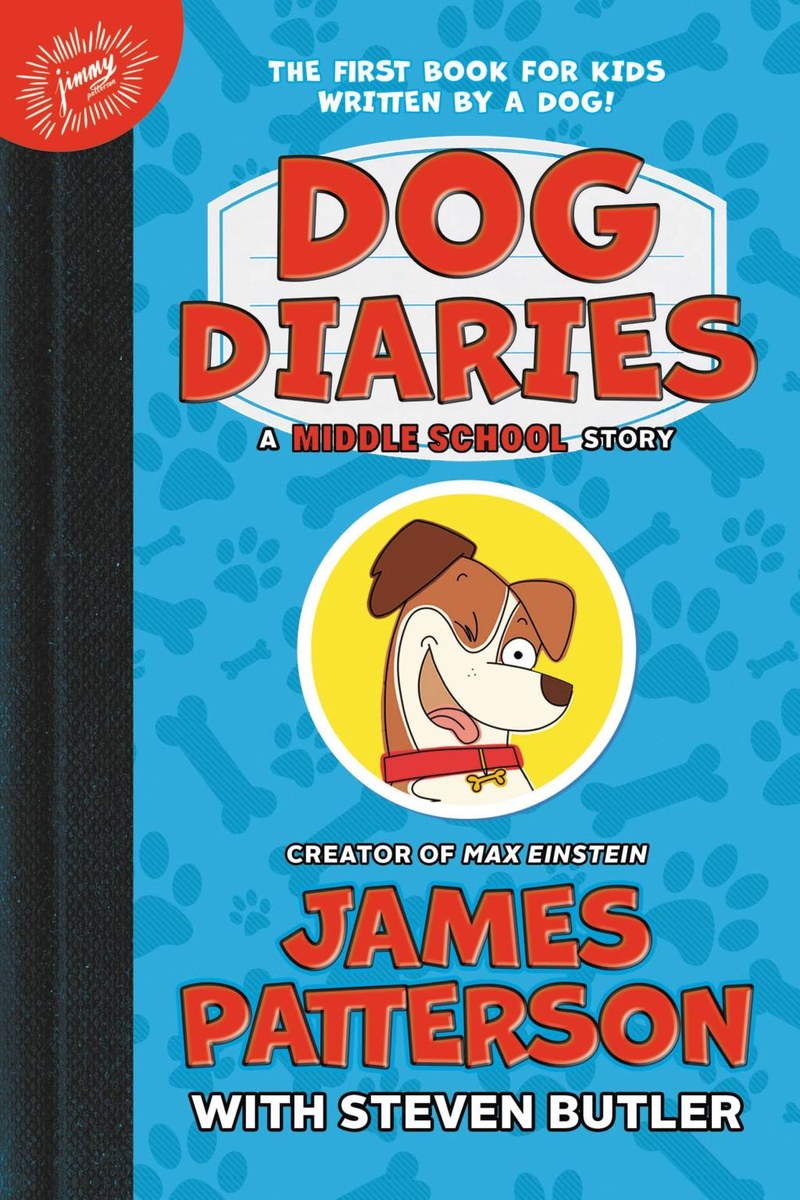
Dog Diaries by James Patterson is Lexile 760L and AR level 5.0, but its cartoons and short text make it a grades 3 to 5 read. Here's how it works for struggling readers and kids with dyslexia, and which words to practice first.

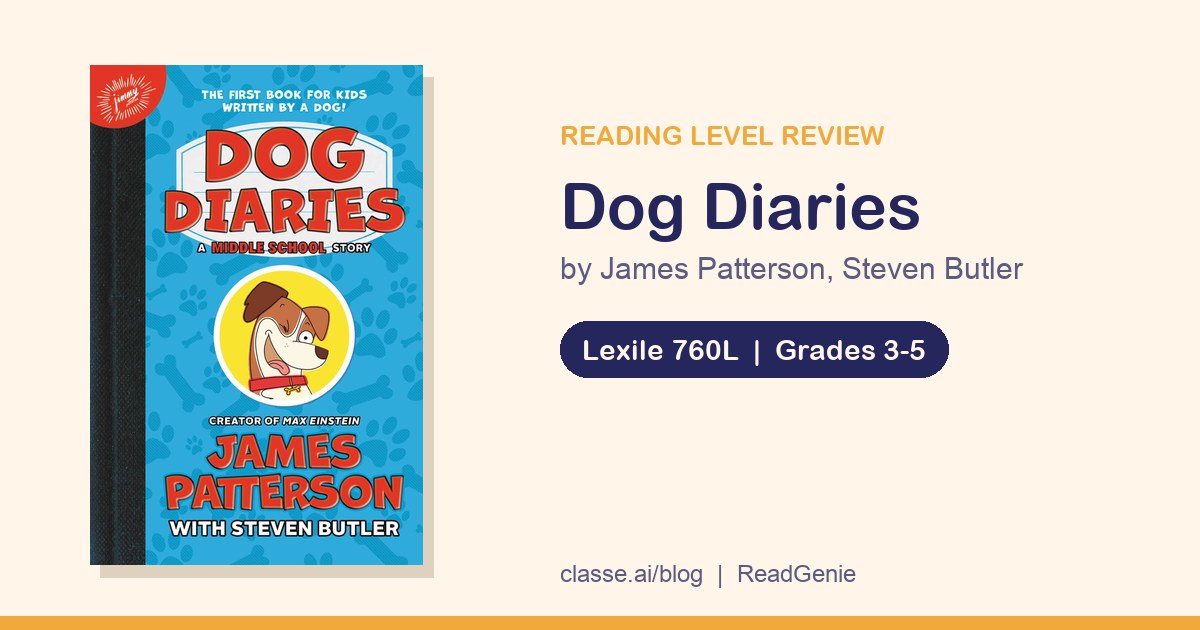
Dog Diaries by James Patterson and Steven Butler has a 760L Lexile measure and an AR (ATOS) book level of 5.0. Those numbers look like a 5th grade book, but the whole thing is only about 11,400 words spread over 208 pages packed with cartoons, so most kids can read it on their own somewhere in 3rd to 5th grade. For a struggling reader in grades 3 to 6 who loves dogs, it's a strong pick. The puns and a few long names make it harder than it looks, so plan to read the first pages together.
The narrator is Junior, the scruffy, overexcited dog who belongs to Rafe Khatchadorian from Patterson's Middle School books. Junior guards the yard against birds, squirrels and, above all, raccoons. He reads the neighborhood news with his nose and lives in fear of the vacuum cleaner. When Mrs. Stricker threatens to send him back to the pound, Junior and Rafe have to go to obedience school and win the trophy for Best Trained Dog. Kids like it for the same reason they like Dog Man. The jokes are big, the dog is lovable, and there's a drawing on nearly every page.
One thing to check before you buy or borrow it. There's an older, unrelated series also called Dog Diaries, written by Kate Klimo, and it shows up in the same searches. This review covers the James Patterson books, the ones with Junior and the "A Middle School Story" line on the cover.
Dog Diaries reading level at a glance
| Lexile measure | 760L (TeachingBooks) |
|---|---|
| ATOS / AR book level | 5.0 (TeachingBooks) |
| AR points | 2 (TeachingBooks) |
| Interest level | Ages 7-12 (Hachette Book Group) |
| Approximate grade band | Grades 3-5 (ages 8-11) ReadGenie |
| Length | 208 pages, ~11,414 words |
| Format | Chapter book |
| Good for struggling readers? | ★★★★★ 4/5 |
| Dyslexia-friendly rating | ★★★★★ 4/5 |
We couldn't find a published Guided Reading level, DRA level, grade level equivalent or Flesch score for this book.
Scores checked 2026-11-07. Different leveling systems don't always agree, so we show each published value with its source and mark our own estimates. Links to every source are under How we rate books.
Is your child working hard and still getting stuck on words?
ReadGenie helps struggling readers improve their reading, spelling and handwriting with Orton-Gillingham practice at home. Your child reads out loud, the app listens, and it helps with the exact sound they missed. Join today and we'll mail your child Dog Diaries for free.
Try ReadGenie and get your free bookStarts with a free 7-day trial. Book mailed after your first paid month. US only, one per family.
What grade level is Dog Diaries?
Dog Diaries reads at about a 3rd to 5th grade level once you account for the pictures. The official numbers on their own point a little higher, and it helps to understand why.
An AR level of 5.0 means the sentences and words are about as hard as what a typical student reads at the start of 5th grade. The Lexile measure of 760L lands in a similar place. Both formulas look only at the words, mostly sentence length and how common the vocabulary is. Junior talks a lot, in long, breathless runs, and he loves big dog words and puns. That pushes both scores up.
What the formulas don't see is how little text there is. The book is worth just 2 AR points, which is what you'd expect from a short book. Across 208 pages, that works out to roughly 55 words a page on average, with cartoons doing much of the storytelling. A 3rd grader who hits a long sentence can look at the drawing, figure out the joke and keep going.
Hachette publishes it for ages 7 to 12, and Booksource lists an interest level of grades 3 to 7. In practice, 7- and 8-year-olds enjoy it as a read-aloud, 8- to 11-year-olds read it alone, and older kids who are behind in reading can pick it up without it feeling young. No publisher or school source we could find gives it a Guided Reading or DRA level.
Is Dog Diaries good for struggling readers?
Yes, for most of them. We give it 4 out of 5 for struggling readers.
The format does a lot of the work. A thick book with a cartoon on every page looks like a real accomplishment to a child who has never finished one, and the text comes in small bites between the drawings. Because the whole book is short, a slow reader can finish it in a week or two of nightly reading instead of a month. That finish line matters. Kids who finish one book are far more willing to start the next.
It also passes the "does this look like a little kid's book" test. Junior lives in the Middle School world, Rafe is a middle schooler, and the humor is the gross, goofy kind that 5th and 6th graders still love. A 10-year-old reading a year or two behind can carry it to school without anyone noticing.
The catch is the language. Junior's voice is full of wordplay, made-up dog words and mashed-together jokes. A strong reader laughs at these. A child who is still sounding words out can hit one and stall, because the word isn't spelled the way any rule says it should be. Literal thinkers can also miss the joke entirely, which takes the fun out of it.
A few groups to think about before you hand it over.
- Great for dog lovers in grades 3 to 6 who need a book that feels big but reads light.
- Great for kids who finished Dog Man and want something with more words but the same energy.
- Harder for kids still reading below a 3rd grade level. Read it together or play the audiobook.
- Harder for kids who get frustrated by puns. Make the wordplay a game instead of a test.
Is Dog Diaries good for kids with dyslexia?
Overall: ★★★★★ 4/5
| Factor | Score | Why |
|---|---|---|
| Sentence length | 3/5 | A 760L Lexile is high for a book this illustrated, which points to some longer, chatty sentences in Junior's voice. |
| Vocabulary load | 3/5 | Everyday dog and family words, mixed with puns and coined words built from dog terms. |
| Decodability | 3/5 | Common words decode well, but names like Khatchadorian and Stricker and the pun words break the usual patterns. |
| Text density and layout | 4/5 | About 11,400 words over 208 pages, roughly 55 words a page on average, with drawings breaking up the text. |
| Pictures that carry meaning | 4/5 | Richard Watson's cartoons are on almost every page and act out the jokes. |
| Chapter length | 4/5 | The whole book is about 11,400 words, around an hour or two of reading, in short diary sections. |
| Engagement for reluctant readers | 5/5 | Slapstick, a lovable dog narrator and a vacuum cleaner villain. Dog lovers and reluctant readers both stick with it. |
| Audiobook / read-along support | 5/5 | Unabridged audiobook from Hachette, read by co-author Steven Butler. |
We give it 4 out of 5 on our dyslexia-friendly scale. Its strongest scores are for engagement, audio and the way the pages are laid out.
Engagement is easy. A dog who thinks the vacuum is a monster is funny to almost every kid, and the obedience school contest gives the story a clear goal. Children who usually drift off after a page tend to keep reading to see whether Junior will ever behave.
Audio support is excellent. Hachette publishes an unabridged audiobook read by Steven Butler, one of the two authors, so the voice your child hears is the one who helped write Junior. For a dyslexic reader, listening while following the print lets them enjoy the jokes at full speed while still seeing each word.
The layout is friendlier than most chapter books. With only about 55 words on an average page and Richard Watson's drawings breaking up the text, pages rarely look like a wall of words. That helps a reader who tires quickly or loses their place.
Decoding is where it gets harder, and it's the reason the score isn't higher. Names like Khatchadorian and Stricker are tough to sound out, and the pun words bend spelling on purpose. Words like obedience and vacuum don't follow the patterns most kids have learned yet. A short list of words to pre-teach, below, takes care of most of this.
Words and phonics patterns to practice first
If your child is in an Orton-Gillingham or structured literacy program, Dog Diaries works well once closed syllables, blends and digraphs are secure and vowel teams are coming along. These are the patterns your child will keep meeting.
- Closed syllables with short vowels, like dog, pup, sniff, fetch and trick.
- Consonant blends in sniff, best, trophy, squirrels and Stricker.
- Digraphs sh, ch, th and ck, as in leash, fetch, chase, bath and tricks.
- R-controlled vowels in yard, bird, bark, porch and Junior.
- Vowel teams, as in raccoon, school, treat, leash and trainer.
- The endings -ing, -ed and -er, in sniffing, barking, trained, trainer and cleaner.
Pre-teach these words before your child starts. Junior, Rafe, Khatchadorian, Stricker, raccoons, squirrels, vacuum, obedience, trophy and canine. Say Rafe aloud once so your child knows how it sounds. Khatchadorian is easier in pieces, and the tutor section below shows one way to split it. Vacuum and obedience are worth simply telling your child, then letting them find each one in the book.
This is the kind of pattern practice ReadGenie does every day. Your child reads aloud, the app listens, and it helps with the exact sound they missed, so words like these are already familiar when they show up on the page.
How to read Dog Diaries with your child
Start by reading the first few pages aloud yourself, in your best overexcited dog voice. Junior's voice is half the fun, and hearing it once makes it easier for your child to hear it in their head when they read alone.
Then trade. You read a page, your child reads a page. With so few words per page, each turn is short, and nobody gets worn out. When your child hits a pun, stop and ask what two words got mashed together. Kids who struggle with reading are often quick with jokes, and figuring out the wordplay gives them a win instead of a stumble.
If the book starts to drag, switch to the audiobook for a chapter or two while your child follows the print, then go back to reading aloud. Mixing the two is the easiest way to finish the book in about a week.
Afterward, ask your child to draw one diary page from the point of view of your own pet, or a pet they'd like to have. It's a fun way to talk about point of view, and it gets a reluctant writer writing.
Using Dog Diaries in the classroom or tutoring
For teachers, Dog Diaries is a high-interest independent read for grades 3 to 5 and a good book club choice for reluctant readers in grade 6. Since it has no published Guided Reading level, match it to readers by Lexile and AR level and by how much they enjoy picture support. It's useful for a point of view lesson too. Ask students how Rafe or Mrs. Stricker would tell the same day Junior just described. It also shows clearly how pictures and words work together, because many jokes need both.
For tutors, split Khatchadorian into syllables (Khat-cha-dor-i-an) and use it as a reminder that long names are just short parts in a row. Put obedience, vacuum and trophy on a card of tricky words to review at the start of each session. The -ing and -er words make a quick suffix drill. Say the base word, add the ending, then have the student hunt for more examples on the next few pages.
Content notes for parents
Dog Diaries is silly, not scary. Expect plenty of potty humor and butt-sniffing jokes, a few grumpy adults, and some mild name-calling in the style of the Middle School books. The main tension is that Junior might be sent back to the pound if he can't learn to behave, which may upset a very sensitive child who has a rescue dog. Nothing in it is frightening beyond that, and the tone stays light throughout.
Should your child read it?
If your child is reading somewhere around a 3rd to 5th grade level and loves animals or funny books, Dog Diaries is an easy yes, especially with the audiobook nearby. If they're reading below that, start with Dog Man or The Bad Guys, which have even more picture support, and come back to Junior later. When they finish, Diary of an Awesome Friendly Kid and Big Nate: In a Class by Himself are similar reads, and Diary of a Wimpy Kid is the natural next step up.
Make the next book easier
Short daily sessions of reading, spelling and handwriting practice, built with Orton-Gillingham teachers. It works alongside tutoring and school support. The first 7 days are free. Join today and we'll mail your child Dog Diaries for free.
Try ReadGenie and get your free bookStarts with a free 7-day trial. Book mailed after your first paid month. US only, one per family.
FAQ
What age is Dog Diaries for?
Hachette publishes the James Patterson Dog Diaries books for ages 7 to 12. Most kids read book 1 on their own around ages 8 to 11, and younger kids enjoy it as a read-aloud.
What is the AR level of Dog Diaries?
The first Dog Diaries book has an ATOS book level of 5.0 and is worth 2 AR points. The level is high because of Junior's long sentences and wordplay, while the low point value shows how short the book is.
What is the Lexile level of Dog Diaries?
Dog Diaries has a Lexile measure of 760L. The cartoons on almost every page make it easier to read than that number suggests for most kids.
Is Dog Diaries the same as the Kate Klimo Dog Diaries books?
No. Kate Klimo wrote a different series with the same name, with different dog narrators. The James Patterson series is narrated by Junior, Rafe Khatchadorian's dog, and carries "A Middle School Story" on the cover.
Is Dog Diaries good for reluctant readers?
Yes. It's short, funny and full of pictures, and it doesn't look young, so it works well for kids in grades 3 to 6 who usually avoid books. Pre-teach a few tricky names and pair it with the audiobook if decoding is still hard.
Get Dog Diaries free
ReadGenie helps struggling readers improve their reading, spelling and handwriting in short daily sessions at home. Join and we'll mail your child this book for free.
Claim your free bookStarts with a free 7-day trial. Book mailed after your first paid month. US only, one per family.
What to read next
- Dog Man by Dav Pilkey (easier). Another goofy dog hero in comic form, at a much lower level.
- The Bad Guys by Aaron Blabey (easier). Animal characters, big jokes and pictures on every page, with simpler text.
- Diary of an Awesome Friendly Kid: Rowley Jefferson's Journal by Jeff Kinney (similar). Another illustrated diary spin-off with a sweet, silly narrator.
- Big Nate: In a Class by Himself by Lincoln Peirce (similar). A comic and text mix about a kid who is always in trouble, much like Rafe.
- Diary of a Wimpy Kid by Jeff Kinney (harder). The best-known illustrated diary, with more words per page and a higher Lexile.
Browse all of our reading-level book reviews.
How we rate books
Lexile, ATOS (Accelerated Reader), Guided Reading and DRA levels come from the companies that own them and from publishers. We link to where we found each one, and when a level isn't published we say so. Anything marked "ReadGenie estimate" is our own call, not an official level. Flesch scores come from a short public excerpt when the publisher offers one. The struggling-reader and dyslexia-friendly ratings are our judgment, based on eight things (sentence length, vocabulary, decodability, page layout, pictures, chapter length, how gripping the story is, and audiobook support). Treat them as a starting point. The right book is one your child can read with about 95% accuracy and wants to keep reading.
Sources
- TeachingBooks: Dog Diaries (Lexile, ATOS, AR points, word count)
- Booksource: Dog Diaries (Lexile check, AR level check, interest level, page count)
- Hachette Book Group: Dog Diaries (hardcover) (ISBN, page count, age range, formats, publication date)
- Hachette Book Group: Dog Diaries (audiobook) (unabridged audiobook read by Steven Butler)
- James Patterson Kids: Dog Diaries (publisher description, summary)