Franny K. Stein Reading Level: 780L, AR 5.0, Guided Reading N
Lunch Walks Among Us, the first Franny K. Stein book, is Lexile 780L, AR level 5.0 and Guided Reading N. It is only about 3,600 words with a cartoon on every page, so most kids can read it alone in 3rd or 4th grade, and it is a great confidence builder for struggling readers.

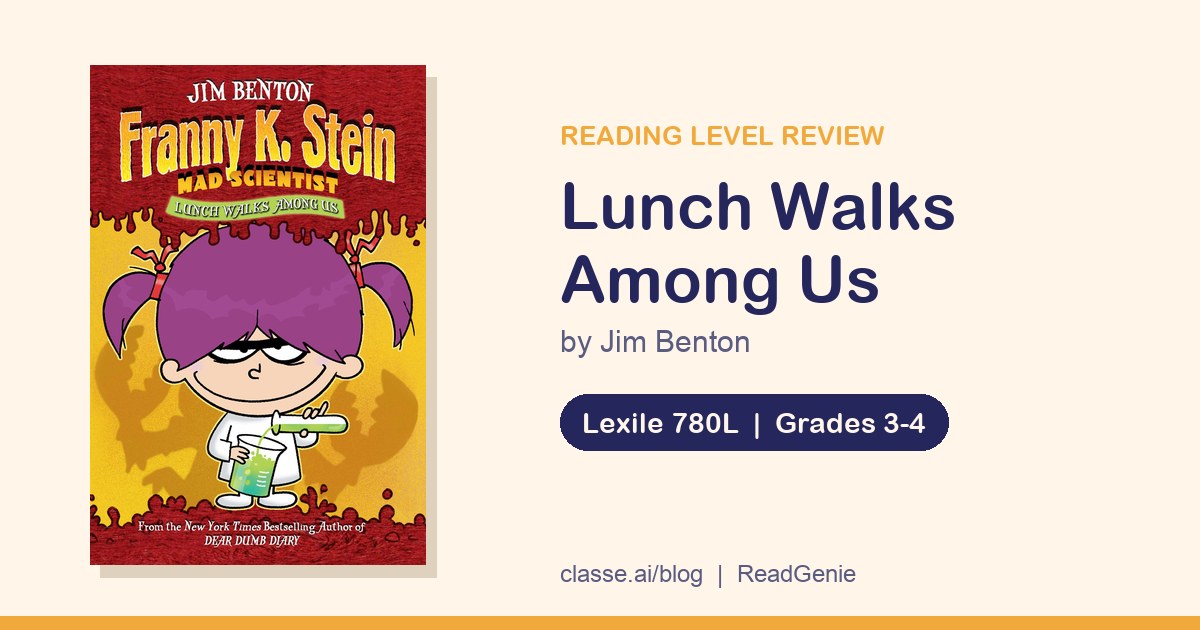
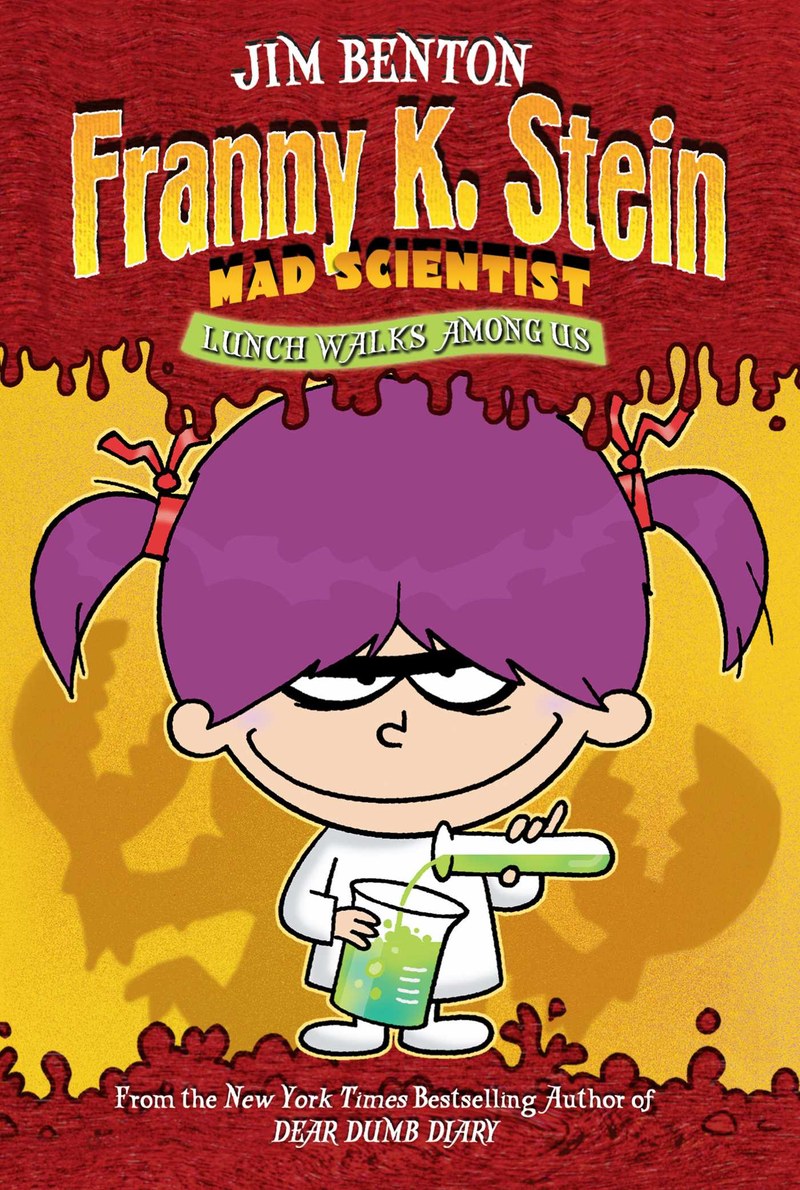
Lunch Walks Among Us, the first Franny K. Stein, Mad Scientist book by Jim Benton, has a Lexile measure of 780L, an AR (ATOS) book level of 5.0 and a Guided Reading level of N. Those numbers seem to disagree, but most kids can read it on their own in 3rd or 4th grade, because the whole book is only about 3,600 words with a big cartoon on every page. It is a strong confidence builder for struggling readers in grades 3 to 5 who like funny, spooky stories.
Franny K. Stein is not like the other kids. She is a mad scientist. Her bedroom is dark and creepy, the bats keep moving in, and she jumps rope with her pet snake. The kids in her class don't know what to make of her. So her teacher, Miss Shelly, suggests an experiment. Franny will try to fit in. It sort of works, until a giant Monstrous Fiend attacks the class and only a mad scientist can stop it. Kids love the gadgets, the gross jokes and a hero who turns out to be right about being herself.
Lunch Walks Among Us reading level at a glance
| Lexile measure | 780L (Simon & Schuster) |
|---|---|
| ATOS / AR book level | 5.0 (TeachingBooks) |
| AR points | 1 (TeachingBooks) |
| Guided Reading (Fountas & Pinnell) | N (Simon & Schuster) |
| Flesch Reading Ease (0-100) | 85.4 ReadGenie estimate |
| Flesch-Kincaid grade | 3.7 ReadGenie estimate |
| Interest level | Grades 2-5 (Simon & Schuster) |
| Approximate grade band | Grades 3-4 (ages 8-10) ReadGenie |
| Length | 112 pages, ~3,609 words |
| Format | Chapter book |
| Good for struggling readers? | ★★★★★ 5/5 |
| Dyslexia-friendly rating | ★★★★★ 4/5 |
We couldn't find a published DRA level or grade level equivalent for this book.
Scores checked 2026-11-12. Different leveling systems don't always agree, so we show each published value with its source and mark our own estimates. Links to every source are under How we rate books.
Is your child working hard and still getting stuck on words?
ReadGenie helps struggling readers improve their reading, spelling and handwriting with Orton-Gillingham practice at home. Your child reads out loud, the app listens, and it helps with the exact sound they missed. Join today and we'll mail your child Lunch Walks Among Us for free.
Try ReadGenie and get your free bookStarts with a free 7-day trial. Book mailed after your first paid month. US only, one per family.
What grade level is Franny K. Stein?
Lunch Walks Among Us reads at about a 3rd to 4th grade level for independent reading. The publisher lists it for grades 2 to 5 and ages 7 to 10.
The published levels tell two different stories. An AR level of 5.0 means the text is about as hard as what a typical student reads at the start of 5th grade, and 780L sits in the 4th to 5th grade range on most Lexile charts. Guided Reading level N, from Simon & Schuster and Booksource, usually lines up with the end of 2nd grade or the start of 3rd.
The gap comes from how each system works. Lexile and ATOS look mostly at sentence length and word difficulty, and Jim Benton writes long, rolling sentences that pile ideas up with and. Those long sentences push the formulas up. Fountas and Pinnell leveling also weighs how much help the pictures give, how much text sits on a page and how simple the story is. Here a cartoon fills most of every spread, there are only a few lines of text per page, and the plot is easy to follow.
Our own check agrees with the lower reading. On five of the publisher's sample spreads, sentences average about 9.5 words, and the Flesch-Kincaid formula puts the text near the end of 3rd grade.
Is Franny K. Stein good for struggling readers?
Yes. We give it 5 out of 5 for struggling readers, and it works best with a 3rd, 4th or 5th grader who reads a year or so below grade level.
The size of the book is the first win. At about 3,600 words, it is shorter than many early chapter books, and the text is broken into short chapters of a page or two each. A child who has never finished a chapter book on their own can read this one in a week and feel proud of it. That first finished book matters more than any level.
The pictures do real work too. Each page has three to six lines of text above a large black and white cartoon, and the drawing almost always shows what the words just said. When a child stumbles on a word like pterodactyl, the bat with wings in the picture helps them check their guess.
And the humor pulls kids along. Bats that show up uninvited, dolls with steel teeth, a teacher who knows exactly how to get Franny's attention. There is a laugh on almost every spread, and Franny looks clever, not babyish, which matters to a 4th or 5th grader who doesn't want to be seen with a little kid's book.
There are a few things to watch for.
- Some words are harder than the rest, like pterodactyl, experiment, modifications and scientist.
- The long and sentences can make a reader lose the thread halfway through.
- The type is a hand-lettered style with curly letters, which slows some kids down at first.
- A strong 5th grade reader will finish it in one sitting and want something longer.
Is Franny K. Stein good for kids with dyslexia?
Overall: ★★★★★ 4/5
| Factor | Score | Why |
|---|---|---|
| Sentence length | 3/5 | About 9.5 words per sentence in the excerpt. Many short lines of dialogue, but some long sentences chained with the word and. |
| Vocabulary load | 3/5 | Mostly everyday words, with a few science and monster words like pterodactyl, experiment, modifications and gizmos. |
| Decodability | 4/5 | Few names to learn (Franny, Miss Shelly). Most long words split into regular syllables. |
| Text density and layout | 3/5 | Three to six lines of text per page and lots of white space, but the type is a hand-lettered serif style with curly f and A shapes. |
| Pictures that carry meaning | 5/5 | A large cartoon fills most of every spread and shows what the text describes. |
| Chapter length | 5/5 | About 3,600 words across many short chapters, roughly two or three minutes each for a slower reader. |
| Engagement for reluctant readers | 5/5 | Jokes and creepy gadgets from the first page, then a monster attack at school. |
| Audiobook / read-along support | 3/5 | An unabridged Recorded Books audiobook (about 29 minutes) exists, but it is older and less widely held than newer series. |
We give it 4 out of 5 on our dyslexia-friendly scale. Short chapters, very little text per page and pictures that carry the story make it easier than its Lexile suggests. The font and a handful of long words hold it back from a 5.
The font is the thing to know about before you start. The text isn't in a plain book typeface. It's a hand-drawn serif style where the capital A and the letter f have curly strokes. Most kids get used to it within a few pages, but a dyslexic reader who relies on letter shape may hesitate at first. Spend a minute looking at a page together and point out how those letters look in this book.
Decoding is mostly friendly. There are only a few names to learn, Franny, Stein and Miss Shelly, and most long words break into regular syllables. Words like experiment and scientist look long but follow common patterns once they are split up. Pterodactyl is the real outlier, so just tell your child that word.
Sentence length is mixed. Dialogue lines are short and punchy, while the narration sometimes runs on with and after and. Reading those sentences aloud first, with a pause at each and, shows a child how to break them into pieces.
Audio support is fair. Recorded Books published an unabridged audiobook that runs about half an hour. It is older and harder to find than newer series, but listening once and then reading along is a good way in for a child who tires quickly. There is no dyslexia-friendly edition.
Words and phonics patterns to practice first
Lunch Walks Among Us reads smoothly once a child is steady with closed syllables, digraphs, vowel teams, silent e and r-controlled vowels. The consonant-le ending shows up in a few of the best describing words.
- Closed syllables and blends, like bats, grin, class, friends and spiders.
- Digraphs in she, that, much, teeth and with.
- Vowel teams in creepy, sweet, steaming, afraid and day.
- Silent e words like like, make, wide, store and rope.
- R-controlled vowels in dark, store, horses, smart and arms.
- Consonant-le in little, bubbling and crackling.
The vowel teams carry a lot of the mood here, since creepy, sweet and steaming describe Franny's room and her lab, so a child who reads them well gets the jokes. Consonant-le is a quick win too. Once a reader sees that bubbling and crackling end the same way, those lab sounds become fun to read aloud.
Pre-teach Franny, Stein and Shelly, plus pterodactyl, experiment, modifications, scientist, monstrous, beakers, gizmos and dungeon. Patterns like these are what ReadGenie practices with a child each day. Your child reads aloud, the app listens and helps with the exact sound they missed, so a funny chapter book like this one becomes something they can read alone.
How to read Franny K. Stein with your child
Read chapters 1 and 2 aloud together. They set up Franny's room, the bats and her lab, and hearing your voice on the long sentences shows your child how they should sound. From chapter 3 on, let your child take over and step in only when they ask.
Before each page, look at the picture first and ask what your child thinks is going on. The drawings almost always match the text, so a good guess about the picture makes the words easier to read.
Two or three short chapters a night is plenty. At that pace you'll finish in about a week, which is a great length for a child who hasn't finished a chapter book alone yet.
After reading, talk about Franny's experiment. Was trying to fit in a good idea? What did she keep about herself in the end? Kids who feel different from their classmates often have a lot to say.
Using Franny K. Stein in the classroom or tutoring
For teachers, Lunch Walks Among Us fits a level N guided reading group, even though its Lexile looks much higher. That makes it a good example for talking about why reading measures differ. Franny's plan to fit in gives a clear arc for a lesson on character change, and because she treats friendship like an experiment, it pairs nicely with a short science lesson on making a guess and testing it.
For tutors, pre-teach pterodactyl, experiment and scientist by breaking each into syllables. Use the long and sentences for phrasing practice, where the student reads up to each and and pauses. Pull little, bubbling and crackling for a quick consonant-le lesson, then hunt for more as you read.
Content notes for parents
The humor is spooky and a little gross, with bats, snakes, spiders and dolls with modified teeth. Franny feels lonely and left out at school before things turn around, which some kids relate to strongly. The monster attack is cartoon peril with no real violence, and nobody gets hurt. Most kids who like Halloween will find it funny rather than scary.
Should your child read it?
If your child is in grades 3 to 5 and needs a funny, short book they can finish on their own, Lunch Walks Among Us is a great choice. If they are still building up to chapter books, start with Ricky Ricotta's Mighty Robot or The Princess in Black, which have even fewer words per page. When they finish, there are nine more Franny books, and The Adventures of Captain Underpants is a similar level with the same kind of jokes.
Make the next book easier
Short daily sessions of reading, spelling and handwriting practice, built with Orton-Gillingham teachers. It works alongside tutoring and school support. The first 7 days are free. Join today and we'll mail your child Lunch Walks Among Us for free.
Try ReadGenie and get your free bookStarts with a free 7-day trial. Book mailed after your first paid month. US only, one per family.
FAQ
What age is Franny K. Stein for?
Simon & Schuster lists the Franny K. Stein books for ages 7 to 10 and grades 2 to 5. Most kids read the first book on their own around 8 to 10, and younger kids enjoy it as a read-aloud.
What is the AR level of Franny K. Stein?
Lunch Walks Among Us has an ATOS book level of 5.0 and is worth 1 AR point. The level is pushed up by long sentences, and the single point reflects how short the book is.
What is the Lexile level of Lunch Walks Among Us?
Lunch Walks Among Us has a Lexile measure of 780L, according to the publisher. That usually points to 4th or 5th grade, but the pictures and short pages make it easier than the number suggests.
What is the guided reading level of Franny K. Stein?
Simon & Schuster lists Lunch Walks Among Us at Fountas and Pinnell level N, which most schools tie to late 2nd or early 3rd grade.
How many Franny K. Stein books are there?
There are ten Franny K. Stein, Mad Scientist books, starting with Lunch Walks Among Us. Each one is a separate adventure, so kids can read them in any order after the first.
Get Lunch Walks Among Us free
ReadGenie helps struggling readers improve their reading, spelling and handwriting in short daily sessions at home. Join and we'll mail your child this book for free.
Claim your free bookStarts with a free 7-day trial. Book mailed after your first paid month. US only, one per family.
What to read next
- Ricky Ricotta's Mighty Robot by Dav Pilkey (easier). Another short, illustrated story about a kid, a robot and a monster fight, with even fewer words per page.
- The Princess in Black by Shannon Hale (easier). A girl with a secret monster-fighting side, in short chapters with color pictures on every page.
- The Adventures of Captain Underpants by Dav Pilkey (similar). Silly school humor, cartoons on almost every page and a villain to beat, at a similar level.
- Stink: The Incredible Shrinking Kid by Megan McDonald (similar). A funny kid with odd interests, short chapters and cartoons, at a similar level.
- The Last Kids on Earth by Max Brallier (harder). Monsters, gadgets and jokes with lots of art, in a longer book for when Franny feels easy.
Browse all of our reading-level book reviews.
How we rate books
Lexile, ATOS (Accelerated Reader), Guided Reading and DRA levels come from the companies that own them and from publishers. We link to where we found each one, and when a level isn't published we say so. Anything marked "ReadGenie estimate" is our own call, not an official level. Flesch scores come from a short public excerpt when the publisher offers one. The struggling-reader and dyslexia-friendly ratings are our judgment, based on eight things (sentence length, vocabulary, decodability, page layout, pictures, chapter length, how gripping the story is, and audiobook support). Treat them as a starting point. The right book is one your child can read with about 95% accuracy and wants to keep reading.
Sources
- Simon & Schuster: Lunch Walks Among Us (paperback) (Lexile, F&P level, grades, ages, ISBN, pages, series, look-inside excerpt, cover)
- TeachingBooks: Lunch Walks Among Us (ATOS, AR points, AR quiz, word count, Lexile check)
- Booksource: Lunch Walks Among Us (Guided Reading check, Lexile check, AR check, interest level, pages)
- AudiobooksNow: Lunch Walks Among Us (Recorded Books) (audiobook)