Harry Potter Reading Level: Lexile, AR Level and Age Guide
Harry Potter and the Sorcerer's Stone is Lexile 880L, AR 5.5 and Guided Reading level V, so most kids read it alone in grades 5 to 7. Younger fans and struggling readers do best sharing it with a grown-up or the audiobook.

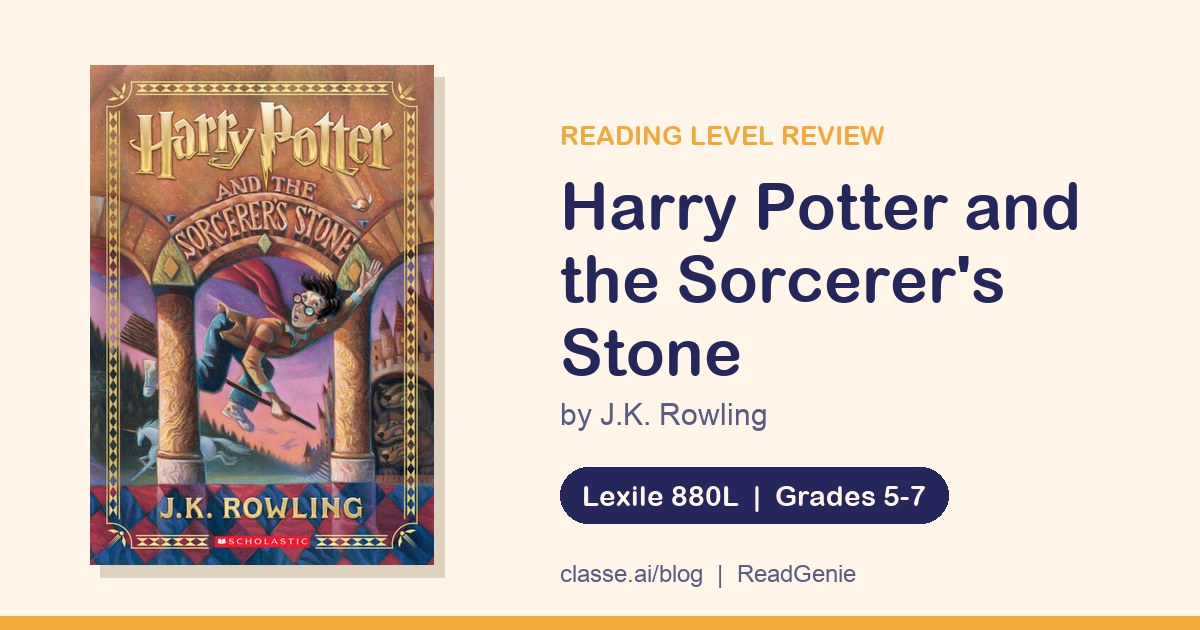
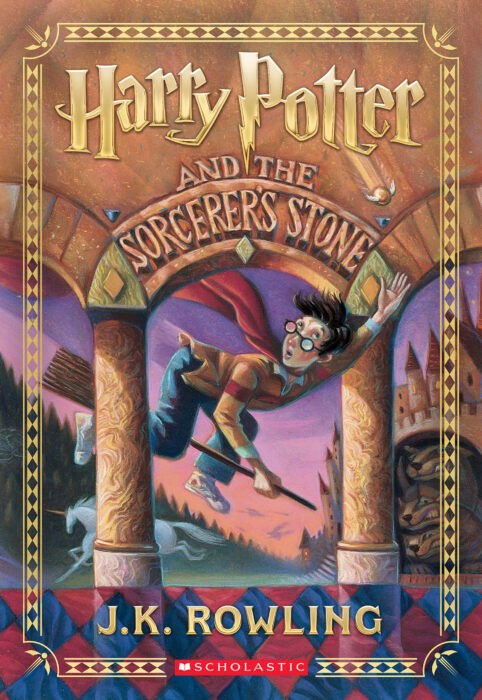
Harry Potter and the Sorcerer's Stone, the first Harry Potter book by J.K. Rowling, has a Lexile measure of 880L, an AR (ATOS) book level of 5.5, a Guided Reading level of V and a DRA level of 40 to 50. Most kids can read it on their own somewhere in grades 5 to 7. For a struggling reader it works best as a read-together or audiobook-supported book, since the story is hugely motivating but the chapters are long and packed with new names. A child who is still building stamina will have a better time starting with a shorter fantasy series and coming back to Harry a little later.
Harry has spent ten years sleeping in the cupboard under the stairs while his aunt, uncle and cousin Dudley treat him like a nuisance. Then letters start arriving that the Dursleys won't let him read, and a giant named Hagrid shows up to tell Harry he is a wizard. At Hogwarts School of Witchcraft and Wizardry he finds two best friends in Ron and Hermione, turns out to be a natural on a broomstick, and starts to learn the truth about his parents. Kids love it because Harry goes from the most ignored boy on Privet Drive to someone special, and because the school is full of moving staircases, ghosts and talking portraits. Many children know the story from the films before they ever open the book, and that head start can help a lot.
Harry Potter and the Sorcerer's Stone reading level at a glance
| Lexile measure | 880L (Scholastic Teacher Store) |
|---|---|
| ATOS / AR book level | 5.5 (Booksource) |
| AR points | 12 (Booksource) |
| Guided Reading (Fountas & Pinnell) | V (Scholastic Teacher Store) |
| DRA level | 40-50 (Scholastic Teacher Store) |
| Flesch Reading Ease (0-100) | 82.5 ReadGenie estimate |
| Flesch-Kincaid grade | 4.6 ReadGenie estimate |
| Interest level | Grades 4-6 (Scholastic Teacher Store) |
| Approximate grade band | Grades 5-7 (ages 10-13) ReadGenie |
| Length | 320 pages |
| Format | Middle grade novel |
| Good for struggling readers? | ★★★★★ 2/5 |
| Dyslexia-friendly rating | ★★★★★ 3/5 |
We couldn't find a published grade level equivalent for this book.
Scores checked 2026-11-09. Different leveling systems don't always agree, so we show each published value with its source and mark our own estimates. Links to every source are under How we rate books.
Is your child working hard and still getting stuck on words?
ReadGenie helps struggling readers improve their reading, spelling and handwriting with Orton-Gillingham practice at home. Your child reads out loud, the app listens, and it helps with the exact sound they missed. Join today and we'll mail your child Harry Potter and the Sorcerer's Stone for free.
Try ReadGenie and get your free bookStarts with a free 7-day trial. Book mailed after your first paid month. US only, one per family.
What grade level is Harry Potter?
The Sorcerer's Stone reads at roughly a 5th to 6th grade level. Scholastic, its US publisher, sells it for grades 4 to 6, but in practice most kids handle it best on their own from 5th grade up, and a lot of younger fans meet it first as a read-aloud.
An AR level of 5.5 means the text is about as hard as what a typical student reads in the middle of 5th grade. The Lexile of 880L lands at the upper end of 5th grade and into 6th. Both measures mostly count sentence length and how common the words are, and Harry Potter has more long, winding sentences than most books kids read at this age.
Guided Reading level V usually lines up with late 5th grade. F&P levels also weigh how many characters there are and how much of the world a reader has to keep track of. Hogwarts has four houses, a long list of teachers and a whole sport with its own rules, so V makes sense. The DRA range of 40 to 50 runs from 4th to 5th grade, a little lower than the other measures.
When we ran all of chapter 1 through a readability formula, it came out closer to a 4th or 5th grade level, with sentences averaging about 11 words. The book's difficulty comes less from any single sentence and more from length, stamina and vocabulary. The later books in the series get much longer, so this first one is the easiest place to start.
Is Harry Potter good for struggling readers?
As a book to read alone, it is a stretch for most struggling readers. We give it 2 out of 5 for independent reading by a child who is a year or two behind. That number goes up a lot when a parent shares the reading or the audiobook carries part of the load, because almost no book motivates kids the way this one does.
The first chapter is the hardest part. It opens with the Dursleys, not Harry, and he spends most of it as a baby being left on a doorstep. That chapter runs about 4,600 words over 17 pages. For a child who reads slowly that can mean half an hour or more before the boy in the title does anything, and that is where many reluctant readers put the book down.
Once Harry gets his letter, things change. There is humor on almost every page, the chapters are built around exciting moments like the first trip to Diagon Alley and the first Quidditch match, and kids want to know what is hidden on the third floor. The book also looks right for an older child. Nobody in 6th grade thinks Harry Potter is babyish.
What makes it hard is the size of the world. There are 320 pages, 17 long chapters and only a small drawing at the start of each one. There are dozens of invented words and names. And it is set in England, so some British words and the idea of school houses can need a quick explanation.
- Great for strong readers in grades 5 to 7 who love fantasy.
- Great as a family read-aloud, even with kids a few years younger.
- Harder for kids still building stamina with short chapter books, who should try Dragon Masters or Wings of Fire first.
- Harder for readers who lose track of a story with a big cast of characters.
Is Harry Potter good for kids with dyslexia?
Overall: ★★★★★ 3/5
| Factor | Score | Why |
|---|---|---|
| Sentence length | 3/5 | About 11.5 words per sentence in chapter 1, with long descriptive sentences mixed with short dialogue. |
| Vocabulary load | 3/5 | Mostly everyday words, but about 6 percent of words have three or more syllables, with rarer ones like peculiar and mysterious. |
| Decodability | 2/5 | A heavy load of names and made-up words that don't follow common patterns, like Dumbledore, McGonagall, Voldemort and Muggles. |
| Text density and layout | 2/5 | Full pages of small type with long paragraphs, typical of a longer middle grade novel. |
| Pictures that carry meaning | 1/5 | A small chapter-opening drawing, then text only. A separate illustrated edition exists. |
| Chapter length | 2/5 | Chapter 1 runs about 4,600 words over 17 pages, 30 minutes or more for a slower reader. |
| Engagement for reluctant readers | 5/5 | Magic, a secret world and a boy who finally gets to leave the cupboard under the stairs keep kids reading. |
| Audiobook / read-along support | 5/5 | Unabridged audiobook read by Jim Dale, widely available in libraries. |
We give it 3 out of 5 on our dyslexia-friendly scale. Engagement and audio support are as strong as they get. Layout, pictures and chapter length pull the score down, and so do the names.
Most of the everyday words follow regular phonics patterns. Words like neck, brick, garden and street come up often, and about 6 in every 100 words in chapter 1 have three or more syllables. The hard part is the made-up and unusual names. Dumbledore, McGonagall and Voldemort are long and don't look the way they sound to a young reader, and Muggles, Hogwarts and Quidditch are new words with no clue in the spelling. Kids with dyslexia often read the first syllable and guess, so it helps a lot to say the names aloud together before starting.
The pages themselves are a challenge. This is a standard novel layout with small type and long paragraphs, and there are no pictures in the story beyond the chapter openers. A separate illustrated edition with full-color art exists, and some families use it so a child has pictures to rest on, even though the text is the same.
Audio support is excellent. The unabridged audiobook read by Jim Dale is in almost every library, on CD and in the library apps. Reading the print while listening means a dyslexic child hears every name said the right way and sees how it is spelled at the same time. There is no dyslexia-friendly edition of the novel.
Words and phonics patterns to practice first
Chapter 1 leans on closed syllables with blends, silent e, r-controlled vowels, vowel teams, the -ed ending and consonant-le. A child who is solid on these will spend their energy on the story instead of on decoding.
- Closed syllables and blends, like neck, stiff, brick, swept and black.
- Silent e in drive, made, time, shape and smile.
- R-controlled vowels in corner, garden, normal, dark and sharp.
- Vowel teams in street, tea, cloak, sweet and road.
- The -ed ending in pointed, gazed, cleared, shouted and shocked.
- Consonant-le in little, middle, purple, single and uncle.
The -ed ending is a good one to practice first, because the whole book is told in the past tense. Pointed adds a syllable and ends in /id/, gazed and cleared end in /d/, and shocked ends in /t/. Sensible is a nice longer word for consonant-le once little and middle are easy.
Pre-teach Dursley, Privet, Dumbledore, McGonagall, Hagrid, Voldemort, Muggles, Hogwarts and Quidditch, along with mysterious, peculiar and cousin. ReadGenie practices exactly these kinds of patterns with a child a few minutes a day, listening as they read aloud and helping with the sound they missed, which makes a long book like this one feel more manageable.
How to read Harry Potter with your child
Read chapter 1 aloud yourself. It is the longest and slowest start in the book, and it is told mostly from Mr. Dursley's side. Your child gets the story without spending all their reading energy before Harry is even awake.
Before you start, make a name card with Dumbledore, McGonagall, Hagrid, Voldemort and the Dursleys, and how each one sounds. Keep it in the book as a bookmark and add Ron, Hermione, Neville and the teachers as they show up.
Split each chapter into two sittings, stopping at a scene break. For the longest chapters, let your child listen to the audiobook and follow the words, then read the shorter, chattier scenes together. Dialogue between Harry and Ron is a good place to hand over the reading, since the lines are short.
If your child hasn't seen the movie yet, save it as a reward for finishing the book. Comparing the two is a fun way to talk about what was left out.
Using Harry Potter in the classroom or tutoring
For teachers, the book fits a Guided Reading V group or a fantasy book club in grades 5 to 7, and it is a popular whole-class read-aloud in grades 3 and 4. Chapter 1 is a good lesson in point of view, since the story opens with Mr. Dursley rather than Harry. Keep a class chart of new wizarding words and what they mean as they come up. If some students can't read it on their own yet, run it as a read-aloud and give stronger readers the book to follow along.
For tutors, pre-teach the character names before the first session and use them for syllable division, as in Dum ble dore and Mc Gon a gall. Pull a page of chapter 1 for an -ed sort by sound, and warm up with consonant-le words like little, middle, purple and uncle before reading. A page aloud at the start of each session, then the audiobook for the rest of the chapter, keeps the student moving through the story.
Content notes for parents
Harry is neglected and treated unkindly by his aunt and uncle, which some children find upsetting. His parents were killed before the story begins, and the villain is described as a murderer. There are a few scary scenes, including a troll in the girls' bathroom, a night in a dark forest and a final confrontation with a frightening figure. There is also some name-calling and bullying at school. None of it is gory, but sensitive readers under about 8 may want a grown-up nearby for the forest and the ending.
Should your child read it?
If your child is in grades 5 to 7 and reads close to grade level, Harry Potter and the Sorcerer's Stone is a wonderful pick, and the audiobook will help with the long chapters. If they are still reading below a 4th grade level, start with Rise of the Earth Dragon from Dragon Masters or The Dragonet Prophecy and come back to Harry as a read-aloud in the meantime. When they finish, The Lightning Thief is a good next adventure at a similar level, and The Hobbit is the step up after that.
Make the next book easier
Short daily sessions of reading, spelling and handwriting practice, built with Orton-Gillingham teachers. It works alongside tutoring and school support. The first 7 days are free. Join today and we'll mail your child Harry Potter and the Sorcerer's Stone for free.
Try ReadGenie and get your free bookStarts with a free 7-day trial. Book mailed after your first paid month. US only, one per family.
FAQ
What is the AR level of Harry Potter book 1?
Harry Potter and the Sorcerer's Stone has an ATOS book level of 5.5 and is worth 12 AR points. The high point value comes from its length, more than 300 pages.
What is the Lexile level of Harry Potter?
The first book has a Lexile measure of 880L. That falls at the top of 5th grade and into 6th grade, so it is a step up from most books kids read in elementary school.
What is the Fountas and Pinnell level of Harry Potter?
Scholastic lists The Sorcerer's Stone at Guided Reading (Fountas and Pinnell) level V. That usually matches late 5th grade, and teachers use it in V groups and for 5th and 6th grade book clubs.
What age is Harry Potter for?
Most kids can read the first book on their own from about 10 or 11, which matches grades 5 to 7. Scholastic sells it for grades 4 to 6, and many younger children enjoy it as a read-aloud first.
Is Harry Potter too hard for a 3rd grader?
For most 3rd graders it is too hard to read alone, since its levels sit around 5th grade. It makes a great read-aloud at that age, and the audiobook lets a younger fan enjoy it while their reading catches up.
Get Harry Potter and the Sorcerer's Stone free
ReadGenie helps struggling readers improve their reading, spelling and handwriting in short daily sessions at home. Join and we'll mail your child this book for free.
Claim your free bookStarts with a free 7-day trial. Book mailed after your first paid month. US only, one per family.
What to read next
- Rise of the Earth Dragon by Tracey West (easier). Dragon Masters is a short, illustrated magic series that builds the stamina for longer fantasy.
- The Dragonet Prophecy by Tui T. Sutherland (similar). A prophecy, a group of friends and lots of action, with slightly shorter sentences.
- The Lightning Thief by Rick Riordan (similar). A kid who finds out he belongs to a hidden world, told with plenty of humor.
- The City of Ember by Jeanne DuPrau (similar). Two friends uncover a secret about their world, in a shorter book.
- The Hobbit by J.R.R. Tolkien (harder). A classic fantasy quest with longer sentences and older language, for when a reader is ready.
Browse all of our reading-level book reviews.
How we rate books
Lexile, ATOS (Accelerated Reader), Guided Reading and DRA levels come from the companies that own them and from publishers. We link to where we found each one, and when a level isn't published we say so. Anything marked "ReadGenie estimate" is our own call, not an official level. Flesch scores come from a short public excerpt when the publisher offers one. The struggling-reader and dyslexia-friendly ratings are our judgment, based on eight things (sentence length, vocabulary, decodability, page layout, pictures, chapter length, how gripping the story is, and audiobook support). Treat them as a starting point. The right book is one your child can read with about 95% accuracy and wants to keep reading.
Sources
- Scholastic Teacher Store: Harry Potter and the Sorcerer's Stone (Lexile, Guided Reading, DRA, AR check, grades, pages, ISBN)
- Booksource: Harry Potter And The Sorcerer's Stone (ATOS, AR points, Lexile check, Guided Reading check, interest level, pages)
- Scholastic See Inside: Harry Potter and the Sorcerer's Stone (paperback) (excerpt, layout, phonics patterns)