Holes Reading Level: Louis Sachar Lexile, AR and Dyslexia Guide
Holes by Louis Sachar is Lexile 660L, AR level 4.6 and Guided Reading level V, so most kids can read it alone by the end of 4th grade or in 5th grade. Short chapters and a gripping mystery make it a good pick for struggling readers in grades 6 to 8, best with the audiobook.

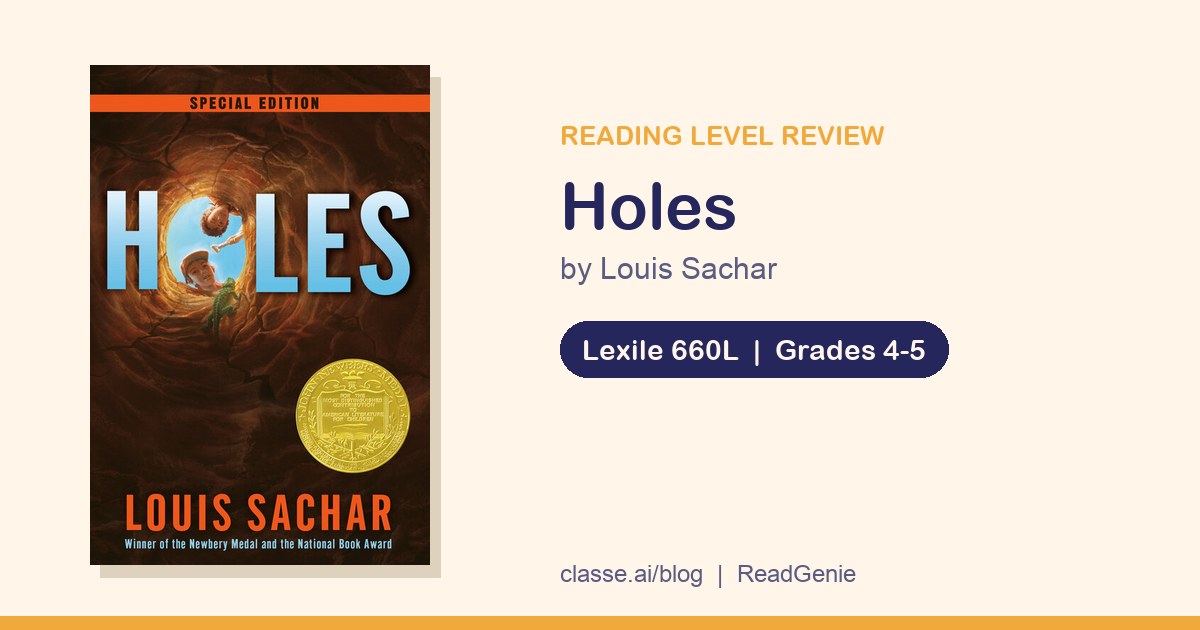
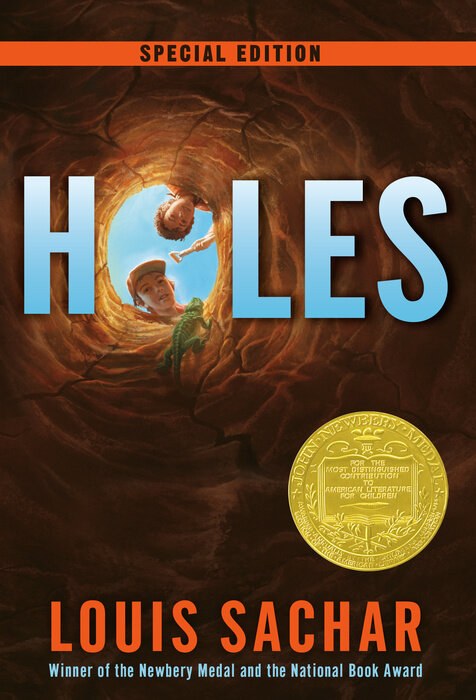
Holes by Louis Sachar has a 660L Lexile measure, an AR (ATOS) book level of 4.6, a Guided Reading level of V and a DRA level of 40 to 50. Most kids can read it on their own by the end of 4th grade or in 5th grade. The story is gripping and the chapters are short, so it is a strong pick for struggling readers in grades 6 to 8, especially with the audiobook. It is a long book with no pictures, so plan to read it together or listen along with a child still reading below a 4th grade level.
Stanley Yelnats is sent to Camp Green Lake for stealing a pair of sneakers he never stole. The camp sits in a dry Texas desert, there is no lake, and every boy has to dig one hole a day, five feet wide and five feet deep. Stanley slowly figures out that the warden is looking for something. Along the way the book drops back in time to his great-great-grandfather, a broken promise and a famous outlaw. Kids love the way the three stories snap together at the end, and the dry humor keeps even the hard parts moving. It won the Newbery Medal and the National Book Award.
Holes reading level at a glance
| Lexile measure | 660L (Scholastic Teacher Store) |
|---|---|
| ATOS / AR book level | 4.6 (TeachingBooks) |
| AR points | 7 (TeachingBooks) |
| Guided Reading (Fountas & Pinnell) | V (Scholastic Teacher Store) |
| DRA level | 40-50 (Scholastic Teacher Store) |
| Flesch Reading Ease (0-100) | 80.0 ReadGenie estimate |
| Flesch-Kincaid grade | 5.2 ReadGenie estimate |
| Interest level | Grades 6-8 (Scholastic Teacher Store) |
| Approximate grade band | Grades 4-5 (ages 9-11) ReadGenie |
| Length | 272 pages, ~47,079 words |
| Format | Middle grade novel |
| Good for struggling readers? | ★★★★★ 3/5 |
| Dyslexia-friendly rating | ★★★★★ 3/5 |
We couldn't find a published grade level equivalent for this book.
Scores checked 2026-11-08. Different leveling systems don't always agree, so we show each published value with its source and mark our own estimates. Links to every source are under How we rate books.
Is your child working hard and still getting stuck on words?
ReadGenie helps struggling readers improve their reading, spelling and handwriting with Orton-Gillingham practice at home. Your child reads out loud, the app listens, and it helps with the exact sound they missed. Join today and we'll mail your child Holes for free.
Try ReadGenie and get your free bookStarts with a free 7-day trial. Book mailed after your first paid month. US only, one per family.
What grade level is Holes?
Holes sits at about a 4th to 5th grade reading level, but the publisher and most schools teach it in grades 5 to 8. That gap between how hard the words are and who the book is written for is the main thing to understand about it.
An AR level of 4.6 means the text is about as hard as what a typical student reads in the middle of 4th grade. The Lexile of 660L lands in the same band. Both measures look mostly at sentence length and how common the words are, and Sachar writes in plain, clear sentences. In the opening chapters they average about a dozen words, with lots of very short ones mixed in. Our own readability check on that excerpt came out at about a 5th grade level.
Guided Reading level V usually lines up with 5th grade, and DRA 40 to 50 covers 4th and 5th grade on most school charts. Those levels weigh things the formulas miss. Holes has three story lines set in different times, a big cast of boys with nicknames, and a plot that only makes sense once you notice small clues planted early. That takes more focus than the sentences alone suggest.
It is also long. The book runs about 47,000 words and is worth 7 AR points. A 5th grader reading on grade level can handle it. A 6th, 7th or 8th grader reading a year or two behind gets a book their classmates are reading that they can actually read, with some help on the length.
Is Holes good for struggling readers?
Often, yes. We give it 3 out of 5 for struggling readers, with the audiobook moving it closer to a 4.
The story is the best reason to try it. A curse, a buried secret, an outlaw and deadly yellow lizards pull kids along, and the humor is quiet enough that older readers don't feel talked down to. Stanley is a teenager at a tough camp, so nothing about it feels young to a 12-year-old. It is also one of the most assigned novels in middle school, and being able to keep up with the class book means a lot to a kid who usually can't.
The chapters help too. There are about 50 of them, many only two or three pages long, and the average is under 1,000 words. A slower reader can finish a chapter in one sitting and feel the progress.
What holds it back is length and the lack of pictures. Every page is full text, so a reader who leans on pictures to follow along gets no help. The flashbacks can also trip kids up. One chapter is about Stanley digging in the desert, and the next is about a pig farmer in Latvia more than a hundred years ago. Readers who are spending most of their energy on the words can lose the thread of which story they are in.
Here is who it fits and who it may frustrate.
- Great for 6th to 8th graders reading at about a 4th or 5th grade level who want the book the class is reading.
- Great for 4th and 5th graders reading on grade level who like mysteries and funny adventure stories.
- Harder for kids still reading below a 4th grade level on their own. Read it aloud or use the audiobook.
- Harder for a reader who gets lost when a story jumps back in time, unless you talk through each jump.
Is Holes good for kids with dyslexia?
Overall: ★★★★★ 3/5
| Factor | Score | Why |
|---|---|---|
| Sentence length | 3/5 | About 12 words per sentence in the opening chapters, with many short sentences mixed in. |
| Vocabulary load | 3/5 | Everyday words, with some longer ones like perseverance, descendants and embarrassment. About 6 percent of words in the excerpt have three or more syllables. |
| Decodability | 3/5 | Most words follow common patterns. Yelnats, Zeroni and the boys' nicknames are hard to sound out without help. |
| Text density and layout | 3/5 | Standard novel type with full pages of text, broken up by many short chapters. |
| Pictures that carry meaning | 1/5 | No illustrations, so the words carry all of the meaning. |
| Chapter length | 4/5 | About 47,000 words in 50 chapters, close to 950 words each, or under 10 minutes for most slower readers. A few chapters are only a page. |
| Engagement for reluctant readers | 5/5 | A curse, an outlaw, buried treasure and deadly lizards, with dry humor on almost every page. |
| Audiobook / read-along support | 5/5 | Unabridged audiobook read by Kerry Beyer (Listening Library), on CD and as a download. |
We give it 3 out of 5 on our dyslexia-friendly scale. It scores highest for engagement, chapter length and audio support, and lowest for pictures.
The vocabulary is mostly everyday words. About 6 in every 100 words in the opening have three or more syllables, which is low for a Newbery winner. The longer words that do show up, like perseverance, descendants and embarrassment, tend to appear once and move on.
Names are the hard part. Yelnats, Zeroni and Barlow don't sound out the way a child expects, and the boys all go by nicknames like Zero, Squid, X-Ray, Armpit and Zigzag. Teach the names before chapter 1 and keep a list handy, and the pages get much easier.
Audio support is strong. Listening Library publishes an unabridged audiobook read by Kerry Beyer, and most libraries carry it. Following the print while listening lets a dyslexic child keep up with the plot, hear the names said aloud and still see every word. There is no dyslexia-friendly edition, and the paperback uses standard novel type.
Words and phonics patterns to practice first
Holes reads smoothly once a child is comfortable with blends, vowel teams, r-controlled vowels and the -ed ending. These patterns come up again and again in the opening chapters.
- Closed syllables and blends, like camp, stuck, stranded, digging and handcuffed.
- The -ed ending in its three sounds, as in arrested, promised and stretched.
- Vowel teams in green, seat, teacher, stealing and sneakers.
- R-controlled vowels in warden, curse, farther and perseverance.
- Compound words, which Sachar uses a lot, like backpack, toothpaste, grandfather, sunglasses and woodpecker.
The -ed ending is worth extra time because it is everywhere in this book. Arrested ends in /id/, promised ends in /t/ and survived ends in /d/, and kids who learn that rule stop stumbling on past tense verbs in every chapter. Compound words are an easy win. Have your child find the two smaller words first, then read them together.
Pre-teach Stanley Yelnats, Madame Zeroni and Kate Barlow before you start, plus a few longer words from the opening like supposedly, innocent and descendants. Patterns like these are what ReadGenie practices with a child every day. Your child reads aloud, the app listens and helps with the exact sound they missed, so endings and vowel teams stop being speed bumps in a long novel.
How to read Holes with your child
Read the first eight or so chapters together. They are short, and by the end of them your child knows about the curse, the camp and the holes. That is a natural place to stop and ask what they think the warden is really looking for. Write the guess down and check it at the end of the book.
Make a bookmark with the boys' real names and nicknames as you meet them. Add the grown-ups at camp too. When the story jumps back in time, say so out loud before you start the chapter, so your child knows which story they are in.
Point out that Yelnats is Stanley spelled backward. It is a small thing, but kids love it, and it is a good way to practice reading a word letter by letter.
On long days, use the audiobook for one chapter and read the next one together. At two or three short chapters a night, the book takes about three weeks.
Save the 2003 movie as a reward for finishing. Watching it afterward and talking about what changed is a good way to check what your child remembers, without a quiz.
Using Holes in the classroom or tutoring
For teachers, Holes fits a Guided Reading level V group or a whole-class novel in grades 5 to 7. A three-row timeline works well, one row each for Stanley, his great-great-grandfather and the town of Green Lake long ago, filled in as the class reads until the rows connect. The short chapters make it easy to plan small reading chunks for guided groups. Talk about fate, fairness and friendship, and prepare students before the chapters with the racist violence in the old story.
For tutors, have the student read one short chapter aloud each session for fluency and finish the next with the audiobook. Pull past tense words from the page into a quick -ed drill sorted by the three sounds. The names and nicknames are good syllable practice too. Try Yel-nats, Ze-ro-ni and Bar-low before they come up in the text.
Content notes for parents
The boys are at a juvenile detention camp, the guards carry guns and the warden is cruel. The story set in the past includes a Black man who is shot and killed by a mob for loving a white woman, and she then becomes an outlaw who kills people. There are venomous lizards, a boy who runs away into the desert and nearly dies, and a boy who hits a guard with a shovel. None of it is graphic, and the book handles the injustice seriously, but younger or sensitive readers may want to read those chapters with a parent.
Should your child read it?
If your child is in grades 5 to 8 and reading at about a 4th grade level or above, Holes is a great pick, and even better with the audiobook. If they're reading below that, read it aloud together or start with a shorter Louis Sachar book like Sideways Stories from Wayside School. When they finish, Restart is another story about a boy with a bad reputation at a similar level, and Hatchet is a good next step up.
Make the next book easier
Short daily sessions of reading, spelling and handwriting practice, built with Orton-Gillingham teachers. It works alongside tutoring and school support. The first 7 days are free. Join today and we'll mail your child Holes for free.
Try ReadGenie and get your free bookStarts with a free 7-day trial. Book mailed after your first paid month. US only, one per family.
FAQ
What age is Holes for?
The publisher lists Holes for ages 10 and up, and Scholastic lists it for grades 6 to 8. Most kids can read it on their own between about 10 and 12. Because the story is about teenagers at a camp, it also works well for older middle schoolers who read below grade level.
What is the AR level of Holes?
Holes has an ATOS book level of 4.6 and is worth 7 AR points. The level reflects plain sentences and common words, and the high point value reflects how long the book is.
What is the Lexile level of Holes?
Holes has a Lexile measure of 660L. That is in the usual range for 4th and 5th grade, though the three linked stories make it feel a bit harder than the number suggests.
What is the guided reading level of Holes?
Holes is listed at Guided Reading level V, which most schools expect around 5th grade. Scholastic also lists it at DRA 40 to 50.
Is Holes appropriate for a 9 year old?
A strong 9-year-old reader can read the words, but the length and some of the violence in the old story make it a better fit for most kids at 10 or 11. If a younger child is keen, read it together so you can talk through the harder chapters.
How many chapters are in Holes?
Holes has 50 chapters in three parts. Most chapters are short, some only a page or two, which makes it easier to read in small pieces than its length suggests.
Get Holes free
ReadGenie helps struggling readers improve their reading, spelling and handwriting in short daily sessions at home. Join and we'll mail your child this book for free.
Claim your free bookStarts with a free 7-day trial. Book mailed after your first paid month. US only, one per family.
What to read next
- Sideways Stories from Wayside School by Louis Sachar (easier). The same author's silly school stories, in 30 very short chapters.
- There's a Boy in the Girls' Bathroom by Louis Sachar (easier). Louis Sachar again, about a fifth grader everyone calls a troublemaker who starts to change.
- Restart by Gordon Korman (similar). Another boy with a bad reputation and a second chance, told in short, funny chapters.
- Hatchet by Gary Paulsen (harder). A boy alone in the wild who has to survive on his own, for readers who liked the desert scenes.
- Small Steps by Louis Sachar (harder). The follow-up book about Armpit and X-Ray after Camp Green Lake, written for older readers.
Browse all of our reading-level book reviews.
How we rate books
Lexile, ATOS (Accelerated Reader), Guided Reading and DRA levels come from the companies that own them and from publishers. We link to where we found each one, and when a level isn't published we say so. Anything marked "ReadGenie estimate" is our own call, not an official level. Flesch scores come from a short public excerpt when the publisher offers one. The struggling-reader and dyslexia-friendly ratings are our judgment, based on eight things (sentence length, vocabulary, decodability, page layout, pictures, chapter length, how gripping the story is, and audiobook support). Treat them as a starting point. The right book is one your child can read with about 95% accuracy and wants to keep reading.
Sources
- Scholastic Teacher Store: Holes (paperback) (Lexile, Guided Reading, DRA, ACR check, pages, grades)
- Penguin Random House: Holes by Louis Sachar (Lexile check, F&P check, ISBN, ages, formats, audiobook narrator, excerpt)
- TeachingBooks: Holes (ATOS, AR points, word count, Lexile check, grades)
- Booksource: Holes (Guided Reading check, Lexile check, AR check, interest level)