Love That Dog Reading Level: Lexile 1010L, AR 4.5, Guided Reading T
Love That Dog by Sharon Creech is Lexile 1010L, AR level 4.5 with 1 AR point, Guided Reading T and DRA 40-50. The words are easy and the book is under 4,000 words, so most kids can read it alone in grades 3 to 5, and it is a great novel for struggling readers in grades 4 to 7.

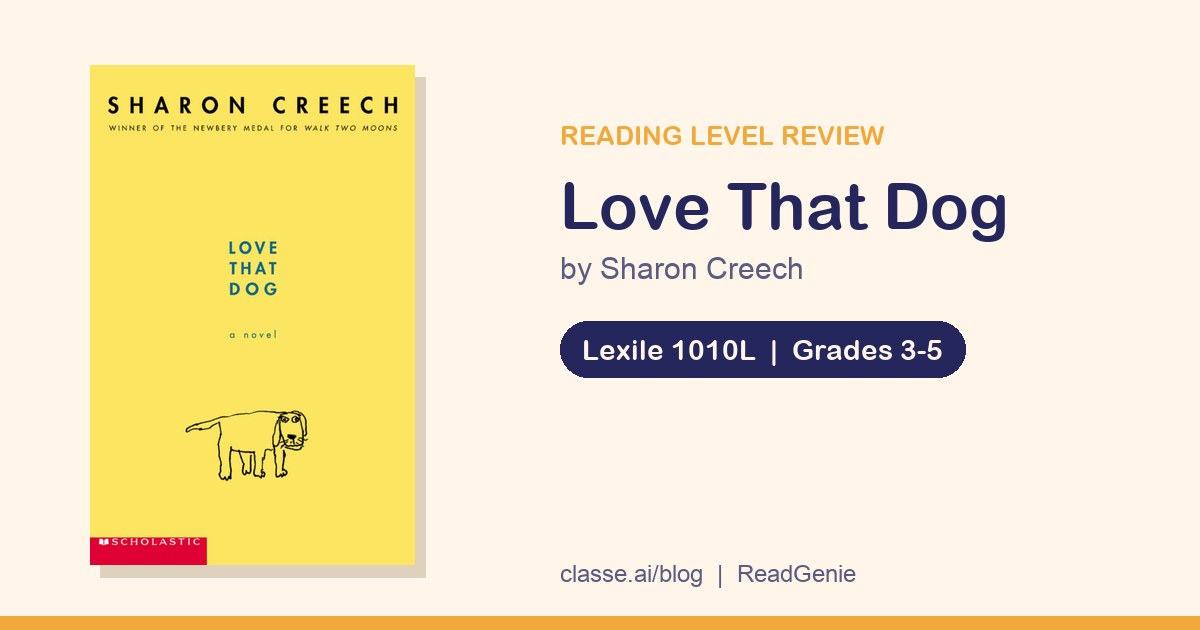
Love That Dog by Sharon Creech has a Lexile measure of 1010L, an AR (ATOS) book level of 4.5 worth 1 AR point, a Guided Reading level of T and a DRA level of 40-50. Those numbers make it look hard, but the words are short and everyday and the whole book is under 4,000 words, so most kids can read it on their own somewhere in grades 3 to 5. For a struggling reader in grades 4 to 7 who wants a real novel, it is one of the best picks on the shelf.
The book is written as a school year of short poems by a boy named Jack, who starts out sure that poetry is for girls and that he has nothing to write about. His teacher keeps nudging, Jack keeps grumbling back, and bit by bit he starts writing about the yellow dog he loved. A poem by Walter Dean Myers turns everything around for him. Kids who hate writing tend to recognize themselves in Jack within a page or two, and that is a big part of why teachers keep handing this book to reluctant readers.
Love That Dog reading level at a glance
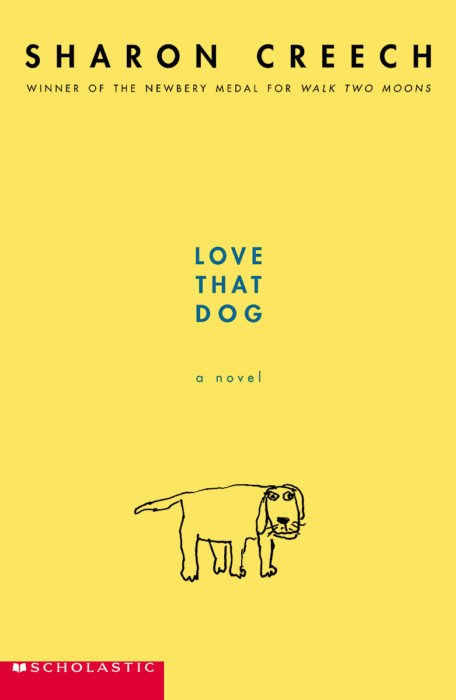
| Lexile measure | 1010L (Scholastic Teacher Store) |
|---|---|
| ATOS / AR book level | 4.5 (TeachingBooks) |
| AR points | 1.0 (TeachingBooks) |
| Guided Reading (Fountas & Pinnell) | T (Scholastic Teacher Store) |
| DRA level | 40-50 (Scholastic Teacher Store) |
| Flesch Reading Ease (0-100) | 95.3 ReadGenie estimate |
| Flesch-Kincaid grade | 2.8 ReadGenie estimate |
| Interest level | Grades 5-8 (Scholastic Teacher Store) Also listed as Grades 4-7 and Grades 3-8 |
| Approximate grade band | Grades 3-5 (ages 8-11) ReadGenie |
| Length | 112 pages, ~3,935 words |
| Format | Poetry/verse |
| Good for struggling readers? | ★★★★★ 4/5 |
| Dyslexia-friendly rating | ★★★★★ 4/5 |
We couldn't find a published grade level equivalent for this book.
Is Love That Dog a struggle for your child right now? ReadGenie gives struggling readers short daily Orton-Gillingham practice at home, out loud, with help on the exact sound they missed.
Try ReadGenie and get this book freeScores checked 2026-11-19. Different leveling systems don't always agree, so we show each published value with its source and mark our own estimates. Links to every source are under How we rate books.
What grade level is Love That Dog?
Love That Dog reads like a 3rd to 5th grade book, even though one of its official levels says otherwise.
Start with the AR level. A 4.5 means the text is about as hard as what a typical student reads in the middle of 4th grade, and it is worth only 1 AR point because the book is so short. Guided Reading level T and DRA 40-50 are usually taught in 4th grade too, so those three agree.
The odd one out is the Lexile. A 1010L measure is what you would expect from a dense middle school novel, not a slim book of free verse. The reason is how the Lexile formula works. It looks at word difficulty and sentence length, and in Jack's poems a single sentence often runs down six, eight or ten short lines before it reaches a period. The formula sees one long sentence. A child reading it sees a few words per line and lots of white space. So when you look up the Lexile and panic, look at a page instead.
Our own readability check on two spreads from the middle of the book points the same way. Only about 2 percent of the words have three or more syllables, and the Flesch-Kincaid estimate comes out near a 3rd grade level. The hard part of Love That Dog is not the words. It is following Jack's ideas about the poems he is reading, which is why the book is often taught to older kids than its word difficulty would suggest.
Is Love That Dog good for struggling readers?
Yes. We rate it 4 out of 5 for struggling readers. It is short, it looks grown-up, and its narrator is a kid who does not like reading or writing poetry any more than a struggling reader does. The main things holding it back from a 5 are that there are no pictures and that some of the jokes depend on poems a child may not know yet.
The length is what sells it. Under 4,000 words spread across about 112 pages means many pages hold only 30 or 40 words. Each entry is dated, like a journal, and most run a page or two. A child can read three entries, stop, and feel like they really got somewhere. Plenty of kids finish the whole book in two or three sittings, and finishing a book that looks like a real middle-grade novel does a lot for a reader's confidence.
There are a few things to watch for.
- Jack keeps answering famous poems by Robert Frost, William Blake and others, and those lines make more sense once a grown-up has read the poems aloud
- Sentences run across many short lines with little punctuation, so kids have to hold a thought for a while
- There are no pictures, apart from a few poems printed in shapes on the page
- The middle of the book turns sad when Jack writes about what happened to his dog
For a 4th to 7th grader who reads below grade level and is tired of books that look young, this is a great choice. For a younger child who still needs pictures to follow along, try something like Mercy Watson to the Rescue first and save this one for a read-together book.
Is Love That Dog good for kids with dyslexia?
Overall: ★★★★★ 4/5
| Factor | Score | Why |
|---|---|---|
| Sentence length | 4/5 | Lines are very short, but a sentence often runs across six or more lines, averaging about 11 words in the excerpt. |
| Vocabulary load | 5/5 | Mostly high-frequency words. Only about 2% of words in the excerpt have three or more syllables. |
| Decodability | 4/5 | Most words follow common patterns. Poets' names and a few irregular words (would, thought, copied) need a preview. |
| Text density and layout | 5/5 | Short centered-left lines, a clear serif type and lots of white space, with a date heading for each entry. |
| Pictures that carry meaning | 2/5 | Text only, except for a few concrete poems shaped on the page. |
| Chapter length | 5/5 | Each dated entry takes a minute or two to read. |
| Engagement for reluctant readers | 4/5 | Jack's grumpy, funny voice pulls kids in, and the dog story gives the book a strong emotional pull. A few kids find the poetry theme slow at first. |
| Audiobook / read-along support | 4/5 | HarperChildren's Audio publishes an unabridged recording read by Scott Wolf, about 35 minutes long. |
We rate it 4 out of 5 for dyslexic readers. Short lines, generous white space, very short entries and plain vocabulary all work in its favor. The lack of pictures is the one real weak spot.
The layout is friendlier than almost any prose novel at this level. Lines sit along the left side of the page, usually three to six words long, with blank lines between stanzas and a date heading at the top of each entry. A child's eyes never have to sweep across a crowded line and find the start of the next one. For many dyslexic kids, that alone makes a page far less tiring.
The vocabulary is easy, too. Most words are one syllable, and the longer ones repeat. The names are the bumps. Walter Dean Myers comes up again and again, often in full, and Jack mentions other poets by last name. Preview those once and they stop being a problem.
What a dyslexic reader loses here is picture support. There is nothing on the page to look at when a word won't come, so an audiobook is a real help. HarperChildren's Audio published an unabridged recording read by actor Scott Wolf, about 35 minutes long. A child can listen to the whole story in one sitting, then go back and read it with Jack's voice already in their head.
Words and phonics patterns to practice first
Love That Dog is a good book for a child who is solid on short vowels and silent e and is still building speed with vowel teams and r-controlled vowels.
Closed syllables with short vowels carry most of the text, in words like dog, glad, just, think and up. They are the easy wins on every page.
Silent e words like wrote, tape, like, made and those come up often. A quick reminder that the final e makes the first vowel say its name is usually enough.
R-controlled vowels appear in words, person, morning, board, ears and sort. Words is the tricky one, since or there sounds like er, and it shows up constantly because Jack talks about words all the time.
Vowel teams and diphthongs show up in evening, secret, sounds, now, envelope and boy. Envelope is worth breaking into syllables before reading.
Past tense -ed endings like copied, folded, inspired, typed and called are a good chance to sort the three sounds of -ed. Copied also brings in the y-to-i change.
Contractions like don't, couldn't and I'd are everywhere, because Jack writes the way kids talk.
Pre-teach these words before reading: Walter, Myers, Frost, Blake, inspired, envelope, copied, would, thought and poem. If words like these still slow your child down, a few minutes a day of Orton-Gillingham practice with ReadGenie on vowel teams and r-controlled vowels can make a book like this one go much more smoothly.
How to read Love That Dog with your child
Before you start, flip to the back. The poems Jack reads in class are printed there, and reading a few of them aloud first makes Jack's complaints about them funny instead of confusing. You don't need to explain them. Your child just needs to have heard them once.
Then take turns. Most of Jack's entries take a minute or less to read aloud, so you can trade back and forth entry by entry. Kids often slip into Jack's grumpy voice without being asked, and reading with expression is good fluency practice.
Know where the sad part is. Partway through, Jack finally writes about what happened to his dog, Sky. It is short and handled gently, but it lands hard, especially for a child who has lost a pet. Sit close for that section, and let your child talk about it if they want to.
If reading the whole book feels like too much, listen to the 35-minute audiobook together first, then let your child reread their favorite entries. When you finish, invite them to write one poem back to Jack, the same way Jack writes back to the poets in his class. Reluctant writers are often surprised at how easy it feels after seeing Jack do it.
Using Love That Dog in the classroom or tutoring
For teachers, the book is practically a poetry unit on its own. Pair each of Jack's entries with the poem he is responding to, from the back of the book, and read them side by side. It works as a level T guided reading text that a struggling group can finish in a week. Ask students to track how Jack's opinion of poetry changes from the first entry to the last, and to find the moment they think it turned.
For tutors, the short lines are made for fluency work. Have the student read an entry pausing at every line break, then read it again as smooth sentences, and talk about how the meaning changes. Preview the names Walter, Myers, Frost and Blake before each session where they come up. An -ed sort with copied, folded, inspired and typed fits right into a lesson.
Content notes for parents
Jack's dog dies after being hit by a car, and he writes about it in one short, sad poem. Grief and memories of the dog run through the middle of the book, but the ending is warm and hopeful. There is no swearing, no romance and no violence beyond that accident. Most kids 8 and up handle it well, and many say it is the part they remember most.
Should your child read it?
If your child is in 3rd to 7th grade, can read most everyday words, and needs a short book that doesn't look young, hand them Love That Dog. If they still rely on pictures, read it together or start with the audiobook, and try a shorter illustrated book like Mercy Watson to the Rescue on their own. When they finish, Hate That Cat continues Jack's story, Because of Winn-Dixie is another warm dog book in short chapters, and The Crossover or Locomotion are great next steps into longer novels in verse.
Make the next book easier
Short daily sessions of reading, spelling and handwriting practice, built with Orton-Gillingham teachers. It works alongside tutoring and school support. The first 7 days are free. Join today and we'll mail your child Love That Dog for free.
Try ReadGenie and get your free bookStarts with a free 7-day trial. Book mailed after your first paid month. US only, one per family.
FAQ
What is the AR level of Love That Dog?
Love That Dog has an AR (ATOS) book level of 4.5 and is worth 1 AR point. That is about the middle of 4th grade, and because the book is under 4,000 words, most kids can read it and take the quiz in a few days.
Why is the Love That Dog Lexile level so high?
Love That Dog has a Lexile measure of 1010L because the formula counts sentence length, and Jack's sentences run down many short lines before reaching a period. The words themselves are easy, and the AR level of 4.5 and Guided Reading level T both put it around 4th grade.
What age is Love That Dog for?
Scholastic lists Love That Dog for grades 5 to 8, and other school sources say grades 3 to 8. Most kids can read it on their own around ages 8 to 11, and older struggling readers enjoy it because it looks like a regular novel.
What is the Love That Dog Guided Reading level?
Scholastic lists Love That Dog at Guided Reading level T, which is usually taught in 4th grade. Its DRA level is 40-50.
Is Love That Dog sad?
Yes, in parts. Jack's dog dies after a car accident, and the poem where he finally writes about it is sad. The book ends on a hopeful note, and most kids find it moving rather than upsetting.
Get Love That Dog free
ReadGenie helps struggling readers improve their reading, spelling and handwriting in short daily sessions at home. Join and we'll mail your child this book for free.
Claim your free bookStarts with a free 7-day trial. Book mailed after your first paid month. US only, one per family.
What to read next
- Mercy Watson to the Rescue by Kate DiCamillo (easier). A much shorter, funny animal story with pictures, for kids not ready for a full novel.
- Because of Winn-Dixie by Kate DiCamillo (similar). A warm dog story with short chapters, told in prose.
- Hate That Cat by Sharon Creech (similar). The sequel: Jack is back in a new school year, writing poems again.
- Locomotion by Jacqueline Woodson (harder). Another boy writing poems for his teacher, with a heavier story.
- The Crossover by Kwame Alexander (harder). A longer novel in verse about basketball and brothers, for kids who want more.
Browse all of our reading-level book reviews.
How we rate books
Lexile, ATOS (Accelerated Reader), Guided Reading and DRA levels come from the companies that own them and from publishers. We link to where we found each one, and when a level isn't published we say so. Anything marked "ReadGenie estimate" is our own call, not an official level. Flesch scores come from a short public excerpt when the publisher offers one. The struggling-reader and dyslexia-friendly ratings are our judgment, based on eight things (sentence length, vocabulary, decodability, page layout, pictures, chapter length, how gripping the story is, and audiobook support). Treat them as a starting point. The right book is one your child can read with about 95% accuracy and wants to keep reading.
Sources
- Scholastic Teacher Store: Love That Dog (paperback) (Lexile, Guided Reading level, DRA, ACR check, pages, interest level, ISBN)
- TeachingBooks: Love That Dog (ATOS, AR points, word count, Lexile check)
- Booksource: Love That Dog (HarperCollins paperback) (Guided Reading check, Lexile check, AR level and points check, interest level)
- Scholastic product images: interior spreads (pages 48 to 51) (excerpt, layout)
- Lion Libraries catalog: Love That Dog (HarperChildren's Audio CD) (audiobook narrator, edition and length)