Restart Reading Level: Gordon Korman Lexile, AR and Dyslexia Guide
Restart by Gordon Korman is Lexile 730L, AR level 5.1 and Guided Reading level W, so most kids can read it alone in 5th or 6th grade. Short sentences and a gripping middle school story make it a strong pick for struggling readers in grades 6 to 8.

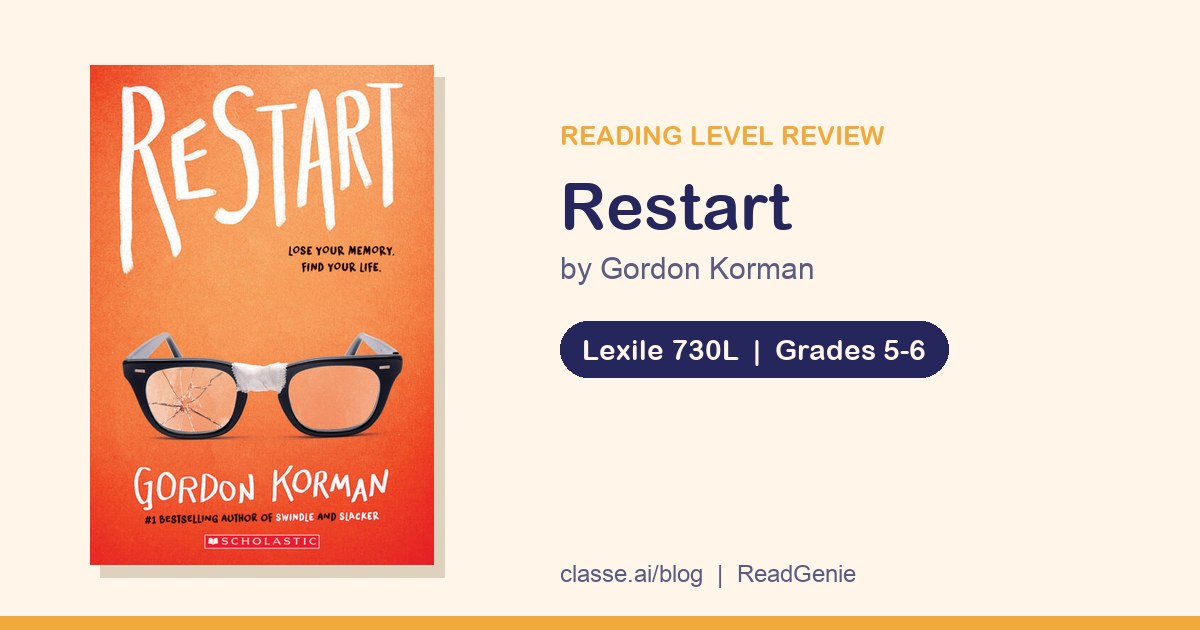
Restart by Gordon Korman has a 730L Lexile measure, an AR (ATOS) book level of 5.1, a Guided Reading level of W and a DRA level of 40 to 50. Most kids can read it on their own in 5th or 6th grade. The sentences are short and the story pulls hard from the first page, so it is one of the better novels to hand a struggling reader in grades 6 to 8, especially with the audiobook. The chapters run long and the narrator changes often, so plan to read the first few together.
Chase Ambrose falls off the roof of his house and wakes up in the hospital with no idea who he is. When he goes back to middle school, some kids treat him like a football hero and others flinch when he walks past. Bit by bit he works out that he was the school's worst bully, and he isn't sure he likes the person he keeps hearing about. The chapters switch between Chase and the kids around him, including the sister of a boy he drove out of town. Middle schoolers love the mystery of who Chase really was and whether a person can start over.
Restart reading level at a glance
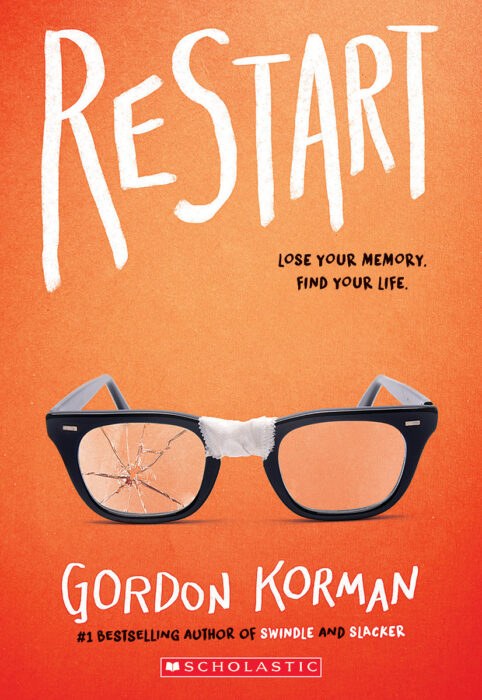
| Lexile measure | 730L (Scholastic Teacher Store) |
|---|---|
| ATOS / AR book level | 5.1 (TeachingBooks) |
| AR points | 9 (TeachingBooks) |
| Guided Reading (Fountas & Pinnell) | W (Scholastic Teacher Store) |
| DRA level | 40-50 (Scholastic Teacher Store) |
| Flesch Reading Ease (0-100) | 87.3 ReadGenie estimate |
| Flesch-Kincaid grade | 3.5 ReadGenie estimate |
| Interest level | Grades 5-9 (Scholastic Teacher Store) |
| Approximate grade band | Grades 5-6 (ages 10-12) ReadGenie |
| Length | 256 pages, ~59,925 words |
| Format | Middle grade novel |
| Good for struggling readers? | ★★★★★ 4/5 |
| Dyslexia-friendly rating | ★★★★★ 4/5 |
We couldn't find a published grade level equivalent for this book.
Scores checked 2026-11-06. Different leveling systems don't always agree, so we show each published value with its source and mark our own estimates. Links to every source are under How we rate books.
Is your child working hard and still getting stuck on words?
ReadGenie helps struggling readers improve their reading, spelling and handwriting with Orton-Gillingham practice at home. Your child reads out loud, the app listens, and it helps with the exact sound they missed. Join today and we'll mail your child Restart for free.
Try ReadGenie and get your free bookStarts with a free 7-day trial. Book mailed after your first paid month. US only, one per family.
What grade level is Restart?
Restart sits at about a 5th to 6th grade reading level, and the publisher aims it at grades 5 to 9. The different measures agree more closely than they do for many books, which makes it easier to place.
An AR level of 5.1 means the text is about as hard as what a typical student reads at the start of 5th grade. The Lexile of 730L lands in the same place. Both measures look mostly at sentence length and how common the words are. Korman writes in quick, punchy sentences, many of them a single thought on its own line, and the first chapter averages under 10 words a sentence. Our own readability check on that chapter came out closer to a 3rd or 4th grade level, which shows how plain the sentences are.
Guided Reading level W usually lines up with the end of 5th grade, and DRA 40 to 50 covers 4th and 5th grade on most school charts. Those levels weigh things the formulas miss. The book has several narrators, a plot that turns on what people remember and hide, and real questions about guilt and forgiveness. That takes more maturity than the sentences alone would suggest.
The book is worth 9 AR points and runs about 60,000 words, so it is long. The short version for a parent is that a 5th or 6th grader reading on grade level can handle it, and a 7th or 8th grader reading a year or two behind gets a book about kids their own age that they can actually read.
Is Restart good for struggling readers?
Yes, for the right kid. We give it 4 out of 5 for struggling readers in grades 6 to 8.
The biggest strength is that it looks and feels like a middle school book. Chase is in 8th grade, the setting is a real middle school with football, group chats and a principal's office, and nothing about the cover or the story feels younger. That matters to a 13-year-old who is tired of being handed books meant for little kids. The hook is strong too. The first chapter ends with Chase staring at an old photo of himself and wondering what kind of person he was, and most kids want to keep going.
The writing helps a slower reader. Sentences are short, there is a lot of dialogue, and only about 5 in every 100 words have three or more syllables. Some chapters include text-message chats, which break up the page.
What keeps it from a 5 is length and structure. Chapter 1 runs close to 2,900 words, which is 20 to 30 minutes for a child who decodes slowly. The point of view also jumps between several kids. Each chapter title names the narrator, but a reader who is putting all their energy into the words can lose track of who is talking.
Here is who it fits and who it may frustrate.
- Great for 6th to 8th graders reading at about a 4th or 5th grade level who want a book that feels their age.
- Great for 5th and 6th graders reading on grade level who like funny, fast school stories.
- Harder for kids still reading below a 4th grade level on their own. Read it aloud or lean on the audiobook.
- Harder for a reader who gets lost when the narrator changes, unless you keep a name card handy.
Is Restart good for kids with dyslexia?
Overall: ★★★★★ 4/5
| Factor | Score | Why |
|---|---|---|
| Sentence length | 4/5 | Chapter 1 averages about 9 or 10 words a sentence, with many one-line thoughts and short bits of dialogue. |
| Vocabulary load | 4/5 | Mostly everyday words, with about 5 in 100 words of three or more syllables. A few longer ones like fluorescent and concussion. |
| Decodability | 4/5 | Most words follow common patterns. Names like Shoshanna, Hakimian, Bratsky and Cooperman are harder to sound out. |
| Text density and layout | 3/5 | Standard novel type on 256 pages, broken up by dialogue, short paragraphs and some text-message chats. |
| Pictures that carry meaning | 1/5 | Text only. |
| Chapter length | 2/5 | Chapter 1 is about 2,900 words, around 20 to 30 minutes for a slower reader. |
| Engagement for reluctant readers | 5/5 | A big mystery from page one and lots of humor. Kids want to know what Chase did and whether he has really changed. |
| Audiobook / read-along support | 5/5 | Unabridged audiobook from Recorded Books, read by several narrators. |
We give it 4 out of 5 on our dyslexia-friendly scale. It scores highest for engagement and audio, and lowest for pictures and chapter length.
Short sentences are the main win. A dyslexic reader doesn't have to hold a long chain of words in mind while still working out the end of a line, and many of Korman's sentences are four or five words long. Most of the vocabulary is everyday middle school talk. The harder words in the opening are medical ones from the hospital scene, like concussion and fluorescent, and they don't keep coming back.
Names are the tricky part. Shoshanna, Hakimian, Bratsky and Cooperman are long and not all of them follow regular patterns, and they appear often. Teach them before your child meets them and the pages get much easier.
Audio support is strong. Recorded Books publishes an unabridged audiobook read by several narrators, and many libraries carry it. Following the print while listening lets a dyslexic child keep up with the story, hear how the names and longer words sound, and still see every word.
There is no dyslexia-friendly edition. The paperback uses standard novel type with a fair amount of white space from dialogue.
Words and phonics patterns to practice first
Restart works best once a child is comfortable with blends, digraphs, vowel teams and common suffixes. These patterns show up again and again in the first chapter.
- Closed syllables with short vowels, like grass, neck, clip, shut, kicked and punched.
- Consonant blends in brace, blank, blinking, glasses, squeeze and screams.
- The digraphs sh, ch, th and ck in thrash, shut, chart, choked and neck.
- Vowel teams, as in screams, squeeze, sheet, beeping and feel.
- R-controlled vowels in harsh, chart, hurts, mother, finger and doctor.
- The endings -sion, -tion, -ness and -ment in explosion, concussion, celebration, brightness, nothingness and excitement.
Pre-teach the names first, because they carry the whole book. That means Chase Ambrose, his dad's wife Corinne, his little half sister Helene, Shoshanna Weber, Aaron Hakimian and Bear Bratsky. Then add a handful of harder words from the opening chapters, like fluorescent, concussion, amnesia, conservatory and exile. Amnesia is worth a minute of talk, since the whole story hangs on it.
Patterns like these are what ReadGenie practices with a child every day. Your child reads aloud, the app listens, and it helps with the exact sound they missed, so endings like -sion and -tion stop being speed bumps in a long novel.
How to read Restart with your child
Read chapter 1 aloud together. It opens with Chase falling and waking up, and it ends on that photo. Stop there and ask your child to guess what Chase was like before the fall. Then keep the guesses and check them as you read.
Make a name card with the narrators as you meet them. Chase, Shoshanna, Joel, Aaron and Bear are enough to start. Write one word next to each name about how that person feels about Chase. The words will change as the book goes on, which is half the fun.
Split long chapters in half. Let your child read one half aloud and listen to the other half on the audiobook while following the print. That keeps the story moving without wearing anyone out, and at a chapter a night the book takes a few weeks.
Talk about the big question. Can people really change, and how would you know if they had? Ask what Chase has to do to prove it, and whether the kids he hurt owe him a second chance.
Talk about the bystanders too. A lot of kids in the book watched the bullying and did nothing. Ask your child what they could have done, and what they would do.
Using Restart in the classroom or tutoring
For teachers, it fits a Guided Reading level W group or a whole-class novel in grades 6 to 8, with the audiobook available for students who need it. A simple chart works well, with each narrator in a row and columns for what they think of Chase at the start, the middle and the end. The book is a natural way into a class talk about bystanders, second chances and how a reputation forms, and it gives quieter students something concrete to argue about.
For tutors, use a few pages a session for fluency instead of a whole chapter. Pull words like explosion, concussion and celebration into a quick drill on -sion and -tion, then have the student find them in the text. The narrators' names are good syllable division practice too. Try Sho-shan-na, Ha-ki-mi-an and Coo-per-man. For an older student who is tired of younger-looking books, this one is easy to carry around.
Content notes for parents
Bullying is at the center of the story, and some of it is described in detail, including pranks, shoving and a bike crash that injures a boy. Chase is badly hurt in his fall and spends time in the hospital. His parents are divorced and his dad has a new family, which causes some tense scenes. The book is often funny and the tone stays hopeful, and it treats the bullying as wrong without lecturing.
Should your child read it?
If your child is in grades 5 to 8 and reading at about a 4th or 5th grade level or above, Restart is a great pick, and even better with the audiobook. If they're reading below that, read it aloud together or start with a shorter school story like Fish in a Tree. When they finish, Ungifted is more Gordon Korman at a similar level, Because of Mr. Terupt is another class told by many voices, and Wonder and Freak the Mighty are good next steps up.
Make the next book easier
Short daily sessions of reading, spelling and handwriting practice, built with Orton-Gillingham teachers. It works alongside tutoring and school support. The first 7 days are free. Join today and we'll mail your child Restart for free.
Try ReadGenie and get your free bookStarts with a free 7-day trial. Book mailed after your first paid month. US only, one per family.
FAQ
What age is Restart by Gordon Korman for?
The publisher lists Restart for grades 5 to 9, which is about ages 10 to 14. Most kids can read it on their own between about 10 and 12. Because the story is set in 8th grade, it also works well for older middle schoolers who are reading below grade level.
What is the AR level of Restart?
Restart has an ATOS book level of 5.1 and is worth 9 AR points. The level reflects short, plain sentences, and the high point value reflects how long the book is.
What is the Lexile level of Restart?
Restart has a Lexile measure of 730L. That puts it in the usual range for 5th grade, though the book's themes and changing narrators make it feel a little harder than the number suggests.
What is the guided reading level of Restart?
Restart is listed at Guided Reading level W, which most schools expect around the end of 5th grade. Scholastic also lists it at DRA 40 to 50.
Is Restart appropriate for 5th graders?
For most 5th graders, yes. The reading level is a good match, and the bullying is shown as wrong and handled with humor and hope. A sensitive child may want to read it with a parent so they can talk through the harder scenes.
What is Restart about?
An 8th grader named Chase loses his memory after falling off his roof. Back at school he finds out he used to be a bully, and he has to decide whether he can become someone better and whether the kids he hurt will let him.
Get Restart free
ReadGenie helps struggling readers improve their reading, spelling and handwriting in short daily sessions at home. Join and we'll mail your child this book for free.
Claim your free bookStarts with a free 7-day trial. Book mailed after your first paid month. US only, one per family.
What to read next
- Fish in a Tree by Lynda Mullaly Hunt (easier). A school story about a kid hiding a struggle and the classmates who help, at a lower Lexile.
- Because of Mr. Terupt by Rob Buyea (similar). Another classroom told by many narrators in short chapters, with a big event that changes everyone.
- Ungifted by Gordon Korman (similar). Gordon Korman again, a troublemaker sent to a school for gifted kids, told by many narrators.
- Wonder by R.J. Palacio (harder). A middle school story about kindness and bullying, told by several narrators, at a slightly higher level.
- Freak the Mighty by Rodman Philbrick (harder). Two outsiders become friends and stand up to bullies, with harder words and longer sentences.
Browse all of our reading-level book reviews.
How we rate books
Lexile, ATOS (Accelerated Reader), Guided Reading and DRA levels come from the companies that own them and from publishers. We link to where we found each one, and when a level isn't published we say so. Anything marked "ReadGenie estimate" is our own call, not an official level. Flesch scores come from a short public excerpt when the publisher offers one. The struggling-reader and dyslexia-friendly ratings are our judgment, based on eight things (sentence length, vocabulary, decodability, page layout, pictures, chapter length, how gripping the story is, and audiobook support). Treat them as a starting point. The right book is one your child can read with about 95% accuracy and wants to keep reading.
Sources
- Scholastic Teacher Store: Restart (paperback) (Lexile, Guided Reading level, DRA, ACR level, ISBN, page count, grades, See Inside pages for Flesch scores)
- TeachingBooks: Restart (ATOS, AR points, word count, Lexile check)
- Booksource: Restart (Guided Reading check, Lexile check, AR level check, interest level)
- Centre County Library catalog: Restart audiobook (unabridged audiobook from Recorded Books)