The Outsiders Reading Level: Lexile 750L, AR 4.7, Guided Reading Z
The Outsiders by S.E. Hinton is Lexile 750L, AR level 4.7 with 7 AR points and Guided Reading Z. The words are easy for a 5th grader, but the violence makes it a book for 7th grade and up, where it is a strong pick for struggling readers.

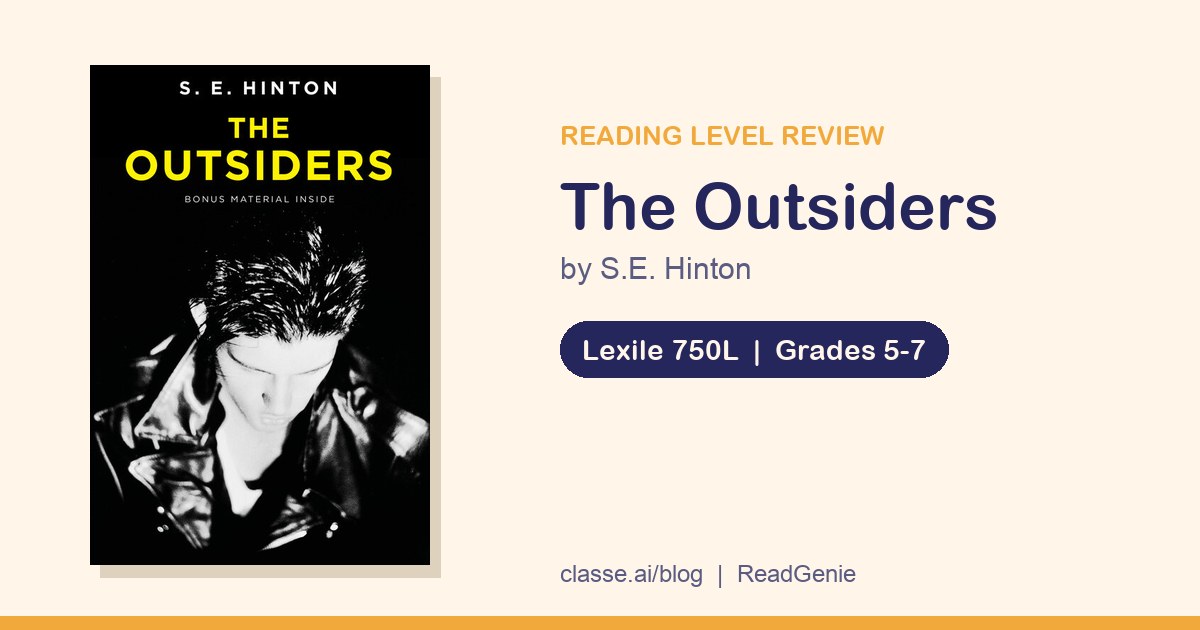
The Outsiders by S.E. Hinton has a 750L Lexile measure, an AR (ATOS) book level of 4.7 worth 7 AR points, and a Guided Reading level of Z. The words and sentences are easy enough for a 5th grader, but gang fights and the deaths of two boys make it a book for 7th grade and up. For a 7th or 8th grader who reads a year or two behind, that gap is good news, because the reading is lighter than the book looks, and the audiobook makes it lighter still.
Ponyboy Curtis is fourteen. His parents died in a car crash, and he lives with his two older brothers, Darry and Sodapop, on the poor east side of an Oklahoma town. He and his friends are greasers, with long, oiled hair and not much money. The Socs are the rich kids from the west side, and they jump greasers for fun. One night a fight in a park goes wrong, and Ponyboy and his friend Johnny have to run. Hinton was a teenager herself when she wrote it, and Ponyboy still sounds like a real kid talking. It has been a middle school class novel for decades, which is why so many parents end up looking up its level.
The Outsiders reading level at a glance

| Lexile measure | 750L (Penguin Random House) |
|---|---|
| ATOS / AR book level | 4.7 (TeachingBooks) |
| AR points | 7 (TeachingBooks) |
| Guided Reading (Fountas & Pinnell) | Z (Penguin Random House) |
| Flesch Reading Ease (0-100) | 88.0 ReadGenie estimate |
| Flesch-Kincaid grade | 4.3 ReadGenie estimate |
| Interest level | Ages 12 and up (grade 7 and up) (Penguin Random House) |
| Approximate grade band | Grades 5-7 (ages 10-13) ReadGenie |
| Length | 224 pages, ~48,523 words |
| Format | Young adult novel |
| Good for struggling readers? | ★★★★★ 4/5 |
| Dyslexia-friendly rating | ★★★★★ 3/5 |
We couldn't find a published DRA level or grade level equivalent for this book.
Is The Outsiders a struggle for your child right now? ReadGenie gives struggling readers short daily Orton-Gillingham practice at home, out loud, with help on the exact sound they missed.
Try ReadGenie and get this book freeScores checked 2026-11-16. Different leveling systems don't always agree, so we show each published value with its source and mark our own estimates. Links to every source are under How we rate books.
What grade level is The Outsiders?
That depends on which number you look at, and with this book the numbers really do disagree.
An AR level of 4.7 means the text is about as hard as what a typical student reads near the end of 4th grade. A Lexile of 750L sits in the same band. Both measures mostly weigh sentence length and how common the words are, and Ponyboy talks in short, plain sentences. Our own readability check on chapter 1 came out a little lower still, in the 4th grade range. By the words alone, a 5th grader reading on grade level could handle it.
Guided Reading level Z is a different story. That is the top of the Fountas and Pinnell scale, usually given to books for 7th and 8th grade and up. Guided Reading looks at more than words. It weighs themes, how much a reader has to infer, and how mature the content is. The Outsiders asks readers to think about class, loyalty, grief and violence, and the publisher lists it for ages 12 and up.
So our estimate for independent reading is grades 5 to 7, while the age the book is written for is 12 and up. In practice, most kids read it in 7th or 8th grade, when the content fits, and at that point the reading itself is comfortable for a typical student. It is about 48,500 words long and worth 7 AR points, which makes it shorter than most class novels at this age.
Is The Outsiders good for struggling readers?
Yes, for the right age. We rate it 4 out of 5 for struggling readers in grades 7 and up.
The reason is that low reading level paired with a story older kids respect. A 13-year-old who reads at a 5th grade level often gets handed books that look young. This one doesn't. It is a teen book about teens, and Ponyboy speaks straight to the reader in everyday words. Fewer than 4 percent of the words in chapter 1 have three or more syllables. The action starts in the first few pages, when Ponyboy is jumped on his walk home from the movies.
There are some real hurdles. There are only 12 chapters in about 48,500 words, so each one runs around 4,000 words, which is a lot for one sitting. There are no pictures. The cast is big, and almost everyone goes by a nickname. The 1960s slang can confuse a modern reader for a few pages.
Watch for these sticking points:
- Nicknames for nearly everyone, like Soda, Pony, Dally and Two-Bit
- Old slang such as hood, tuff, heater and rumble
- Long chapters with only a few scene breaks inside them
- A few heavy scenes that are hard to read alone
A struggling reader whose class is reading The Outsiders will do well with a list of names, a plan to split each chapter in two, and the audiobook for the longest stretches. A younger child who reads well but isn't ready for the violence can wait a year or two without missing anything.
Is The Outsiders good for kids with dyslexia?
Overall: ★★★★★ 3/5
| Factor | Score | Why |
|---|---|---|
| Sentence length | 3/5 | Chapter 1 averages 13.2 words per sentence, and about 44% of sentences have 8 words or fewer. |
| Vocabulary load | 4/5 | Fewer than 4% of words in chapter 1 have three or more syllables, mostly words like neighborhood, cigarette and different. |
| Decodability | 3/5 | Most words follow common patterns, but the nicknames and slang (Sodapop, Two-Bit, Socs, tuff) and words like handkerchief need a preview. |
| Text density and layout | 2/5 | Standard paperback pages of small type with no pictures and few breaks inside the long chapters. |
| Pictures that carry meaning | 1/5 | Text only, with no pictures inside the story. |
| Chapter length | 2/5 | Twelve chapters across about 48,500 words, so most run around 4,000 words, too long for one short sitting. |
| Engagement for reluctant readers | 5/5 | Fights, a chase, a fire and a narrator teens trust keep reluctant readers turning pages. |
| Audiobook / read-along support | 5/5 | An official unabridged audiobook from Listening Library read by Jim Fyfe, and a Recorded Books version, both easy to find in libraries. |
We rate The Outsiders 3 out of 5 for dyslexic readers. The words themselves are friendly, and the story is gripping. The format is the problem.
Start with what helps. Chapter 1 averages about 13 words a sentence, but more than four in ten sentences have 8 words or fewer, and the longer ones sound like speech, so they are easy to follow. The vocabulary is light for a teen novel. Most of the longer words are ones a child already knows by ear, like neighborhood, different and everything.
The page layout works against it. This is a standard paperback with small type, no pictures and long chapters with few breaks inside them. For a dyslexic reader, a 4,000-word chapter can feel endless, even when every sentence is easy. Splitting each chapter at a scene break, or at a set page number, helps more than anything else.
Audio is the best support. There is an official unabridged audiobook from Listening Library, read by Jim Fyfe, and a second recording from Recorded Books. Most libraries carry at least one of them. For a dyslexic reader with The Outsiders on the class list, following the print while listening is the surest way through, and it means they can join class discussion on the same day as everyone else. A Spanish edition exists too.
Words and phonics patterns to practice first
Hinton's words are plain, and the patterns that come up most are ones a 2nd or 3rd grade phonics program covers. That makes this a good book for an older student to see those patterns in real reading, not in a workbook.
The suffix -ed is everywhere, because Ponyboy tells the story in the past tense. Chapter 1 has jumped, scared, pulled, slugged, hollered and walked. Ask whether each ending sounds like /t/, /d/ or /ed/, and point out that slugged doubles its g.
The suffix -ing comes right behind it, in running, walking, getting, grinning, shaking and wishing. Running and grinning are good ones for the doubling rule.
Digraphs show up in shaking, thing, much, which, why and brother. R-controlled vowels appear in Darry, hair, never, older, first and hurt. Vowel teams come in short, common words like real, mean, away and leave, and in greaser and haircut, two words the whole book depends on.
Silent e words like ride, home, made, like, nice and smile are easy wins. Consonant-le ends little, people, trouble, bottle, middle and gentle. People is also a red word, since the eo spelling doesn't follow the usual rules.
Pre-teach these as whole words before chapter 1: Ponyboy, Sodapop, Darry, Socs, greaser, Dallas, handkerchief, cigarette, conscious and perspiration. Socs is said like "sohsh," short for socials, and that surprises almost every new reader. If your older child still stalls on endings like -ed and -ing, short daily Orton-Gillingham practice on exactly those suffixes (the kind ReadGenie gives at home) makes a novel like this far less tiring.
How to read The Outsiders with your child
Read chapter 1 together. It introduces Ponyboy's brothers and the whole gang at once, and it is the hardest stretch of names in the book. Once your child knows who everyone is, the rest goes faster.
Make a nickname card before you start, with each nickname next to the real name. Soda is Sodapop, Pony is Ponyboy, Dally is Dallas. Your child can use it as a bookmark and add to it as new people show up.
Split each chapter in two. Find a scene break near the middle, or just pick a page, and treat each half as one night's reading. Twenty-four short reads feel very different from twelve long ones.
Plan to be nearby for chapter 4, when the fight in the park turns deadly, and for the last few chapters. Read them together or listen to the audiobook side by side. These are the scenes kids most want to talk about, and the hardest to read alone.
When your child finishes, watch the 1983 movie together and talk about what changed. Many kids also want to know that the book became a Broadway musical, which is a nice sign that a book written in the 1960s still matters to teens now.
Using The Outsiders in the classroom or tutoring
For teachers, the single narrator makes this a strong book for teaching point of view. Ask students how the Socs would tell the same story, then look at the Socs who do talk honestly with Ponyboy, like Cherry and Randy. Pair the book with Robert Frost's poem Nothing Gold Can Stay, which Ponyboy recites to Johnny. Give struggling readers the audiobook so they can join whole-class discussion of each chapter on the same day.
For tutors, pre-teach Ponyboy, Sodapop, Darry, Socs and greaser before the first session. Chapter 1 is full of -ed and -ing words for practice, like jumped, slugged, grinning and shaking. Put the slang on an index card, with hood, tuff, heater and rumble and what each one means, so the student doesn't stop to puzzle over them mid-page.
Content notes for parents
The Outsiders is about violence, and it doesn't look away from it. There are gang fights with chains and a knife, and a boy is stabbed and killed in self-defense. Two main characters die by the end. Teens smoke and drink, and there is talk of guns. Some boys come from homes where they are neglected or hit. There is no sex. Most 12 and 13 year olds handle it well and come away talking about loyalty and fairness, but a sensitive child may want you close by for the last third of the book.
Should your child read it?
If your child is in 7th grade or older, hand them The Outsiders, even if they read a year or two behind. The words are easier than the book looks, and the story carries them. If they read below a 4th grade level, use the audiobook and read together. If your child is a strong 5th or 6th grade reader, the reading won't stop them, so the question is whether they are ready for the content. If not, try Holes or Among the Hidden first, and save this one for later.
Make the next book easier
Short daily sessions of reading, spelling and handwriting practice, built with Orton-Gillingham teachers. It works alongside tutoring and school support. The first 7 days are free. Join today and we'll mail your child The Outsiders for free.
Try ReadGenie and get your free bookStarts with a free 7-day trial. Book mailed after your first paid month. US only, one per family.
FAQ
Is The Outsiders appropriate for 6th grade?
The reading is easy enough for most 6th graders, at an AR level of 4.7. The content is the question. The publisher lists it for ages 12 and up because of gang violence and the deaths of two boys. Some 6th grade classes read it, but many families wait until 7th grade.
How many AR points is The Outsiders?
The Outsiders is worth 7 AR points, with an AR (ATOS) book level of 4.7. That is fewer points than many middle school novels, since the book is only about 48,500 words long.
What is The Outsiders Lexile level?
The Outsiders has a Lexile measure of 750L. That sits around 4th to 5th grade on most Lexile charts, well below the age the book is written for, which is why it works so well for older struggling readers.
What age is The Outsiders for?
The publisher lists it for ages 12 and up, and most kids read it at 12 to 14 in 7th or 8th grade. A younger strong reader can handle the words, but the violence and grief are better suited to a child who is 12 or older.
Why is The Outsiders Guided Reading level Z when the Lexile is so low?
Guided Reading levels weigh themes and maturity as well as words. The Outsiders uses short, simple sentences, which keeps the Lexile and AR level low, but its ideas about class, loyalty and death put it at the top of the Guided Reading scale.
Get The Outsiders free
ReadGenie helps struggling readers improve their reading, spelling and handwriting in short daily sessions at home. Join and we'll mail your child this book for free.
Claim your free bookStarts with a free 7-day trial. Book mailed after your first paid month. US only, one per family.
What to read next
- Holes by Louis Sachar (easier). Another story about kids written off by the world who stand up for each other, with a lighter tone and short chapters.
- Among the Hidden by Margaret Peterson Haddix (easier). A short, tense story about a boy who has to hide, good for a reader who isn't ready for the violence yet.
- Hatchet by Gary Paulsen (similar). A plain-spoken survival story that pulls reluctant readers along, with a similar reading load.
- The Crossover by Kwame Alexander (similar). Two brothers, loyalty and loss, told in verse with lots of white space on the page.
- The Giver by Lois Lowry (similar). Another short classic that schools assign in middle school, with big questions to talk about.
- The Hunger Games by Suzanne Collins (harder). A longer, faster book about loyalty and survival for teens ready for a bigger read.
Browse all of our reading-level book reviews.
How we rate books
Lexile, ATOS (Accelerated Reader), Guided Reading and DRA levels come from the companies that own them and from publishers. We link to where we found each one, and when a level isn't published we say so. Anything marked "ReadGenie estimate" is our own call, not an official level. Flesch scores come from a short public excerpt when the publisher offers one. The struggling-reader and dyslexia-friendly ratings are our judgment, based on eight things (sentence length, vocabulary, decodability, page layout, pictures, chapter length, how gripping the story is, and audiobook support). Treat them as a starting point. The right book is one your child can read with about 95% accuracy and wants to keep reading.
Sources
- Penguin Random House: The Outsiders by S. E. Hinton (Lexile, ATOS, Fountas & Pinnell, ages and grades, pages, edition, formats, audiobook narrator, Flesch excerpt, phonics patterns, sentence length)
- TeachingBooks: The Outsiders (ATOS, AR points, Lexile, word count, grades, audiobook)
- Booksource: The Outsiders (Lexile, AR level, AR points, interest level, pages)
- Scholastic 2021-2022 Education Solutions Catalog (Guided Reading, Lexile)