Wayside School Reading Level: Lexile, AR and Grade Level Guide
Sideways Stories from Wayside School is Lexile 460L, AR level 3.3 and Guided Reading level P, so most kids read it alone in 3rd or 4th grade. Here's how it works for struggling readers and kids with dyslexia, and which names to practice first.

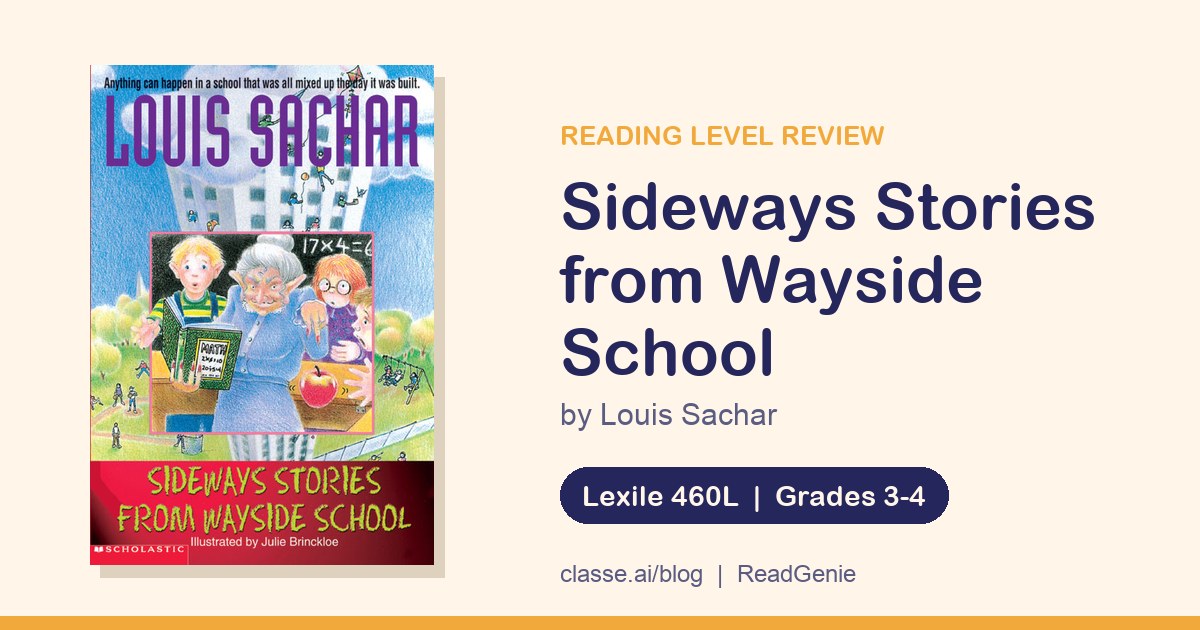
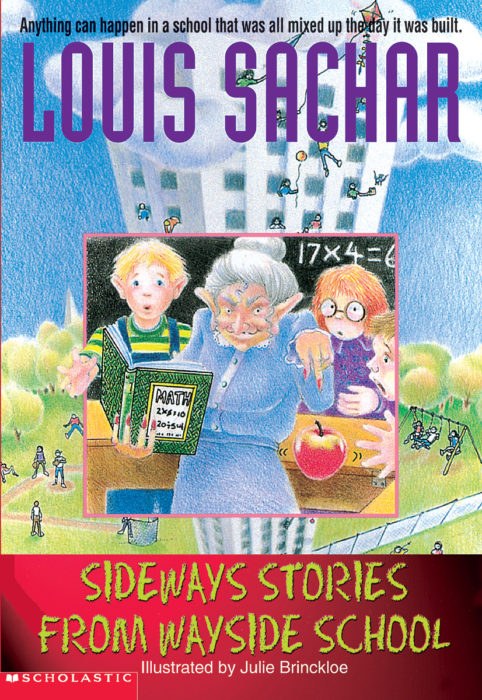
Sideways Stories from Wayside School, the first Wayside School book by Louis Sachar, has a 460L Lexile measure, an AR (ATOS) book level of 3.3 and a Guided Reading level of P. Most kids can read it on their own in 3rd or 4th grade. For a child who finds reading hard, it's one of the best longer books out there, because its 30 chapters are each a short, complete story that can be finished in one sitting. The strange character names are the main thing to prepare for.
The joke starts with the building. Wayside School was meant to be one story tall with thirty classrooms in a row, but the builder stacked them thirty stories high by mistake. The book visits the class on the top floor, one chapter per kid or teacher. A mean teacher turns students into apples, a new student turns out to be something very odd under his raincoats, and there's a nineteenth floor that doesn't exist. Kids love it because nothing works the way it should, and every chapter ends with a twist they want to tell someone about.
Sideways Stories from Wayside School reading level at a glance
| Lexile measure | 460L (Scholastic Teacher Store) Also listed as 530L |
|---|---|
| ATOS / AR book level | 3.3 (TeachingBooks) |
| AR points | 3 (TeachingBooks) |
| Guided Reading (Fountas & Pinnell) | P (Scholastic Teacher Store) |
| DRA level | 34-38 (Scholastic Teacher Store) |
| Interest level | Grades 3-6 (Booksource) |
| Approximate grade band | Grades 3-4 (ages 8-10) ReadGenie |
| Length | 128 pages, ~20,395 words |
| Format | Chapter book |
| Good for struggling readers? | ★★★★★ 4/5 |
| Dyslexia-friendly rating | ★★★★★ 4/5 |
We couldn't find a published grade level equivalent or Flesch score for this book.
Scores checked 2026-11-05. Different leveling systems don't always agree, so we show each published value with its source and mark our own estimates. Links to every source are under How we rate books.
Is your child working hard and still getting stuck on words?
ReadGenie helps struggling readers improve their reading, spelling and handwriting with Orton-Gillingham practice at home. Your child reads out loud, the app listens, and it helps with the exact sound they missed. Join today and we'll mail your child Sideways Stories from Wayside School for free.
Try ReadGenie and get your free bookStarts with a free 7-day trial. Book mailed after your first paid month. US only, one per family.
What grade level is Wayside School?
Book 1 reads at about a 3rd to 4th grade level. A child reading comfortably at the end of 3rd grade can usually read it alone, and most 4th graders find it an easy, funny read.
An AR level of 3.3 means the text is about as hard as what a typical student reads in the third month of 3rd grade. The book is worth 3 AR points because it's longer than most books at that level, about 20,000 words. Guided Reading level P is a letter many schools expect around the end of 3rd grade, and DRA 34 to 38 points to the same spot. So the different measures agree more than they disagree.
The Lexile measure is where sources split. Scholastic, Booksource and Mind Resources all list 460L, while TeachingBooks lists 530L. We go with Scholastic's number because it's for the edition we checked, but either way the book sits in the 400s and low 500s, which is a gentle Lexile for a book this long. That gap between a low Lexile and a higher letter level tells you something useful. The sentences are short and the words are common. What makes it a level P book is the length, the wordplay and keeping track of thirty characters.
The second book, Wayside School Is Falling Down, has nearly the same levels at Scholastic, so a child who finishes book 1 can go straight on. Booksource suggests the series for interest in grades 3 to 6, and plenty of 5th graders still enjoy it.
Is Wayside School good for struggling readers?
Yes, for most kids. We give it 4 out of 5 for struggling readers.
The chapters are the big reason. Thirty chapters for about 20,000 words works out to roughly 680 words each, which is a few pages and often under 10 minutes even for a slow reader. Each one is its own little story with a beginning and an ending. A child who reads one chapter has finished something, and if a busy week means skipping a night, there's no plot to lose track of.
It also looks and feels like an upper elementary book. That matters a great deal to a 4th or 5th grader reading below grade who is tired of thin, younger-looking books. Wayside School is a book their classmates know, and the humor is clever enough that nobody feels talked down to.
There are some things to plan for. Almost every chapter introduces a new name, and many of them don't follow normal spelling, like Maurecia, Dameon and Mrs. Jewls. There's only a small drawing at the start of each chapter, so the words carry everything. And the jokes often run on backwards logic and wordplay. A very literal child may need you to say out loud that the story is being silly on purpose.
Kids who still need pictures on every page will do better with Dog Man or Captain Underpants first, then come back to Wayside School.
Is Wayside School good for kids with dyslexia?
Overall: ★★★★★ 4/5
| Factor | Score | Why |
|---|---|---|
| Sentence length | 4/5 | A low Lexile for its grade band points to short sentences, and much of the book is quick dialogue. |
| Vocabulary load | 4/5 | Mostly everyday school words like class, recess, teacher and floor. Few long or rare words outside the names. |
| Decodability | 3/5 | Common words decode well, but names like Mrs. Jewls, Maurecia, Dameon and Sharie break the usual spelling rules. |
| Text density and layout | 3/5 | About 20,000 words on 128 pages in the Scholastic paperback, so pages are fuller than in a first chapter book, but chapters end often. |
| Pictures that carry meaning | 2/5 | A small drawing opens each chapter. The text carries the story. |
| Chapter length | 5/5 | Thirty chapters for about 20,000 words, roughly 680 words each, or about 5 to 8 minutes for a slower reader. |
| Engagement for reluctant readers | 5/5 | Silly, surprising and fast. Each chapter has a twist ending kids want to tell someone about. |
| Audiobook / read-along support | 4/5 | An unabridged audiobook is published and libraries carry it. |
We give it 4 out of 5 on our dyslexia-friendly checklist.
Chapter length is the strongest point. Short chapters mean a dyslexic reader gets frequent stopping points and a feeling of progress, and decoding fatigue doesn't build up the way it does in a 20-page chapter. The low Lexile also tells you the sentences are short and the everyday vocabulary is easy. Words like class, floor, teacher, recess and yard come up again and again.
Decoding the names is the hardest part. A dyslexic child can read a whole page well and then stall on Maurecia. That's not a sign the book is too hard. It just means the names need to be taught before reading, as whole words.
Pages are fuller than in a first chapter book, with no pictures after the opening drawing, so read in short sessions. An unabridged audiobook is published and many libraries carry it. Listening to one chapter and then reading the next one out loud, with the names already in your child's ear, works well for this book. There's no special dyslexia-friendly edition.
Words and phonics patterns to practice first
Most of the everyday words in this book follow regular patterns, which makes it a good book for practicing them in real reading.
Closed syllables with short vowels show up in class, desk, sticks, ball and in names like Todd and Dana. These are good warm-up words for any chapter.
Vowel teams are everywhere because the book is about a school. School, floor, teacher, read, green and tooth are worth making automatic before you start.
R-controlled vowels come up in story, floor, yard and third, and in names like Gorf and Myron. A quick or, ar and ir sort is a good warm-up.
Silent e words like side, mistake, made, nose, joke and shade are common. Mistake is worth practicing because it's part of the opening joke about the building.
Digraphs appear in thirty, teacher, children, shoes and wish. Sharie is a nice example of sh at the start of a name.
Compound words like sideways, wayside, classroom, outside, something and upstairs are a fun pattern to point out. The book's own title is two of them.
Teach these names as whole words before reading. Wayside, Gorf, Jewls, Louis, Maurecia, Dameon, Sharie, Bebe, Myron, Leslie, Kathy and Zarves. Put them on a bookmark so your child can check without stopping.
If your child gets stuck on patterns like these, short daily practice usually helps more than pushing through a hard book. ReadGenie gives kids Orton-Gillingham style practice on exactly these sounds, so books like Wayside School start to feel easier.
How to read Wayside School with your child
Before chapter 1, make a name card with Wayside, Mrs. Gorf, Mrs. Jewls and Louis the yard teacher. Each time you meet a new kid, add their name. By the end, the card is a list of the whole class and a nice record of how far your child got.
Read one chapter a night. They're short enough to finish in one sitting, so your child ends every session on a win. You can take turns by page, and let your child read the dialogue out loud in funny voices. The book is full of characters who are easy to act out.
After each chapter, ask your child to tell you the twist in one sentence. It's a quick way to check understanding, and it's fun, because the endings are the best part.
Don't worry about reading in order. Most chapters stand on their own, so if your child wants to reread a favorite or jump ahead to a name they like, let them.
Using Wayside School in the classroom or tutoring
For teachers, the book fits a Guided Reading level P group, and it's also a classic daily read-aloud because every chapter is complete. One project that works well is giving each student a chapter to read and present, so the class builds a gallery of all thirty Wayside kids. The joke behind Mrs. Gorf's name, which spells something else backwards, makes a fun mini lesson on reading words in reverse and noticing spelling patterns.
For tutors, one chapter fits neatly into a 30 minute session for fluency work. The names are good material for syllable division, like Mau-re-cia and Da-me-on, and for talking about which parts follow the rules and which don't. Compound words like sideways and classroom make a quick sort where your student splits each word into its two smaller words.
Content notes for parents
The humor is silly and sometimes a little dark in a cartoon way. A strict teacher turns children into apples and ends up eaten by the yard teacher, and one new student turns out to be a dead rat in raincoats. None of it is scary in tone, and kids usually find it hilarious. There's mild name calling and some classroom pranks. There's no swearing or romance.
Should your child read it?
If your child reads around Guided Reading level O or P, or is a 3rd or 4th grader ready for a longer book, Wayside School is a great pick. It's especially good for an older child reading a year or two below grade, because the short chapters make a long book manageable and the humor feels grown up. If your child is still below level M on their own, read it aloud together for now, and try Judy Moody or Junie B. Jones for independent reading. Kids who need pictures on every page should start with Dog Man or Captain Underpants.
Make the next book easier
Short daily sessions of reading, spelling and handwriting practice, built with Orton-Gillingham teachers. It works alongside tutoring and school support. The first 7 days are free. Join today and we'll mail your child Sideways Stories from Wayside School for free.
Try ReadGenie and get your free bookStarts with a free 7-day trial. Book mailed after your first paid month. US only, one per family.
FAQ
What age is Sideways Stories from Wayside School for?
Most kids read it on their own around ages 8 to 10, in 3rd or 4th grade. Booksource lists interest for grades 3 to 6, and younger kids often enjoy it as a read-aloud. Many older kids reread it because the humor still works on them.
What is the AR level of Sideways Stories from Wayside School?
The book has an ATOS book level of 3.3 and is worth 3 AR points. That's about a 3rd grade reading level, with more points than most books at that level because it's around 20,000 words long.
What is the guided reading level of Wayside School?
Book 1 is Guided Reading level P, according to Scholastic, Booksource and Mind Resources. Scholastic lists the second book at level P too, so the first two books sit at the same letter.
What is the Lexile level of Wayside School?
Scholastic lists book 1 at 460L, and Booksource and Mind Resources agree, while TeachingBooks lists 530L. Scholastic puts the second book a little lower. Either way the series is a low Lexile for its length, because the sentences are short.
Are the Wayside School books good for struggling readers?
Yes, for most kids reading around a 3rd grade level. Each chapter is short and stands alone, which keeps a long book manageable. Go over the character names first, since they're the hardest words in the book.
Is Wayside School good for kids with dyslexia?
It's one of the more dyslexia-friendly longer books because the chapters are so short and the everyday words decode well. The unusual names are the main challenge, so teach them as whole words, and use the audiobook on tired days.
Get Sideways Stories from Wayside School free
ReadGenie helps struggling readers improve their reading, spelling and handwriting in short daily sessions at home. Join and we'll mail your child this book for free.
Claim your free bookStarts with a free 7-day trial. Book mailed after your first paid month. US only, one per family.
What to read next
- Junie B. Jones and the Stupid Smelly Bus by Barbara Park (easier). School humor at a much lower level, a good warm-up for younger or struggling readers.
- Judy Moody Was in a Mood by Megan McDonald (easier). Another funny third grade classroom, with more drawings and a slightly lower level.
- The Adventures of Captain Underpants by Dav Pilkey (easier). Silly school mayhem with pictures on most pages for kids who need more visual support.
- Clementine by Sara Pennypacker (similar). A funny, offbeat school story at about the same reading level.
- Wayside School Is Falling Down by Louis Sachar (similar). The next book, at the same level, with thirty more short chapters.
- Holes by Louis Sachar (harder). Sachar's award-winning novel, longer and harder, for when your child is ready for a full plot.
Browse all of our reading-level book reviews.
How we rate books
Lexile, ATOS (Accelerated Reader), Guided Reading and DRA levels come from the companies that own them and from publishers. We link to where we found each one, and when a level isn't published we say so. Anything marked "ReadGenie estimate" is our own call, not an official level. Flesch scores come from a short public excerpt when the publisher offers one. The struggling-reader and dyslexia-friendly ratings are our judgment, based on eight things (sentence length, vocabulary, decodability, page layout, pictures, chapter length, how gripping the story is, and audiobook support). Treat them as a starting point. The right book is one your child can read with about 95% accuracy and wants to keep reading.
Sources
- Scholastic Teacher Store: Sideways Stories from Wayside School (paperback) (Lexile, Guided Reading level, DRA, ACR level, ISBN, page count, grades)
- Scholastic Teacher Store: Wayside School Is Falling Down (paperback) (series Lexile, series Guided Reading level, series DRA)
- TeachingBooks: Sideways Stories from Wayside School (ATOS, AR points, Lexile, word count, grades)
- Booksource: Sideways Stories from Wayside School (interest level, Guided Reading check, Lexile check, AR check, HarperCollins ISBN)
- Mind Resources: Sideways Stories from Wayside School (Guided Reading check, Lexile check, ATOS check)