Wonder Reading Level: Lexile 790L, AR 4.8, Guided Reading V
Wonder by R.J. Palacio is Lexile 790L, AR level 4.8 with 11 AR points and Guided Reading V, so most kids can read it alone in 4th to 6th grade. Short chapters help struggling readers, but it is a long book, so the audiobook helps.

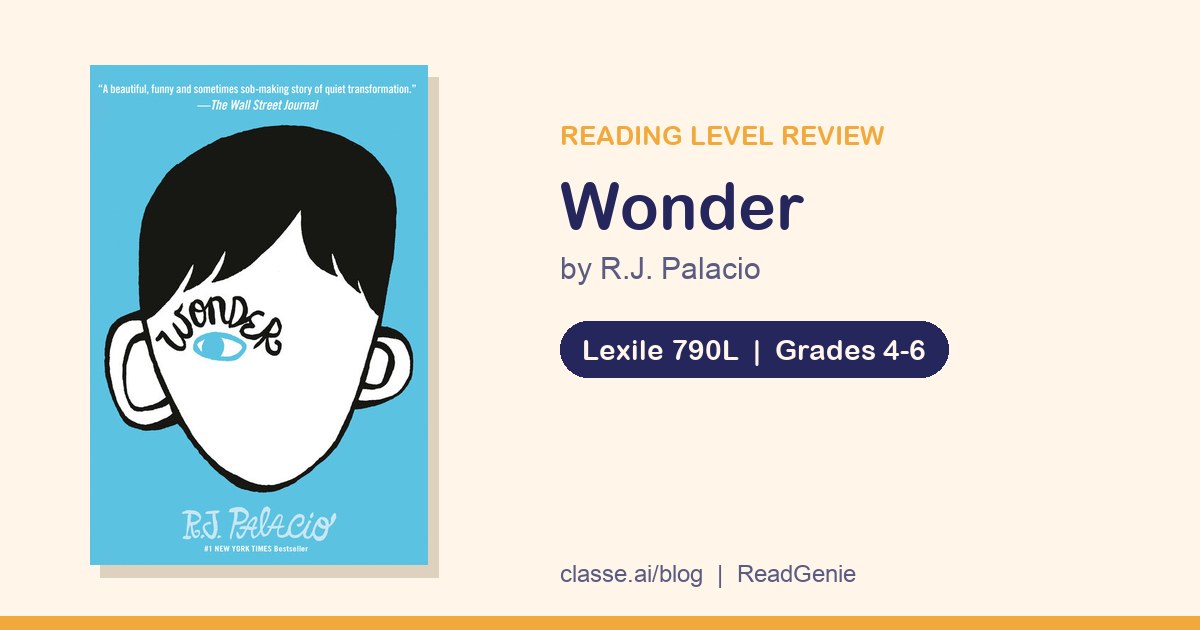
Wonder by R.J. Palacio has a 790L Lexile measure, an AR (ATOS) book level of 4.8 worth 11 AR points, a Guided Reading level of V and a DRA level of 40-50. Most kids can read it on their own in 4th to 6th grade. The chapters are very short and the words are mostly everyday words, so it works well for struggling readers in grades 5 to 8. It is also a 320-page book, and many of those readers will get further with the audiobook running alongside the print.
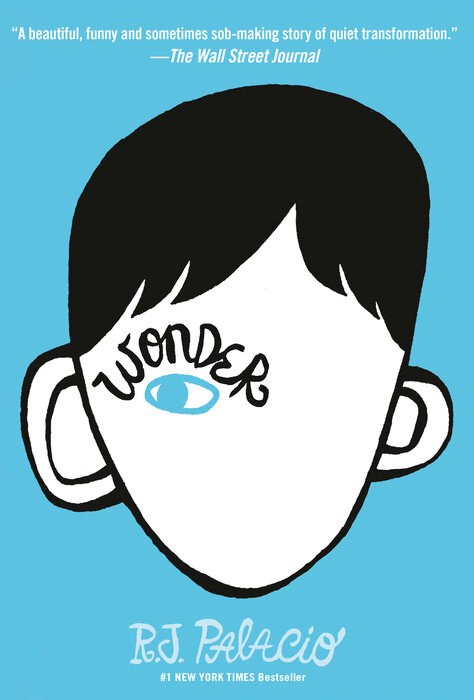
Auggie Pullman is ten. He was born with a facial difference, has had more surgeries than he can count, and has always been homeschooled. Then his parents decide he should start fifth grade at Beecher Prep in New York City. Some kids stare. Some are cruel. A few turn out to be real friends. The book is told in eight parts, by Auggie, his older sister Via and four of the kids around them, so the reader sees the same school year from several sides. It is funny more often than parents expect, and it is a common class novel in upper elementary and middle school, which is why so many families end up looking up its level.
Wonder reading level at a glance
| Lexile measure | 790L (Penguin Random House) |
|---|---|
| ATOS / AR book level | 4.8 (TeachingBooks) |
| AR points | 11 (TeachingBooks) |
| Guided Reading (Fountas & Pinnell) | V (Scholastic Teacher Store) |
| DRA level | 40-50 (Scholastic Teacher Store) |
| Flesch Reading Ease (0-100) | 87.0 ReadGenie estimate |
| Flesch-Kincaid grade | 4.4 ReadGenie estimate |
| Interest level | Ages 8-12 (grades 3-7) (Penguin Random House) |
| Approximate grade band | Grades 4-6 (ages 9-12) ReadGenie |
| Length | 320 pages, ~73,053 words |
| Format | Middle grade novel |
| Good for struggling readers? | ★★★★★ 3/5 |
| Dyslexia-friendly rating | ★★★★★ 4/5 |
We couldn't find a published grade level equivalent for this book.
Is Wonder a struggle for your child right now? ReadGenie gives struggling readers short daily Orton-Gillingham practice at home, out loud, with help on the exact sound they missed.
Try ReadGenie and get this book freeScores checked 2026-11-16. Different leveling systems don't always agree, so we show each published value with its source and mark our own estimates. Links to every source are under How we rate books.
What grade level is Wonder?
By the numbers, Wonder reads at about a 4th to 6th grade level. Many schools teach it in 5th grade, the same grade Auggie is in, and Scholastic lists it for grades 5 to 7.
An AR level of 4.8 means the text is about as hard as what a typical student reads near the end of 4th grade. A Lexile of 790L sits in the same band, a little toward the 5th grade side. Both measures mostly weigh sentence length and how common the words are, and Palacio writes the way a ten-year-old talks. Our own readability check on the first three chapters came out a few months below the AR level, so the formulas agree.
Guided Reading level V and DRA 40-50 land a little higher, around 5th grade on most school charts. Those systems look at more than the words. Wonder switches narrators, and a reader has to keep track of who is talking and how each person sees Auggie. That takes more than decoding.
The real challenge is length. At about 73,000 words and 11 AR points, Wonder is much longer than The Giver. A 5th grader reading on grade level can handle it alone over three or four weeks. A child reading a year behind can too, but the size of the book is what wears them down, not any one page.
Is Wonder good for struggling readers?
Often, with support. We rate it 3 out of 5 for struggling readers, and the audiobook makes it a much easier yes.
The good news is on every page. The chapters are tiny. The first three run about 500 words each, so a child who reads slowly can still finish a chapter in one sitting, and that small win adds up over a month. The vocabulary is mostly words a 4th grader already knows. Auggie's voice is chatty and funny, and the question of whether he will make it through the year at Beecher Prep keeps kids turning pages. For a 6th or 7th grader reading below grade level, it also looks like a book their friends are reading, not a little kid's book.
The hard part is staying power. There are no pictures, the book is thick, and the narrator changes several times. A reader who is still sounding out many words can lose the thread when Via or Jack takes over and the story jumps back a few weeks.
Watch for these sticking points:
- The narrator changes at the start of each part, and some parts go back over events the reader has already seen
- Longer sentences than the chapter length suggests, about 13 words on average in the opening
- One part printed with no capital letters at all
- Sad stretches near the end that some kids need to talk through
A struggling reader whose class is reading Wonder will do well with a read-together start and the audiobook for the longer parts. A child who reads below a 4th grade level and isn't assigned it can wait, or enjoy it as a family read-aloud first.
Is Wonder good for kids with dyslexia?
Overall: ★★★★★ 4/5
| Factor | Score | Why |
|---|---|---|
| Sentence length | 3/5 | The first three chapters average 13.3 words per sentence, though about 39% of sentences have 8 words or fewer. |
| Vocabulary load | 4/5 | About 5% of words in the opening chapters have three or more syllables, mostly everyday words with a few like extraordinary and petrified. |
| Decodability | 3/5 | Most words follow common patterns, but names like Auggie, Pullman and Tushman and words like extraordinary and surgeries need a preview. |
| Text density and layout | 3/5 | Regular novel pages with no pictures, but the short chapters leave plenty of white space. One part is printed all in lowercase. |
| Pictures that carry meaning | 1/5 | Text only, with no pictures inside the story. |
| Chapter length | 5/5 | The first three chapters run about 500 words each, so most chapters take a few minutes to read. |
| Engagement for reluctant readers | 5/5 | Auggie's funny, honest voice and the question of whether he will fit in pull readers through from the first page. |
| Audiobook / read-along support | 5/5 | An official audiobook from Listening Library, read by several narrators, that most libraries carry. |
We rate Wonder 4 out of 5 for dyslexic readers. That is higher than its struggling-reader score, and the reason is the chapters. A dyslexic reader tires quickly, and a book that offers a natural stopping point every few minutes is much easier to keep going with than one with 20-minute chapters.
Sentence length is middling. The opening chapters average a little over 13 words a sentence, but almost four in ten sentences have 8 words or fewer, and the longer ones are easy to follow because they sound like speech. The words are friendly too. About 5 percent of the words in the opening have three or more syllables, which is low for a middle grade novel, and most of those are words a child has heard many times, like ordinary and immediately.
Two things work against it. There are no pictures, so the words carry all of the meaning. And one narrator, Justin, writes his whole part in lowercase. Some dyslexic readers lean on capital letters to see where a sentence starts and stops, and that part can feel slippery. Read it together if your child struggles there.
Audio is the strongest support. There is an official audiobook from Listening Library, read by several narrators, so each part has its own voice, which also helps a listener keep track of who is talking. Most libraries carry it. For a dyslexic reader with Wonder on the class list, following the print while listening is the best way through. A Spanish edition exists too, for families who read in both languages.
Words and phonics patterns to practice first
Wonder's words are friendlier than most books at this level. The patterns that come up most are ones a 2nd or 3rd grade phonics program covers, which makes this a good book for practicing them in real reading.
Silent e words are everywhere in Auggie's chapters: face, nice, ride, bike, name, grade. Face is the most important word in the book, so make sure your child reads it instantly.
The suffix -ed shows up in nearly every paragraph of the opening: stared, noticed, fainted, rushed, dropped, whispered. Ask whether each one ends in /t/, /d/ or /ed/, and point out that dropped doubles its p.
The suffix -ing comes next: screaming, yelling, looking, thinking, pushing, wondering. Cover the ending, read the base word, then add -ing back.
Vowel teams appear in short, common words: school, street, feel, room, really, away. R-controlled vowels show up in nurse, doctor, born, started, world and birthday. Digraphs in think, wish, much, whole, thing and sick are a good warm-up for a younger reader.
Consonant-le ends people, little, couple and unbelievable. People is also a red word, since the eo spelling doesn't follow the usual rules.
Pre-teach these as whole words before chapter 1: Auggie, Pullman, Tushman, Beecher, ordinary, extraordinary, surgeries, petrified, hysterical and people. Ordinary is the first word of the book, so start there, and show how extra in front of it changes the meaning. If your child still stalls on suffixes like -ed and -ing, a few weeks of short daily Orton-Gillingham practice on exactly those endings (the kind ReadGenie gives at home) makes a long book like this much less tiring.
How to read Wonder with your child
Read the first part, Auggie's, together. It sets up everything, and the chapters are short enough that you can trade off, one chapter for you and one for your child.
Before each new part, look at the part title together and say who is telling the story now. It takes ten seconds and saves a lot of confusion, especially when Via's part starts and the story steps back in time.
Use the audiobook on busy nights or for the longer parts, so your child keeps moving. Listening to one chapter and reading the next aloud together is a good rhythm, and the short chapters make that easy.
Talk about Mr. Browne's precepts as they come up. These are short rules for living that Auggie's English teacher writes on the board each month. Ask your child which one they agree with and have them write one of their own.
When your child finishes, plan a movie night with the 2017 film. It is a great reward, and comparing what the movie left out is a natural way to talk about the book.
Using Wonder in the classroom or tutoring
For teachers, the narrators make Wonder an easy book to split. In literature circles, give each group a different narrator's part and have them report back on how that person sees Auggie. Comparing how Auggie and Via describe the same day is a clean way to teach point of view. Pair struggling readers with the audiobook so they can keep up with whole-class discussions, which matter more with this book than with most.
For tutors, pre-teach Auggie, Pullman, Tushman and Beecher before the first session, along with ordinary and extraordinary. The opening chapters are full of -ed words for practice, like stared, noticed, fainted and whispered. Before Justin's part, show the student that it has no capital letters and have them track each sentence with a finger, so the missing capitals don't throw off their reading.
Content notes for parents
Wonder is gentle overall, but it has real sadness in it. Auggie is bullied at school, mostly with stares, cruel notes and comments about his face. Older kids at a nature retreat start a fight with Auggie and his friends. The family dog, Daisy, dies, and the death of Via's grandmother is remembered. There is no bad language beyond mild insults. Most kids come away from the book talking about kindness, but a very sensitive child may need you nearby for the last third.
Should your child read it?
If your child is in 4th to 6th grade and reading on grade level, hand them Wonder. If they are in 5th to 8th grade and reading a year or two behind, it still works well, especially with the audiobook and a read-together start. If your child reads below a 4th grade level, read it aloud to them for now, or start with the picture book We're All Wonders. And if they love it, Fish in a Tree and Restart are good next steps.
Make the next book easier
Short daily sessions of reading, spelling and handwriting practice, built with Orton-Gillingham teachers. It works alongside tutoring and school support. The first 7 days are free. Join today and we'll mail your child Wonder for free.
Try ReadGenie and get your free bookStarts with a free 7-day trial. Book mailed after your first paid month. US only, one per family.
FAQ
What age is Wonder appropriate for?
Most kids are ready for Wonder at about 9 to 12. The publisher lists ages 8 to 12, and the reading level fits ages 9 to 12. The bullying and sad scenes are handled gently, so it also suits younger strong readers with a parent nearby.
How many AR points is Wonder?
Wonder is worth 11 AR points, with an AR (ATOS) book level of 4.8. The points are high because the book is long, about 73,000 words, not because the reading is especially hard.
What is the Guided Reading level of Wonder?
Wonder is Guided Reading level V, which most school charts place in 5th grade. Its DRA level is 40-50. Those levels count the work of following several narrators, which is why they sit a little higher than the Lexile and AR level.
Is Wonder a good book for 4th graders?
Yes, for 4th graders reading on grade level who can handle a long book. The text is close to an end-of-4th-grade level. A 4th grader who reads more slowly will enjoy it more as a read-aloud or with the audiobook.
Is there a Wonder 2?
There is no direct sequel, but Auggie & Me is a companion book with three stories told by other kids from Beecher Prep, and it is much shorter. White Bird is a graphic novel about the grandmother of Julian, one of the kids in Wonder.
Get Wonder free
ReadGenie helps struggling readers improve their reading, spelling and handwriting in short daily sessions at home. Join and we'll mail your child this book for free.
Claim your free bookStarts with a free 7-day trial. Book mailed after your first paid month. US only, one per family.
What to read next
- We're All Wonders by R.J. Palacio (easier). A picture book about Auggie with the same message, an easy way into the story for younger kids.
- Fish in a Tree by Lynda Mullaly Hunt (similar). A school story about a girl with dyslexia who hides it, with the same mix of hard days and kind friends.
- Restart by Gordon Korman (similar). Another middle school story told by several narrators, about a bully who gets a second chance.
- Because of Mr. Terupt by Rob Buyea (similar). Seven students take turns telling a fifth-grade year, just like the narrators in Wonder.
- Out of My Mind by Sharon M. Draper (similar). A girl with cerebral palsy fights to be seen at school, a strong next read on being different.
- The Giver by Lois Lowry (harder). A shorter book with a harder level and bigger questions, for kids ready for more inference.
Browse all of our reading-level book reviews.
How we rate books
Lexile, ATOS (Accelerated Reader), Guided Reading and DRA levels come from the companies that own them and from publishers. We link to where we found each one, and when a level isn't published we say so. Anything marked "ReadGenie estimate" is our own call, not an official level. Flesch scores come from a short public excerpt when the publisher offers one. The struggling-reader and dyslexia-friendly ratings are our judgment, based on eight things (sentence length, vocabulary, decodability, page layout, pictures, chapter length, how gripping the story is, and audiobook support). Treat them as a starting point. The right book is one your child can read with about 95% accuracy and wants to keep reading.
Sources
- Penguin Random House: Wonder by R. J. Palacio (Lexile, ATOS, Fountas & Pinnell, ages and grades, pages, edition, formats, Flesch excerpt, phonics patterns, sentence length)
- Scholastic Teacher Store: Wonder (hardcover) (Lexile, Guided Reading, DRA, ACR level, grades, pages)
- TeachingBooks: Wonder (ATOS, AR points, Lexile, word count, grades, audiobook)
- Booksource: Wonder (Guided Reading, Lexile, AR level, AR points, interest level)